

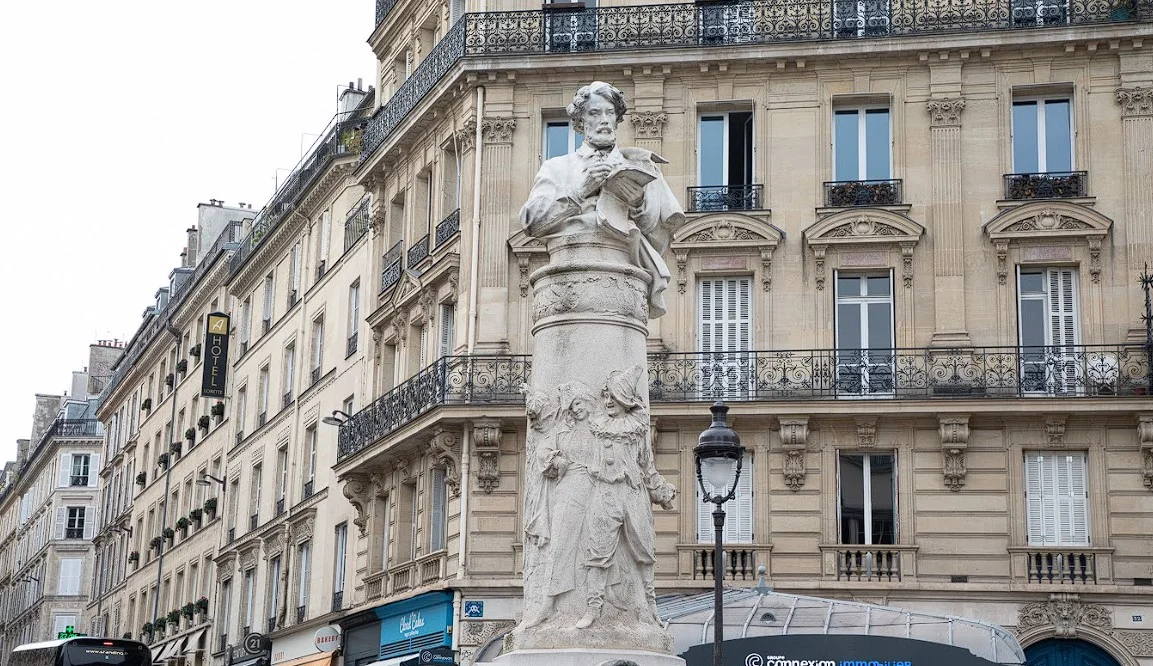
The 9th arrondissement has risen +3.2% over twelve months in 2026. That is the strongest growth in central Paris, and it is no accident. For five years, the 9th has been undergoing a quiet transformation: neighborhoods that Parisians avoided fifteen years ago have become the most sought-after by a generation of buyers who want Haussmannian architecture, centrality and neighborhood life, without the price tag of the 6th or 7th. The 9th offers all three.
I have been observing this transformation since 2011. In the early days, when I suggested the 9th to a client, I had to make a case. Today, it is often the first arrondissement that thirtysomethings and fortysomethings mention. The quality-price-location ratio has become unbeatable in central Paris. And prices, though rising, still leave room before reaching the ceiling of neighboring arrondissements.
Three neighborhoods, three atmospheres, one shared momentum
SoPi: South Pigalle, the epicenter of renewal
The term “SoPi” appeared about a decade ago, modeled on New York’s SoHo, to designate the southern part of Pigalle, the part that has nothing to do with the sex shops of boulevard de Clichy. The perimeter is compact: roughly between rue des Martyrs to the east, rue Notre-Dame-de-Lorette to the south, rue de Douai to the west, and boulevard de Clichy to the north.
This rectangle of a few hectares concentrates a density of cocktail bars, creative restaurants, coffee shops and independent boutiques that few Parisian neighborhoods can match. KB CafeShop led the way, followed by a generation of establishments that transformed former lingerie shops into sought-after addresses. Rue Henry-Monnier, rue de Navarin, rue Frochot: each street has its own personality.
On the property side, SoPi offers very good quality Haussmannian stock. Late 19th-century buildings are well maintained, with ceiling heights of 2.80 to 3.20m, moldings, fireplaces and original parquet flooring. Prices run around 10,500 to 11,500 euros/m2 depending on floor and orientation: 30 to 40% less than a comparable apartment in the 6th.
The typical SoPi buyer: a thirtysomething couple, two executive salaries, first purchase or second purchase after selling a 2-bedroom in an outer arrondissement. Average budget: 550,000 to 750,000 euros for a 3-bedroom of 55-65 m2. Demand exceeds supply, and well-located properties sell in under two weeks.
The downside: SoPi is a going-out neighborhood. Bars close late, terraces are noisy on weekends, and the liveliest streets (rue des Martyrs on Saturday, rue Henry-Monnier in the evening) are not suitable for lower floors. As always in vibrant neighborhoods, the rule is simple: courtyard-facing or upper floor.
Nouvelle Athenes: preserved romanticism
Nouvelle Athenes is the jewel of the 9th, and one of the most underestimated neighborhoods in Paris. Centered around Place Saint-Georges and Place Gustave-Toudouze, this neoclassical enclave was built in the 1820s-1840s to house the artistic bourgeoisie: Chopin, Delacroix, George Sand all lived here. The architecture reflects this ambition: townhouses with columned facades, character buildings with interior gardens, theatrical perspectives on fountain-adorned squares.
What strikes you when walking through Nouvelle Athenes is the silence. Five minutes from the bustle of Pigalle, you find yourself in a neighborhood that resembles the 7th, only less stiff. Residents are protective of this tranquility, and the atmosphere is that of a secret village in the middle of Paris.
Prices reflect this quality: 11,000 to 12,500 euros/m2, with peaks above 13,000 for upper floors overlooking the squares. It is the most expensive micro-neighborhood in the 9th, and the most stable: turnover is slow, owners stay a long time, and properties often sell off-market through the residents’ network.
The Nouvelle Athenes buyer profile differs slightly from SoPi: fortysomethings and fiftysomethings, liberal professions, lovers of architecture and heritage. People buy here for the beauty of the place as much as for the location.
Jean Mascla’s advice: Nouvelle Athenes is one of the rare Parisian neighborhoods where the words “love at first sight” have a literal meaning. My clients who buy there fall in love with the neighborhood on the first visit: the light on Place Saint-Georges in late afternoon, the wisteria of Cite Malesherbes, the calm of rue de La Rochefoucauld. If you are looking in the 9th, make a detour through Nouvelle Athenes on a Sunday morning. If it does not speak to you, the neighborhood is not for you. If it does, you will know.
Grands Boulevards: commercial dynamism
The southern part of the 9th, along the Grands Boulevards (boulevard Montmartre, boulevard Poissonniere, boulevard des Italiens), is the most urban face of the arrondissement. This is where you find the department stores (Galeries Lafayette, Printemps), the boulevard theaters, the covered passages (passage Jouffroy, passage Verdeau) and a concentration of offices that animates the neighborhood on weekdays.
The property market on the Grands Boulevards is more varied than in the northern 9th. You find classic Haussmannian on the boulevards themselves (imposing buildings, upper floors with open views), but also more modest buildings on perpendicular streets, and some architectural surprises in the covered passages, where atypical apartments hide above the shops.
Prices are the most accessible in the 9th: 9,800 to 10,800 euros/m2 depending on the street. The area attracts more investors (small units for furnished rental, decent yields thanks to demand from tourists and professionals) and budget-conscious first-time buyers.
The downside: the neighborhood is noisy and dense during the day. The Grands Boulevards are a major traffic artery, and the crowds around the department stores are intense Monday through Saturday. In the evening, however, the area empties out: the nightlife is in SoPi, not here. To live comfortably, you need to accept the urban rhythm or aim for a set-back apartment on the courtyard side.
Why the 9th is accelerating: the fundamentals
The 9th’s +3.2% rise is not speculative. It rests on structural fundamentals that the market is recognizing.
The price catch-up
The 9th has historically been undervalued relative to its location. As the crow flies, SoPi is closer to the Opera than most streets in the 8th. Nouvelle Athenes is a ten-minute walk from Gare Saint-Lazare and the Trinite. The Grands Boulevards are on metro lines 8 and 9, which cross Paris. In terms of pure centrality, the 9th has nothing to envy the 2nd, the 3rd or the 10th, but its prices remain lower.
This gap is gradually closing. The average price in the 9th has gone from 8,500 euros/m2 in 2018 to 10,800 euros/m2 in 2026: a 27% increase in eight years. That is significant, but catch-up potential remains compared to comparable arrondissements: the 3rd is at 13,200 euros/m2, the 6th at 15,800 euros/m2. The ceiling has not been reached.
The quality of Haussmannian stock
The 9th offers one of the finest Haussmannian stocks in Paris. Buildings constructed between 1860 and 1900 are particularly refined: the Second Empire bourgeoisie had chosen this neighborhood to settle, and architects produced their finest facades. Continuous balconies on the 2nd and 5th floors, sculpted mascarons, marble entrance halls, staircases with wrought-iron railings: the architectural vocabulary is that of grand Haussmannian, comparable to the 8th or the 16th.
The difference from the 8th is that the 9th has remained predominantly residential. Where the 8th has transformed into an office district (with entire buildings converted), the 9th has preserved its residential vocation. Haussmannian apartments there are therefore more numerous, better preserved, and sold at lower prices.
Neighborhood life
This is the hardest factor to quantify and the most decisive. The 9th has a neighborhood life that the 8th does not have and that the 6th has lost. Rue des Martyrs alone concentrates more quality food shops than most entire Parisian arrondissements: bakers, cheese makers, greengrocers, butchers, wine merchants, a fishmonger. The Marche d’Anvers (three times a week) completes the offering.
The restaurants of the 9th are not bargain-basement neighborhood restaurants: the tables of SoPi and Nouvelle Athenes regularly appear in Parisian rankings. But prices remain reasonable, the waiters recognize you after three visits, and the atmosphere is relaxed. It is gourmet Paris without the pretension of gastronomic Paris.
This neighborhood life attracts a population that stays. Turnover in the 9th is slower than the Parisian average: people who buy here do not sell after three years. This contributes to market stability and neighborhood quality.
Who is the 9th made for?
The ideal profile
The 9th is tailored for active thirtysomethings and fortysomethings, in a couple or a young family, who want to live in the heart of Paris without dedicating 100% of their budget to real estate. The typical profile: two incomes, a budget of 500,000 to 900,000 euros, searching for a large 2-bedroom or 3-bedroom in Haussmannian, demanding on daily quality of life (restaurants, shops, transit).
It is also an excellent arrondissement for the ambitious first-time buyer. The first-time buyer’s guide to Paris we published mentions the 9th as one of the best value-for-money options for a first purchase, and that is an opinion I maintain.
The limitations
The 9th is not a family arrondissement in the traditional sense. The absence of large green spaces is a genuine shortcoming: the Square d’Anvers and Square Montholon are pocket handkerchiefs compared to the Luxembourg or the Ranelagh. Families with several children often feel cramped, both in the apartments (4-bedrooms are rare in the 9th) and in public space.
Schools are adequate without being exceptional. Lycee Condorcet (partly in the 9th) has a good reputation, but the choice is more limited than in the 6th or 16th.
Finally, the northern border of the 9th, boulevard de Clichy and its surroundings, remains a challenging area. The transition between the residential 9th and nocturnal Pigalle is sometimes abrupt, and you should not be seduced by an attractive price without checking the immediate vicinity. A street on the south side of boulevard de Clichy can be charming; the same street on the north side is another world.
What the price per m2 does not tell you
In the 9th more than elsewhere, the average price is an average that hides very different realities. Here is what experience has taught me.
The gap between a dark ground floor on rue des Martyrs and a luminous 6th floor on Place Saint-Georges can exceed 50%. The same budget, say 600,000 euros, buys you either a charmless 3-bedroom of 60 m2 in the Grands Boulevards or a 2-bedroom of 45 m2 with a view and fireplace in Nouvelle Athenes. The exact location makes all the difference.
The streets rising fastest: rue Condorcet (upper section), rue de la Tour-d’Auvergne, Cite Malesherbes, rue Clauzel. These are secondary streets, less known than rue des Martyrs or rue Henry-Monnier, but they benefit from SoPi’s glow while offering residential calm. Property hunters who know the 9th understand that this is where the best opportunities lie, not on the main arteries where the reputation is already established.
Buildings to watch: those that have undergone a recent facade renovation. In the 9th, a facade renovation can push prices up by 5 to 8% in the building concerned. This is information our property hunters check systematically: a handsome building with a renovation planned within two years is a buying opportunity with built-in appreciation.
Jean Mascla’s advice: If the 9th interests you, do not limit yourself to SoPi. Nouvelle Athenes offers a superior setting for a comparable price. And the transition streets between the two neighborhoods, rue Rodier, rue de Navarin (upper section), rue Milton, are often the best deals in the 9th. This is the kind of micro-targeting that a property hunter masters perfectly after years of practice in the neighborhood.
The 9th in five years
My projection: the 9th will continue its progression to reach 12,000 to 12,500 euros/m2 by 2030. The dynamic is driven by lasting factors, generational turnover among owners, recognized architectural quality, authentic neighborhood life, and not by a passing trend.
The main risk is excessive gentrification. SoPi is beginning to show signs of a neighborhood losing its diversity: commercial rents are rising, craftspeople are giving way to chains, popular cafes are becoming 5-euro-latte coffee shops. If this trend continues, SoPi could lose the authenticity that makes its charm: the scenario the Marais experienced twenty years ago.
For the 2026 buyer, the message is clear: the 9th still offers an attractive entry point into central Haussmannian Paris. Prices are rising, but the window of opportunity remains open. In five years, buying a 3-bedroom in Nouvelle Athenes at today’s price will no longer be possible.
The 9th arrondissement is the arrondissement our property hunters recommend most often in 2026. Not because it is trendy, but because it checks every box for a successful purchase: centrality, architectural quality, neighborhood life, positive price dynamics. If your project leads you there, do not delay.
Frequently asked questions
Is the 9th arrondissement a good investment in 2026?
The 9th shows the strongest price growth in central Paris: +3.2% over twelve months in 2026, versus +1.8% on average. The fundamentals are solid: centrality, quality Haussmannian stock, dynamic neighborhood life, excellent transit. Prices remain 30 to 40% below the 6th or 7th. Catch-up potential exists. It is the arrondissement our property hunters recommend most often to first-time buyers with a budget of 500,000 to 800,000 euros.
What is the difference between SoPi and Nouvelle Athenes?
SoPi (South Pigalle) is the neighborhood around rue des Martyrs and rue Henry-Monnier: cocktail bars, creative restaurants, coffee shops, moderate nightlife, cosmopolitan thirtysomething atmosphere. Nouvelle Athenes, centered on Place Saint-Georges and Place Gustave-Toudouze, is quieter, more romantic, with neoclassical townhouses and tree-lined squares. SoPi is livelier and slightly cheaper. Nouvelle Athenes is more residential and more prestigious. The two complement each other and are five minutes apart on foot.
What are the downsides of the 9th arrondissement?
The main drawbacks are noise (some streets around Pigalle remain lively at night), the north-south inequality (the area close to boulevard de Clichy is less residential), and the absence of significant green spaces. The 9th is one of the least green arrondissements in Paris, with only the Square d'Anvers and Square Montholon. For families with children, the lack of parks can weigh on daily life.