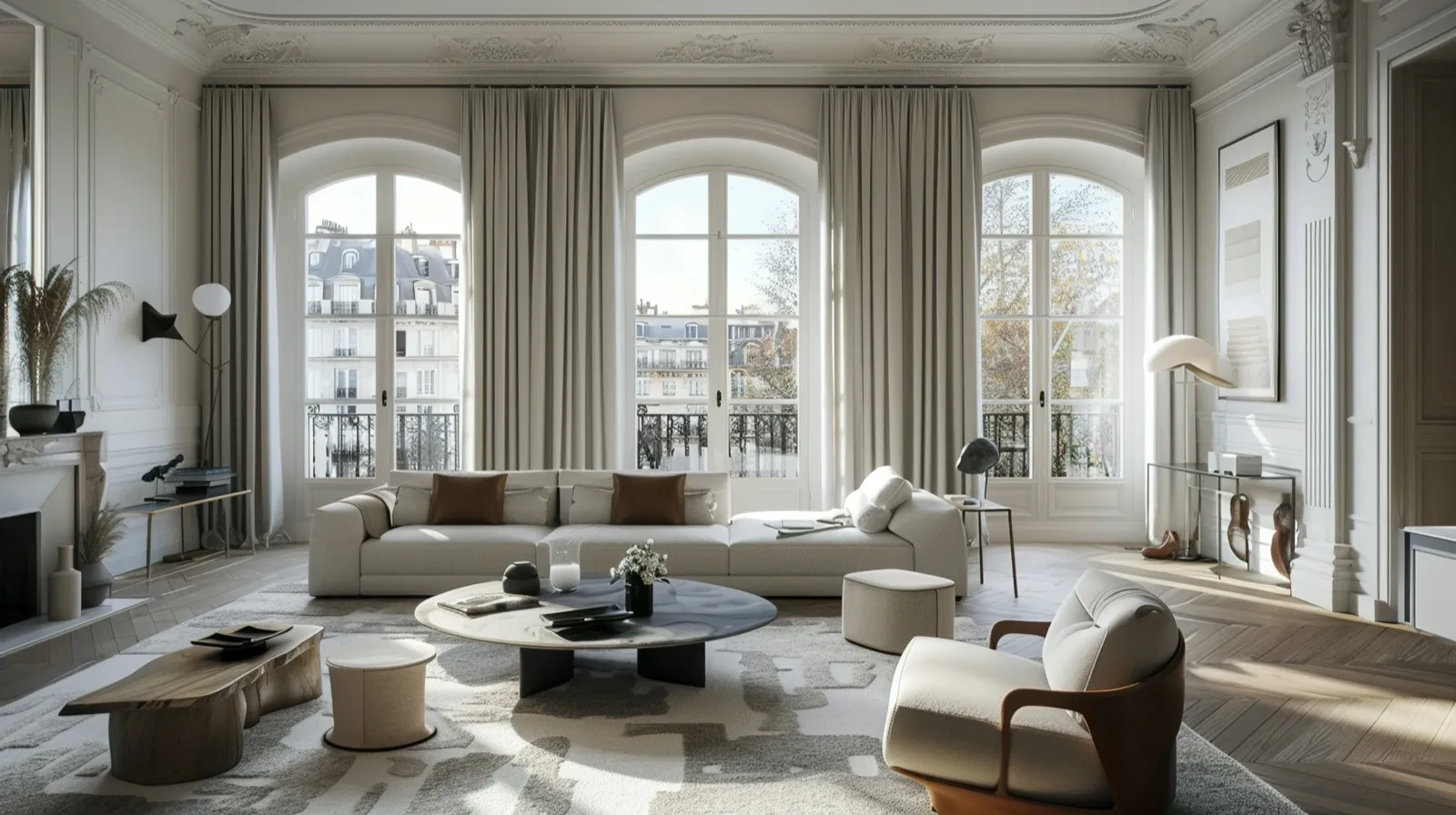



In Paris, the perfect apartment at the right price in the right neighbourhood does not exist. Or rather, it does, but it is in poor condition. A 1970s kitchen, a bathroom tiled floor to ceiling in beige faience, electrics from another era, tired paintwork. This is precisely where the opportunity lies. Properties to renovate represent a significant share of the Parisian market, and for the buyer who can accurately assess the real cost of works, they sometimes offer the best value for money in the capital.
The problem is that most buyers cannot accurately assess that real cost. And the difference between a good deal and a financial sinkhole often comes down to the precision of that assessment. In fifteen years of property hunting in Paris and more than 1,200 transactions at Home Select, our property hunters have accompanied hundreds of projects involving renovation works. Some turned out to be excellent operations: an apartment bought 15% below market, renovated with control, worth 20% more once completed. Others became nightmares: 40% budget overruns, doubled timelines, defects to be rectified.
This guide lays the foundations for ensuring your Parisian renovation project falls into the first category.
The real cost of works in Paris in 2026
The first reflex of any buyer facing a property to renovate is to ask how much it will cost. The honest answer is: more than you think. Not out of pessimism, but from experience.
In Paris in 2026, renovation costs are structured into three clearly distinct levels.
A light refresh, between 400 and 800 euros excl. VAT per square metre. This covers full repainting (walls and ceilings), replacement of flexible floor coverings or parquet varnishing, changing a few sanitary fittings, updating switches and visible outlets. No partition changes, no full electrical rewiring, no plumbing replacement. This is the minimum to make an apartment habitable and pleasant when the fundamentals (electrics, plumbing, structure) are sound. For a 60 sq m apartment, expect 24,000 to 48,000 euros excl. VAT.
An intermediate renovation, between 1,200 and 1,800 euros excl. VAT per square metre. This is the most common scenario in Parisian apartments from the 1960s to 1990s: full electrical rewiring, plumbing replacement, new fitted kitchen, new bathroom, floor replacement, full repainting, possibly removing a non-load-bearing partition to redistribute space. For a 60 sq m apartment, the budget sits between 72,000 and 108,000 euros excl. VAT.
A high-end complete renovation, between 1,800 and 3,000 euros excl. VAT per square metre, sometimes more. This is Haussmannian transformation territory: full restoration of mouldings and cornices, sanding and restoring herringbone or Versailles parquet, creating a bathroom to the highest standards (full waterproofing, new plumbing), bespoke kitchen, home automation, architectural lighting. Removing load-bearing walls with steel beam (IPN) installation adds 8,000 to 15,000 euros per opening. For an 80 sq m Haussmannian apartment, the budget can reach 160,000 to 240,000 euros excl. VAT.
These figures are excluding VAT. VAT is 10% for renovation works in properties over two years old (which covers almost all Parisian stock), except for energy efficiency works which benefit from the reduced rate of 5.5%.
A key order of magnitude to keep in mind: labour costs in Paris are 20 to 30% higher than in other French cities. Qualified tradespeople are in high demand, their lead times are long (two to four months’ wait before the start of work is common), and Parisian logistical constraints (parking, deliveries, noise rules in co-ownerships) push costs up.
The gap between unrenovated and renovated prices: the calculation that matters
The arithmetic of a renovation purchase is simple in theory. If a renovated apartment is worth 12,000 euros/sq m in a given neighbourhood, and the same unrenovated apartment sells for 9,500 euros/sq m, the discount is 2,500 euros/sq m. If your renovation costs 1,500 euros/sq m, you theoretically create 1,000 euros/sq m of value, or 60,000 euros on a 60 sq m apartment.
In practice, this calculation gets complicated for several reasons.
The discount is not always as large. In Paris, a well-located “to renovate” apartment in a sought-after arrondissement attracts many buyers, including professional property developers who know the costs to the last cent. Competition pushes up prices for renovation properties and reduces the margin. In the 6th, 7th and 16th arrondissements, the discount of a renovation property compared to a renovated one is sometimes only 10 to 15%, which leaves little room when works cost 2,000 euros/sq m or more.
Budget overruns are the norm, not the exception. On the renovation projects our property hunters have accompanied, the average overrun compared to the initial quote is 15 to 20%. The reasons are multiple: discoveries during the work (decayed pipe hidden behind a wall, undetected asbestos, degraded structure), changes requested by the client mid-project, price increases on materials between the quote and the order. Building in a 15 to 20% safety margin in your total budget is not pessimism: it is rigour.
Works take longer than expected. A complete renovation project in Paris takes an average of four to six months for a 60-80 sq m apartment. During this time, you are paying rent if you have not yet sold your current property, or deferring your move-in. This indirect cost (transitional rent, storage, dual charges) is rarely included in the initial calculation.
The specific constraints of Parisian buildings
Renovating an apartment in Paris is not the same as renovating one in Toulouse. Parisian construction imposes technical and regulatory constraints that you need to know before committing.
Haussmannian buildings and their load-bearing walls. Haussmannian buildings (1850-1910) are built with load-bearing walls of cut stone or rubble stone. Unlike the plasterboard partitions of modern construction, these walls cannot be knocked down with a sledgehammer. Opening or removing a load-bearing wall requires a structural study by an approved engineering firm (2,000 to 4,000 euros), installation of a custom-dimensioned steel beam (IPN), and approval from the co-ownership at its general meeting. The total represents 10,000 to 20,000 euros per opening, with a lead time of several months if the general meeting is not imminent.
Old floors. The floors of Haussmannian buildings are made of wood: joists supporting an oak floor. These floors have limited load-bearing capacity, which complicates the installation of heavy screeds (for tiling, for example) or cast iron bathtubs. An architect or engineer can determine the allowable load. In some cases, floor reinforcement is necessary before laying a new covering: an additional cost that the initial quote does not always mention.
Asbestos and lead. Almost all Parisian buildings constructed before 1997 contain asbestos somewhere: floor tiles, tile adhesive, pipe lagging, false ceiling panels. If your works involve touching these materials, removal by a certified company is mandatory. The cost varies from 25 to 60 euros/sq m depending on the material type and accessibility. Lead is present in the paint of buildings predating 1949. When sanding or scraping work is involved, specific precautions are required.
Co-ownership rules. All works in a co-owned apartment must comply with the co-ownership regulations. Work hours are strictly regulated (generally Monday to Friday 8am to 7pm, Saturday 9am to 12pm, never on Sundays or public holidays). Use of the lift for material transport requires the management agent’s approval. Running cables or pipes through common areas requires a vote at the general meeting. Facade modifications (windows, shutters, external air conditioning units) require co-ownership approval and, in protected areas, the opinion of the Architecte des Batiments de France (ABF).
The EPC and energy performance. An apartment rated F or G on the energy performance certificate (DPE) costs less to buy, and this is one of the most effective negotiation levers. But improving the EPC in a Parisian co-ownership is complex: external insulation is rarely possible (classified or regulated facades), changing the collective heating system is a co-ownership matter, and internal insulation reduces the habitable area (5 to 8 cm per insulated wall). Improving the EPC through private works alone (windows, internal insulation, mechanical ventilation) is possible but limited: going from G to D is realistic, going from G to B is very difficult without work on the common areas.
Assessing the real potential of a property to renovate is our profession. Our property hunters identify the opportunities and cost the works before you commit. Entrust us with your project
Quotes: how to read and compare them
The quote is the key document in any renovation project. And it is also the one buyers read most poorly.
A good quote is detailed item by item. It distinguishes materials from labour. It specifies brands and references for materials. It states quantities and unit prices. It mentions payment terms (never more than 30% on order), execution timescales, and late-delivery penalties.
A bad quote is an overall “flat fee” amount with no breakdown of items. This type of quote prevents any comparison, conceals the contractor’s margins, and does not protect you in case of dispute over the quality or quantity of work carried out.
Best practice: obtain at least three quotes for each work package (electrics, plumbing, painting, kitchen, bathroom), or three quotes from multi-trade contractors if you entrust the entire project to a single point of contact.
Points of vigilance when comparing quotes. Check that the quotes cover the same scope of work: a cheaper quote may simply exclude certain items. Beware of “indicative prices” or “subject to on-site verification”: these are open doors to variations. Material prices can vary threefold depending on the range (30 euros/sq m tiles versus 120 euros/sq m tiles radically changes the bathroom budget). The cost of rubble removal is often underestimated or absent from quotes: in Paris, skip hire and waste disposal fees represent 2,000 to 5,000 euros on a complete renovation project.
A warning sign our property hunters know well: the abnormally low quote. A tradesperson who offers 30% less than their competitors compensates elsewhere: lower-quality materials, undeclared subcontracting, or cascade variations once the project has started. The cheapest quote is almost never the best value in Parisian renovation.
Financing the works: include in the mortgage or pay cash
Financing renovation works is a topic most buyers address too late, often after signing the preliminary agreement. Yet the question arises from the search phase, as it determines your total budget.
The most common and often most advantageous option: include the works in the main mortgage. Most banks accept financing the works alongside the acquisition, provided you present signed detailed quotes. The mortgage rate (around 3 to 3.5% in 2026) is lower than a standard renovation loan rate (5 to 7%). The works funds are then released in stages, upon presentation of invoices, which protects you if the contractor abandons the project.
The typical setup: a mortgage of 500,000 euros for the acquisition plus 100,000 euros for the works, totalling 600,000 euros. The 500,000 euros are released on the day of the final deed. The 100,000 euros are released progressively (30% at start, 30% at mid-project, 40% at completion) upon presentation of invoices.
An important technical point: during the progressive release period of works funds, you pay interim interest (only on amounts already released, not on the total amount). These interim interest charges represent an additional cost of a few hundred euros per month during the works period. Ask your bank or broker to calculate this cost for inclusion in your overall budget.
The alternative: pay for works from personal savings. If your savings allow it, paying for works in cash avoids interim interest and loan administration fees on the works portion. But it reduces your safety buffer, which is risky given that budget overruns are common.
The buying strategy: how a property hunter evaluates a renovation property
Evaluating a property to renovate is one of the most technical exercises in property hunting. This is where experience makes all the difference between a profitable purchase and a suffered one.
When our property hunters visit a renovation property for a client, they assess five parameters before recommending whether to make an offer.
The redistribution potential. A 70 sq m apartment with three small rooms in sequence can become a superb, bright 70 sq m two-bedroom with a 35 sq m living room and a master bedroom with dressing room. The reverse is rarely true: turning a large volume into small rooms is easier than the opposite. The potential is read in the floor plan, in the position of load-bearing walls, in the location of windows and water connections.
The condition of common areas. The condition of the stairwell, roof, communal pipes and facade determines future co-ownership fund calls. A building whose facade renovation is planned within two years represents 10,000 to 25,000 euros in additional charges per unit, to be added to the private works budget.
Technical feasibility. Some renovation projects are impossible or unreasonably expensive: moving a kitchen far from the water columns, creating a bathroom where there is no drainage with sufficient slope, opening a load-bearing wall when the neighbours above have already opened theirs (structural overload).
The right price. The price of a property to renovate must factor in the discount for its condition AND the estimated cost of works. If the purchase price plus works exceeds the market price for an equivalent renovated property, the operation makes no financial sense, unless the location is exceptional and the renovated property simply does not exist for sale.
The negotiation potential. A property to renovate offers negotiation levers that a renovated property does not. Unfavourable diagnostics (EPC F or G, electrical anomalies, lead, asbestos) are all costed arguments to justify a lower offer. At Home Select, the average negotiation of 6% on the asking price applies particularly well to renovation properties, where the technical arguments are concrete and difficult for the seller to contest.
The most expensive mistakes
Fifteen years of practice and hundreds of accompanied renovation projects have taught us to identify recurring mistakes. The costliest are not the ones you might imagine.
Underestimating the cost of the kitchen and bathroom. These two items alone represent 30 to 40% of the total renovation budget. A decent fitted kitchen (not the cheapest, not luxury) costs 12,000 to 25,000 euros installed in Paris. A complete bathroom (shower or bathtub, basin, toilet, tiling, plumbing) costs 8,000 to 18,000 euros installed. Many buyers budget 5,000 euros for the kitchen. That is two to three times too little.
Not checking electrical compliance before buying. Bringing a complete electrical installation up to standard in a 70 sq m Parisian apartment costs 8,000 to 15,000 euros. This is an incompressible item when the installation is outdated (no earth, fuse board, cloth wiring). The electrical diagnostic attached to the preliminary agreement gives an indication, but only a visit with an electrician allows precise costing.
Starting works without all approvals. Demolishing a load-bearing wall without co-ownership approval exposes you to an obligation to restore (rebuild the wall) at the owner’s expense, plus damages if the structure has been weakened. Such cases exist in Paris, and insurance does not cover unauthorised works.
Choosing the cheapest contractor. This is the classic false economy. A poorly executed project costs more to rectify than one done properly the first time. Defects in plumbing (leaks in walls), electrics (non-compliance), or waterproofing (a bathroom leaking into the neighbour’s flat below) generate claims whose cost far exceeds the initial saving.
Our 16 property hunters assess the potential and risks of every property before your offer. Works budget, technical feasibility, negotiation: everything is anticipated. Get a free callback
Renovating to improve the EPC: an opportunity to seize
Since the ban on letting thermal sieves (class G since 2025, class F from 2028), poorly rated properties on the EPC have experienced a significant discount in Paris, in the order of 5 to 15% depending on the arrondissement and energy class.
For a buyer intending the property as a primary residence, this discount is an opportunity: the property costs less to buy, and the energy efficiency works increase comfort as much as value.
The most effective works for improving the EPC of a Parisian apartment are: replacing single-glazed windows with high-performance double glazing (800 to 1,200 euros per window installed, gaining one to two classes depending on configuration), insulating external walls from the inside (80 to 150 euros/sq m of treated wall, losing 5 to 8 cm of depth per insulated wall), installing a double-flow mechanical ventilation system (3,000 to 6,000 euros for an apartment), and replacing energy-hungry electric heating with a more efficient system (air-to-air heat pump, inertia radiators).
The combination of windows plus internal insulation plus mechanical ventilation typically allows a gain of two EPC classes: a move from F to D or from G to E that radically changes the property’s value and marketability.
Financial incentives (MaPrimeRenov’, CEE, eco-PTZ) are theoretically available but often complex to mobilise in a Parisian co-ownership. The cumulative amount of grants rarely exceeds 20 to 30% of the total cost of works for an owner-occupier on intermediate income. It is a supplement, not a financing solution.
The realistic timeline for a purchase plus renovation project
To conclude on a practical note, here is the typical timeline for a renovation property purchase in Paris, as our property hunters plan it with their clients.
Months 1 to 3: property search with the property hunter. During this phase, the hunter systematically evaluates the renovation potential of visited properties and provides works budget estimates to inform the decision.
Month 3: purchase offer accepted. As soon as agreement is reached, contact with tradespeople or interior architects for quotes. Initial technical visits take place during the period between offer and preliminary agreement.
Months 3-4: signing the preliminary agreement. Quotes are refined and presented to the bank for inclusion in the mortgage. Application for co-ownership authorisation if works concern common areas or the structure.
Months 4-6: period between preliminary agreement and final deed. Obtaining the loan, finalising quotes, choosing materials, planning the project schedule with tradespeople.
Month 6: signing the final deed. Key handover. The project can start immediately if tradespeople are lined up.
Months 7-11: works. Average duration of four to five months for a complete renovation of a 60-80 sq m apartment. With our property hunters, project monitoring can be facilitated through introductions to trusted professionals from our network.
Months 11-12: completion of works, move-in.
From the start of the search to moving into a renovated apartment, expect nine to twelve months. That is long, but it is the price of a controlled project. At Home Select, our support covers the entirety of this journey, from the first viewing to the handover of keys to the renovated property. Because buying to renovate in Paris is an investment project that cannot be improvised.
Frequently asked questions
How much does a full renovation cost per sq m in Paris in 2026?
Between 1,200 and 2,500 euros excl. VAT/sq m for a full renovation (electrics, plumbing, floors, kitchen, bathroom, painting). In a Haussmannian property with moulding and antique parquet restoration, expect 1,800 to 3,000 euros/sq m. A light refresh (painting, floors, minor adjustments) costs 400 to 800 euros/sq m.
Can you borrow to finance renovation works on top of the purchase?
Yes. Most banks accept integrating the works budget into the main mortgage, provided you present detailed quotes. The funds are then released in stages upon presentation of invoices. This is often more advantageous than a separate renovation loan.
Should you complete the works before moving in or live there during renovation?
For a full renovation (electrics, plumbing, floors), it is strongly recommended to complete the works before moving in. The average duration is 3 to 5 months for a 60 to 80 sq m apartment. Living on a building site is stressful and often slows down the work.
What permits are needed to renovate an apartment in Paris?
In a co-ownership, approval from the general meeting is required for works affecting common areas or the exterior appearance (windows, shutters). Removing a load-bearing wall requires co-ownership approval and the involvement of a structural engineer. In protected areas (ABF), facade modifications are subject to the opinion of the Architecte des Batiments de France.
Is buying to renovate really cheaper than buying renovated?
Not always. An apartment to renovate sells for 10 to 25% less than an equivalent renovated property, but the real cost of works often exceeds initial estimates by 15 to 30%. The operation is profitable when the purchase price plus works remains below the renovated price, and when you control the works budget with firm quotes.