

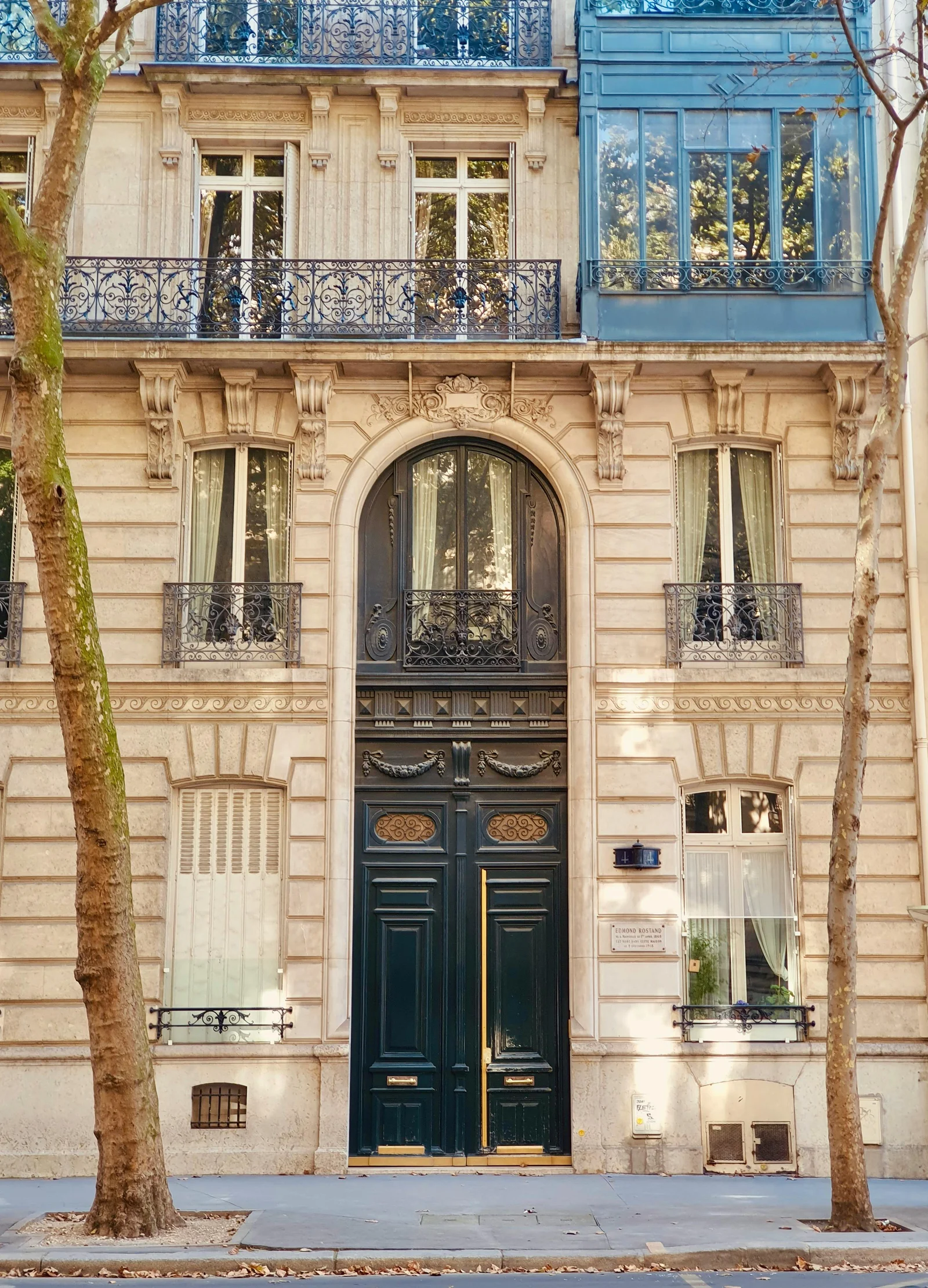
There is a building at 29 avenue Rapp, in the 7th arrondissement, that has been stopping passers-by for over a century. Not because it is beautiful in the classical sense: Parisians in 1901 actually found it scandalous. But because it is impossible to walk past without looking up. The facade is a living organism. Sculpted heads emerge from the stone like fruit from a branch. Glazed ceramic tendrils wrap around the windows. The entrance door, framed by semi-nude female figures, resembles the opening of an enchanted grotto. This is the Lavirotte building, a masterpiece of Parisian Art Nouveau. And it is the kind of building that makes you realise Paris does not have just one face.
People talk a great deal about Haussmann architecture, and rightly so: it is the architectural DNA of the capital. But Paris has another heritage, more discreet, more exuberant, more surprising: that of Art Nouveau. The Paris of 1900. The Paris of curves and scrolls, of wrought iron imitating water lily stems, of ceramics bursting with colour on facades nobody expected. A Paris of rupture, of elegant provocation, which left indelible marks across the city, provided you know where to look.
Art Nouveau in Paris: A Ten-Year Revolution
Art Nouveau is a brief movement. In Paris, it lasts barely fifteen years, from around 1895 to 1910. But those fifteen years produce a staggering density of architectural invention.
The context: the end of the 19th century is a time of ferment. The 1889 World’s Fair gave us the Eiffel Tower. The 1900 one gave us the Grand Palais, the Petit Palais, the Pont Alexandre III, and the first metro stations. Paris aspires to be the capital of modernity. And a group of architects decides that modernity cannot simply repeat the Haussmann codes. It must invent.
Their manifesto is simple: nature as a model. No more straight lines, right angles, or imposed symmetry. Instead, organic curves, plant motifs, new materials: exposed iron, coloured ceramics, curved glass, mosaics. Ornamentation is no longer applied to the structure: it IS the structure. The facade becomes sculpture.
The public is divided. Critics are often fierce. People speak of “noodle style” and “ornamental delirium.” The jury of the City of Paris facade competition, however, is won over: it awards its prizes to Lavirotte, Guimard, and Bigot, the movement’s most daring architects. This paradox sums up Parisian Art Nouveau: too radical for bourgeois taste, but recognised by institutions as a major advance.
Then, as quickly as it appeared, Art Nouveau vanishes. From 1910, the Art Deco movement takes over, bringing a return to geometries, straight lines, and a more restrained modernity. Art Nouveau becomes unfashionable, then forgotten, then rediscovered in the 1960s-1970s. Today, its Parisian creations are protected, restored, and revered. And the apartments hidden behind these extraordinary facades are among the most coveted on the market.
Hector Guimard: The Master of the Style
You cannot talk about Art Nouveau in Paris without talking about Guimard. Hector Guimard (1867-1942) is the most prolific and radical architect of the movement in France. His Parisian work is concentrated in a limited area, essentially the 16th arrondissement around Auteuil, but it transformed the city’s landscape.
Castel Beranger, 14 rue La Fontaine, 16th
This is the founding building. Built between 1895 and 1898, Castel Beranger is the first Art Nouveau building in Paris. Guimard is 28 when he begins the project. He designs everything: the facade (three different materials, stone, brick, and millstone grit, assembled in an asymmetric composition), the entrance door in wrought iron with hallucinatory plant forms, the balcony railings, the door handles, the wallpaper, the vestibule tiles. Every detail is considered, drawn, unique.
The building wins the first City of Paris facade competition in 1898. Parisians immediately nickname it the “Castel Derange” (the “Deranged Castle”). Guimard finds this amusing. His career is launched.
Today, Castel Beranger is a classified historic monument. Apartments very rarely change hands, and when they do, it is an event on the market. The last known sale, a few years ago, was negotiated at a premium of more than 15% compared to neighbouring buildings.
Hotel Mezzara, 60 rue La Fontaine, 16th
A few numbers down from Castel Beranger, Hotel Mezzara (1910-1911) is one of Guimard’s last Parisian works. It is a private mansion, not a residential building, and it shows Guimard at the height of his mastery. The stone and brick facade is more serene than Castel Beranger, but the interior is spectacular: a monumental carved wood staircase, stained glass, ironwork of extraordinary finesse.
The rue La Fontaine and rue Agar ensemble
The 16th arrondissement, around Auteuil, is Guimard territory par excellence. In addition to Castel Beranger and Hotel Mezzara, rue La Fontaine and surrounding streets feature several buildings designed by or inspired by Guimard: nos. 17-21 rue La Fontaine (Jassede building), rue Agar with its characteristic ironwork houses. A walk through this neighbourhood is an open-air architecture course.
The 16th arrondissement, and Auteuil in particular, attracts a very specific buyer profile: architecture lovers, collectors, aesthetes who prefer an Art Nouveau facade to a view of the Seine. Our hunters know this niche market well. It takes patience, networking, and a trained eye to find gems there.
The metro entrances
Guimard’s most visible work in Paris is the metro entrances. Commissioned by the Metropolitan Company for the network’s opening in 1900, these cast iron and glass canopies, with their plant-like stems, flower-shaped lanterns, and wavy “METROPOLITAIN” lettering, have become one of the symbols of Paris worldwide.
Around eighty survive, including two complete covered canopies: at Abbesses (18th) and at Arts et Metiers station (rue de Turbigo exit, 3rd). The Chatelet model was given to the city of Montreal. The Porte Dauphine entrance (16th) is the best-preserved original.
What is remarkable is that these metro entrances are not museum pieces. They function. Every day, millions of Parisians pass beneath a Hector Guimard creation to catch the metro. Art Nouveau in Paris is not in a museum. It is in the street, in daily life. That is perhaps what makes it so endearing.
Jules Lavirotte: The Exuberant One
If Guimard is the master, Lavirotte is the virtuoso. Jules Lavirotte (1864-1929) pushes Art Nouveau to its most spectacular extremes. Where Guimard remains (relatively) restrained in his residential facades, Lavirotte explodes.
29 avenue Rapp: the masterpiece
We return to the building that opens this article. 29 avenue Rapp, built in 1901, is probably the most extraordinary facade in Paris, across all eras. Lavirotte enlisted ceramicist Alexandre Bigot to cover the facade in flamed stoneware in forest-floor colours: greens, browns, ochres, deep blues. The sculptures by Jean-Baptiste Larrive depict allegorical figures, women’s faces, and animals intertwined in lush vegetation.
The entrance door is a work of art in itself: a carved wood portal framed by sensuous female figures, topped by a stoneware lintel where lizards weave through foliage. The ensemble won the 1901 facade competition, unanimously according to accounts.
The building is located in the 7th arrondissement, a stone’s throw from the Eiffel Tower and the Ecole Militaire. The apartments, when they become available (which is rare), command premium prices. The view from the upper floors includes the Eiffel Tower. Add to that the Lavirotte facade, and you have one of the most exceptional properties on the Parisian market.
3 square Rapp: the discreet one
A few metres from 29 avenue Rapp, at 3 square Rapp, Lavirotte designed another building, less spectacular but equally interesting. The facade is more restrained, cut stone with inserts of coloured ceramics, but the quality of the ornamentation remains remarkable. It is a good example of what Art Nouveau could produce in a more contained, more residential register.
34 avenue de Wagram: the monumental
In the 8th arrondissement, the Ceramic Hotel building (now Elysees Ceramic, a hotel) is another Lavirotte-Bigot creation. The facade is entirely covered in ceramics, a technical tour de force for the era. The floral relief motifs, the shimmering colours, the theatrical mascarons: everything is excessive, unapologetic, exuberant.
Other Treasures to Discover
Parisian Art Nouveau is not limited to Guimard and Lavirotte. Here are some lesser-known addresses worth a visit.
33 rue du Champ-de-Mars (7th): a building whose flamed stoneware facade was recently restored, with plant motifs of remarkable finesse. 39 rue de Turbigo (3rd): a commercial building whose polychrome ceramic facade is one of the most photographed in the neighbourhood. 14 rue d’Abbeville (10th): a spectacular facade with turquoise and gold floral ceramics, often cited among the most beautiful in the 10th arrondissement, a neighbourhood that harbours more Art Nouveau treasures than one might think.
And let us not forget the interiors. The restaurant Bouillon Julien (16 rue du Faubourg-Saint-Denis, 10th) is a concentrate of Art Nouveau: stained glass, murals, mosaics, carved woodwork, all in a Parisian bouillon at 15 euros a meal. The Brasserie Mollard (rue Saint-Lazare, 8th) features a classified Art Nouveau ceramic decor. And the pharmacy at 37 rue Jean-Pierre Timbaud (11th) has preserved its original woodwork and stained glass: you buy your paracetamol in a 1900s setting.
Jean Mascla’s advice. Art Nouveau is a market for enthusiasts. Properties in these buildings are rare, owners are viscerally attached to them, and sales are often conducted privately, outside the usual channels. This is a segment where a property hunter makes all the difference, because these opportunities never appear in listings. They come through networks, word of mouth, and patience. Exactly what we know how to do.
Living in an Art Nouveau Building: The Charm and the Constraints
Living in an Art Nouveau building means living in a work of art. But a listed work of art, which implies specific constraints.
Most of Paris’s notable Art Nouveau buildings are registered or classified as historic monuments, or located within the perimeter of the Batiments de France. In practice, this means that any work on the facade, window replacement, renovation, air conditioning installation, requires the approval of the Architecte des Batiments de France. Timelines are long, requirements strict, and costs often increased by the obligation to use materials and techniques consistent with the building’s era.
Inside, the situation is more flexible. Unless there is a specific interior classification (which is rare), you are free to renovate your apartment as you see fit. But most owners of Art Nouveau apartments choose to preserve, or even restore, period features: inlaid parquet, stained glass, interior ironwork, plant-motif mouldings. This is what gives the property its value, and what makes it a pleasure to live there.
The renovation budget in an Art Nouveau building is typically 20 to 30% higher than in a standard Haussmann building. Materials are rarer, specialist craftspeople more expensive, and respecting the style demands an attention to detail that cannot be improvised. It is an investment, but it is also the guarantee of owning a property that appreciates over time. Scarcity, in property as in art, never depreciates.
If Art Nouveau fascinates you, if you are the kind of person who looks up at facades, who notices a wrought-iron railing or a glazed ceramic, let us talk about your project. Paris still hides a few Art Nouveau apartments waiting for the right owner. And our hunters know exactly where to find them.
To complement this architectural exploration, read our guide to the most beautiful Haussmann buildings in Paris and our selection of the most beautiful neighbourhoods to live in Paris.
Frequently asked questions
Where can you see the most beautiful Art Nouveau facades in Paris?
The most beautiful Art Nouveau facades in Paris are concentrated in three areas: the 16th arrondissement in Auteuil (the Guimard ensemble on rue La Fontaine, Castel Beranger, Hotel Mezzara), the 7th arrondissement around avenue Rapp (the Lavirotte building at no. 29, spectacular ceramics), and the 10th arrondissement (39 rue de Turbigo). Guimard's metro entrances at Abbesses, Arts et Metiers, and Chatelet are the most visible traces of this movement in public space.
Can you buy an apartment in an Art Nouveau building in Paris?
Yes, several Art Nouveau buildings in Paris are residential co-ownerships. Apartments in them are rare on the market (owners become deeply attached to them) and trade with a heritage premium of 10 to 15% compared to standard buildings in the same neighbourhood. Constraints include protection under the Batiments de France designation, which strictly regulates works on the facade and common areas.
What is the difference between Art Nouveau and Haussmann architecture in Paris?
Haussmann architecture (1853-1870) is characterised by rigour, symmetry, and restrained ornamentation: cut stone, aligned facades, rectilinear cornices. Art Nouveau (1895-1910) breaks with this discipline: curved lines inspired by nature, deliberate asymmetry, new materials (iron, ceramics, coloured glass), and plant and animal ornamentation. The two styles coexist harmoniously in the Parisian landscape, with post-Haussmann architecture (1880-1910) serving as a transition between the two.