


Home insurance is probably the least glamorous topic in the entire property purchase journey. Nobody dreams of comparing multi-risk coverage while leafing through sixty pages of general terms and conditions. And yet, it is the document the notary will ask for first on the day of signing, before even beginning to read the final deed. No insurance certificate, no signing.
Beyond this administrative obligation, home insurance in Paris has particularities that buyers from other regions or abroad do not always suspect. The proximity of the Seine and flood risk, the specifics of Haussmann-era construction, urban density and the risk of water damage in co-ownerships, the high property value per square metre: all of this requires choosing your coverage with care.
In fifteen years of property hunting in Paris at Home Select, we have accompanied over 1,200 buyers through to the handover of keys. Home insurance is one of those topics our apartment hunters systematically discuss with their clients in the weeks before signing, to avoid last-minute stress and unpleasant surprises after moving in.
The legal obligation: what the law says
In France, home insurance is not technically mandatory for an owner-occupier of a detached house. But in Paris, this situation is virtually non-existent: 95% of transactions involve apartments in co-ownership, and the 2014 Alur law made civil liability insurance mandatory for every co-owner.
In practice, each co-owner must be covered at minimum for their civil liability, meaning damage they could cause to third parties (neighbours, common areas, passers-by) as a result of their property. Water damage that affects the apartment below, a fire that spreads, falling material from your balcony: without civil liability insurance, you bear the entire cost personally. In Paris, where water damage in a Haussmann building can easily reach 15,000 to 50,000 euros in damage (parquet, mouldings, paintwork), the absence of insurance is a major financial risk.
The co-ownership management company is also entitled to request an insurance certificate from you each year. If you do not provide one, it can take out insurance on your behalf and charge you the increased cost.
In practice, subscribing to simple civil liability alone is not enough. It is a legal minimum, not sufficient protection. Multi-risk home insurance policies offer a much broader base of coverage, and in Paris, this base is essential.
Essential coverage for a Parisian apartment
A standard multi-risk home insurance policy covers a range of risks. Not all are equal, and some deserve particular attention in the Parisian context.
Fire and explosion. Basic coverage, included in all policies. It covers damage caused by fire, lightning and explosions (including gas explosions, a real risk in older buildings with outdated installations). In Paris, the woodwork, period parquet floors and fireplaces of Haussmann buildings represent a higher fire risk than in modern concrete constructions.
Water damage. This is by far the most common claim in Parisian co-ownerships. Leaks from ageing pipes, washing machine overflow, roof infiltration, seepage through bathroom joints: the causes are many and the damage often significant. Water damage in a Haussmann apartment with solid parquet and plaster mouldings can cost 20,000 to 40,000 euros to repair. Check the indemnity ceilings in your policy and ensure they cover the real value of your fittings.
Theft and vandalism. Paris is a major metropolis, with a burglary rate higher than the national average. Ground floors and first floors are particularly exposed. Theft coverage usually comes with conditions: certified lock, reinforced or armoured door, shutters or bars on accessible windows. Check your insurer’s requirements before moving in: a burglary with a door that does not meet the policy conditions can result in a claim refusal.
Civil liability. Beyond the legal minimum in co-ownership, civil liability covers damage that you, your family or your pets cause to third parties. A flower pot falling from the balcony onto a passer-by, water damage affecting three apartments below: the amounts can be considerable.
Natural disasters. Mandatory coverage in every multi-risk home insurance policy in France, it covers damage caused by events recognised as natural disasters by inter-ministerial decree. In Paris, the main risk is the Seine flooding, a topic we develop further below.
Glass breakage. Covers windows, mirrors, ceramic hob surfaces and shower panels. In a Haussmann apartment with large period windows, replacing a pane can cost 500 to 1,500 euros depending on size and glass type.
Parisian specifics you should not ignore
Paris is not Bordeaux or Lyon. Home insurance must account for local particularities that influence both risk and the cost of claims.
The Seine flood risk. Paris lives with the memory of the 1910 flood, which inundated a large part of the city. The Paris Flood Risk Prevention Plan (PPRI) identifies exposed zones: the banks of the Seine obviously, but also neighbourhoods further from the river that can be affected by rising water tables. The 7th, 15th and 16th arrondissements are particularly concerned in their lower sections. The 12th and 13th are also affected along the Seine.
If your apartment is in a flood zone, insurance will not be denied (it is prohibited by law), but the excess in the event of a natural disaster may be higher. Most importantly, prevention measures (flood barriers, pumps, raising electrical installations above water level) fall to the co-ownership: check that the building has a flood safety plan.
The value of contents. The price per square metre in Paris being among the highest in France, interior fittings are often proportionally high: high-end fitted kitchen, restored parquet, custom wardrobes, home automation. The declared contents value must reflect the real value of your belongings. Undervaluing to pay less in premiums is tempting, but on the day of a claim, the indemnity will be proportional to the declared value.
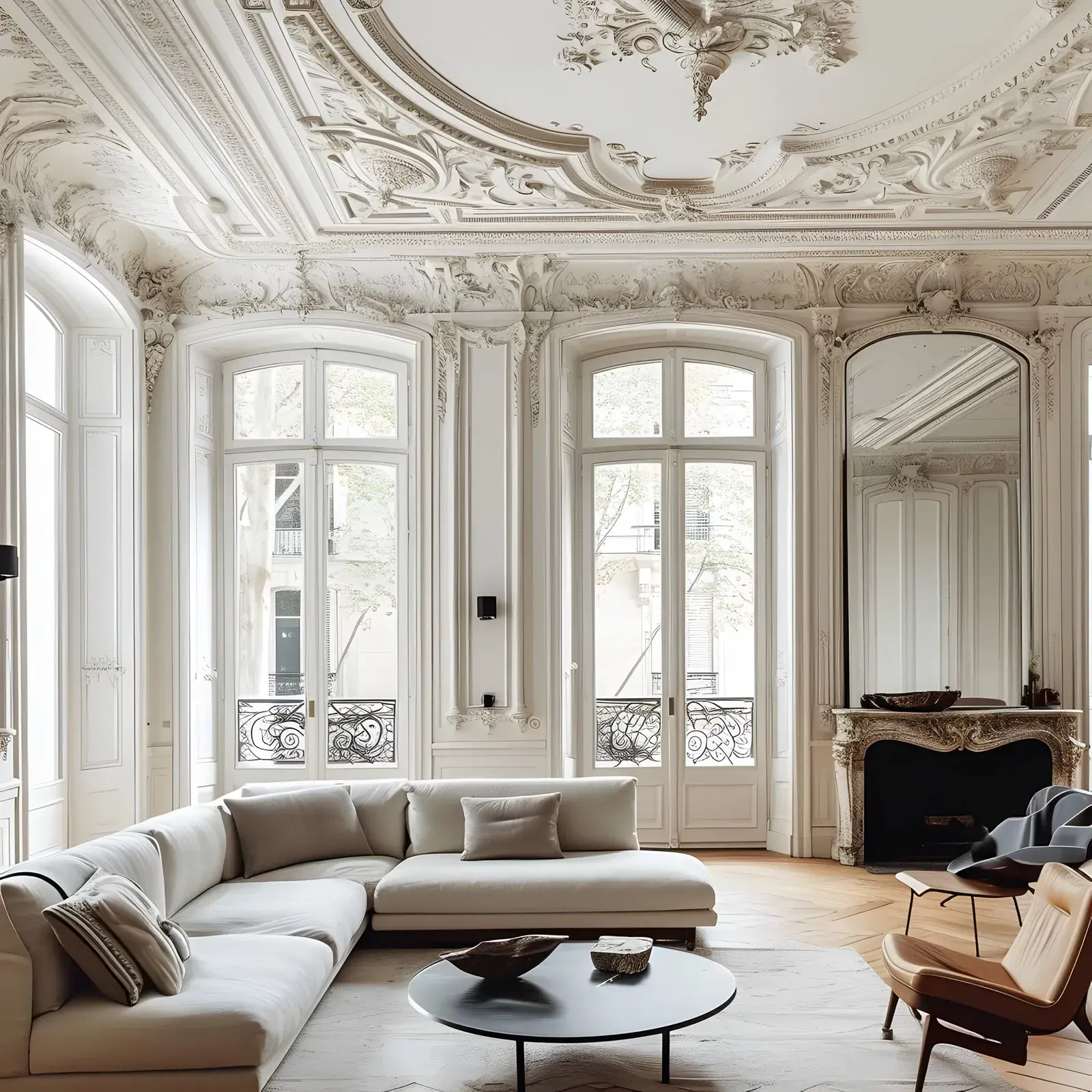
Haussmann buildings and their materials. Plaster mouldings, marble fireplaces, herringbone parquet, sculpted woodwork: these elements have a heritage value that standard policies do not always cover adequately. Restoring a moulded ceiling after water damage can cost 8,000 to 15,000 euros, an amount your policy must provide for. Some insurers offer “heritage” or “character building” options suited to older buildings.
Density and cascading water damage. In a six-storey Haussmann building, water damage on the fifth floor can affect the four apartments below. This is a common scenario, and the IRSI convention (Building Claims Indemnification and Recovery) governs the cost allocation between the insurers of the different owners. Your home insurance must be compatible with this convention, which is the case for virtually all multi-risk policies on the market.
Home insurance is one of the details our apartment hunters anticipate for you. From the search to moving in, we support you at every step. Entrust us with your project
How much it costs: price ranges in Paris in 2026
The cost of home insurance depends on many factors: surface area, floor, arrondissement, coverage chosen, contents value and the insured person’s profile (claims history, number of occupants).
To give realistic price ranges for the Parisian market in 2026, here is what our clients typically find. A studio of 25-30 sqm: 150 to 250 euros per year. A one-bedroom of 40-50 sqm: 200 to 350 euros per year. A two-bedroom of 65-80 sqm: 300 to 500 euros per year. A three-bedroom of 90-120 sqm: 400 to 700 euros per year. A large family apartment of 150 sqm and above: 600 to 1,200 euros per year.
These ranges apply to multi-risk policies with a reasonable level of coverage (not minimum, not premium). Factors that increase the cost: a ground floor (higher theft and flood risk), a PPRI flood zone, high contents value (above 50,000 euros), declared valuables (artworks, jewellery, musical instruments), and claims history.
A common-sense tip: compare at least three quotes before subscribing. Price differences between insurers can reach 30 to 40% for equivalent coverage. Online insurers (such as Luko, Lovys or the digital offerings of major groups) often offer competitive rates with fast subscription processes, an advantage when the signing date is approaching and time is short.
The signing day pitfall
Let us return to the most practical point: the notary requires a home insurance certificate covering the property from the day of signing the final deed. This is a non-negotiable requirement.
Forgetting home insurance is one of the most common reasons for postponing signings in Paris. At Home Select, our property hunters send a systematic reminder to their clients ten days before the scheduled signing date. This reminder specifies the information needed to subscribe: exact property address, surface area, floor, number of rooms, desired start date (the day of signing).
Best practice: subscribe to insurance two weeks before signing, with a start date set for the day of signing. The certificate is generally available immediately after subscribing online, or within 24 to 48 hours by post for policies taken out in-branch.
A particular case our apartment hunters encounter with expatriate buyers: some French insurers refuse to cover a property whose owner resides abroad, or apply significant surcharges. There are brokers specialising in property insurance for non-residents, a point we anticipate from the compromis stage to avoid surprises on the day.
Home insurance and renovation: the blind spot
If you are buying an apartment with planned works, and in Paris this is common, whether modernising a Haussmann property or improving a poor energy rating, your standard home insurance may not suffice.
During works, the risk of a claim increases: water damage related to plumbing being modified, fire from welding, falling materials onto a neighbour or passer-by. Your multi-risk home insurance covers your basic civil liability, but not damage specifically related to the building site.
For light works (painting, laying parquet, replacing a kitchen), standard coverage is generally sufficient provided you inform your insurer. For major works (complete renovation, partition changes, plumbing and electrical overhaul), two complementary types of insurance are worth considering.
Structural damage insurance (assurance dommages-ouvrage), mandatory for works affecting the structure (load-bearing walls, floors, roof), protects the client (you) against defects for ten years after completion. Its cost is high (2 to 5% of the works total), but it is the only insurance that allows you to obtain rapid indemnification without waiting for the outcome of legal proceedings against the responsible contractor.
The contractor’s ten-year guarantee (garantie decennale), which every building company is required to hold, covers damage compromising the structural integrity or making the property unfit for its intended use for ten years. Before entrusting major works, always request a copy of each contractor’s ten-year guarantee certificate. This is a reflex our property hunters pass on to every client planning renovation work.
The link with co-ownership insurance
In co-ownership, two levels of insurance overlap, and their relationship is a frequent source of confusion.
The building multi-risk insurance (MRI), taken out by the management company on behalf of the co-ownership, covers common areas (stairwell, roof, facade, shared pipes) and the co-ownership’s civil liability. Its cost is shared among all co-owners through service charges.
Your individual home insurance covers your private areas (the interior of your apartment, your improvements, your furniture) and your personal civil liability.
In the event of a claim, the IRSI convention determines which insurer intervenes first based on the nature and amount of the damage. For claims below 5,000 euros excluding tax, it is the insurer of the affected premises (where the damage is observed) that manages and compensates, regardless of the origin of the claim. Above 5,000 euros, a joint expert assessment is organised between the insurers involved.
The key takeaway: even if the building is well insured, your individual insurance remains essential. The two do not replace each other: they complement each other.
How to choose: the criteria that matter
For a Parisian apartment, here are the comparison points that truly make the difference between two home insurance policies.
Indemnity ceilings for water damage. This is the most likely claim. Check that the ceiling covers the real restoration cost of your apartment, including character elements (parquet, mouldings, fireplaces).
The indemnification formula. “Replacement value” means the insurer reimburses the replacement cost without deduction for wear and tear. “Current value” applies a depreciation coefficient that reduces the indemnity. For a recently renovated apartment, replacement value is preferable.
Excess amounts. A high excess reduces premiums but increases your out-of-pocket cost in the event of a claim. For frequent water damage (tap leak, shower joint), an excess of 300 euros is manageable. An excess of 1,500 euros may discourage declaring small claims.
Theft coverage and security conditions. If your apartment is on the ground floor or first floor, check the insurer’s requirements for locks and window protection. Non-compliance with security conditions means no indemnification.
Assistance and claims management. Insurer responsiveness in the event of a claim makes a real difference. Water damage on a Saturday evening in a Haussmann building requires rapid intervention to limit damage. Insurers offering 24/7 assistance with emergency plumber dispatch provide genuine value.
From the search to moving in, nothing is left to chance. Our 16 apartment hunters support you on every detail, including those you would not have imagined. Get a free callback
Insurance checklist before signing
To conclude on a practical note, here is what our property hunters recommend to their clients in the two weeks before signing the final deed.
Compare at least three multi-risk home insurance quotes. Check that indemnity ceilings match the real value of the property and its contents. Ensure the policy start date corresponds to the day of signing. Obtain the insurance certificate and send it to the notary at least 48 hours before the appointment. If works are planned after purchase, inform the insurer and check the necessary coverage extensions. For expatriates, identify an insurer accepting non-resident owners.
It is a modest topic in the ocean of concerns surrounding a Parisian property purchase. But it is precisely because it seems secondary that buyers find themselves on signing day without a certificate, or discover after a claim that their policy does not cover the mouldings of their Haussmann apartment. At Home Select, our end-to-end support includes these details which, taken together, make the difference between a stressful purchase and a serene one.
Frequently asked questions
Is home insurance mandatory for a property owner in Paris?
In a co-ownership, yes: the Alur law requires at least civil liability insurance. For a detached house (rare in Paris), it is not legally mandatory but strongly recommended. In all cases, the notary requires an insurance certificate on the day of signing the final deed.
How much does home insurance cost in Paris in 2026?
Between 200 and 600 euros per year for an apartment of 50 to 80 sqm, depending on the coverage chosen and the arrondissement. Ground floors, properties in flood zones and apartments with valuables cost more to insure. A Haussmann-style apartment with period parquet flooring and mouldings requires higher replacement value coverage.
When should you take out home insurance during a purchase?
Ideally two weeks before signing the final deed. The insurance certificate is mandatory on the day of signing at the notary's office. Subscribing at the last minute is risky: some companies require processing time, and an oversight can postpone the signing.
Isn't the co-ownership insurance enough?
No. The co-ownership insurance (building multi-risk policy) covers common areas and the co-ownership's civil liability. It does not cover your personal belongings, your interior fittings, or your personal civil liability. Your individual home insurance is complementary and essential.
Do you need specific insurance for a property undergoing renovation?
If you carry out major works after the purchase, your standard home insurance may not cover damage related to the building site. Notify your insurer and request an extension of coverage or structural damage insurance if the works affect the building's structure. This is a point our property hunters systematically flag.