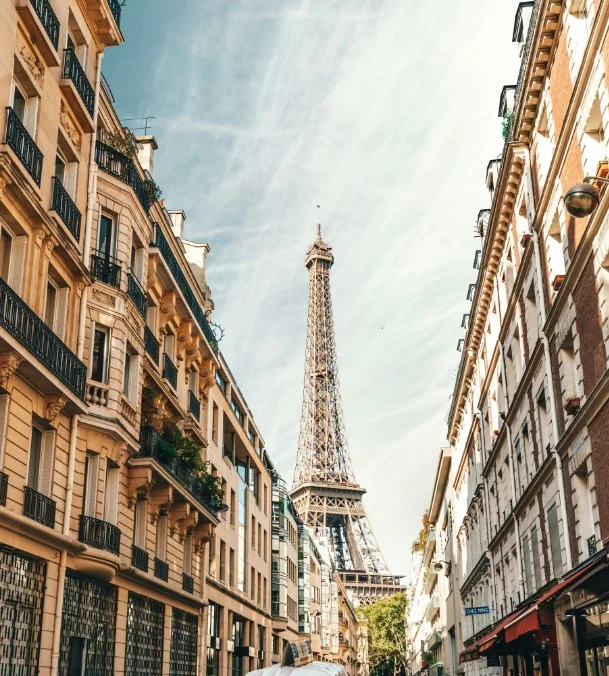


You spent five, ten, fifteen years abroad. You are returning to Paris. And you discover that the property market you left bears little resemblance to the one you are coming back to. Prices have shifted, neighbourhoods have transformed, rules have changed, and your hybrid financial situation (foreign income, savings in foreign currency, non-existent French banking history) does not fit any standard category.
At Home Select, returning French expats represent a significant share of our clientele since 2011. Americans back from New York, couples returning from Singapore or Hong Kong, families leaving London or Dubai: we know this profile by heart, its strengths and its blind spots. This guide is the distillation of what we have learned from supporting them.
The gap: what has changed during your absence
Prices: the per-square-metre shock
The returning expat’s first reflex is to compare. And the comparison often hurts.
If you lived in Singapore, Dubai or an American city outside New York and San Francisco, you got used to generous living spaces at reasonable budgets. In Paris, 80 m2 in a decent family neighbourhood costs 700,000 to 1,000,000 euros depending on the arrondissement. For an expat who was renting 120 m2 in Singapore for the equivalent of 3,500 euros/month, the Parisian reality is harsh.
In 2026, the average price per m2 in Paris is around 10,400 euros. But this average hides enormous gaps. In the 6th arrondissement (Saint-Germain-des-Pres), expect 15,000 to 16,000 euros/m2. In the 19th (Buttes-Chaumont), more like 8,000 to 9,000 euros/m2. And within each arrondissement, variations from one street to the next can reach 20%.
If you left Paris before 2020, know that the market hit a historic peak that year, followed by a 5 to 8% correction between 2021 and 2024, then a stabilisation. 2026 prices have broadly returned to 2018-2019 levels: an interesting window to buy, especially if you had pre-Covid prices in mind.
Neighbourhoods: sometimes spectacular transformations
Paris changes slowly, but fifteen years away is enough to observe real transformations.
The 10th arrondissement (Canal Saint-Martin) has become one of the most sought-after neighbourhoods for young professionals and trendy families, with prices to match. The 9th (SoPi, Nouvelle Athenes) has undergone accelerated gentrification. The 17th (Batignolles) has been transformed by the new Martin Luther King district and the Paris courthouse. The 13th (Bibliotheque) has gained attractiveness with the ZAC Paris Rive Gauche developments.
Conversely, some historically sought-after arrondissements, the 16th in particular, have seen their prices stagnate more than the rest of Paris, victims of an ageing image among younger buyers.
For a returning expat, this renewed geography is both an opportunity (discovering neighbourhoods you would never have considered) and a trap (projecting memories from ten years ago onto a market that has evolved).
The rules: what is new
Several regulatory changes have altered the Parisian property landscape since 2020.
The EPC (Energy Performance Certificate, or DPE in French) has become a determining criterion. G-rated homes have been banned from rental since 2025, F-rated will follow in 2028, E-rated in 2034. A poorly rated apartment sells at a steeper discount, but energy renovation works in a Parisian condominium are complex and costly.
Rent control has been in force in Paris since 2019. If you are buying as an investment, the rents you can charge are capped by zone and property type.
Interest rates have changed profoundly. If you bought your previous Parisian property before 2022 at 1.2%, be prepared to borrow at 3.3-3.8% in 2026. The impact on your borrowing capacity is significant.
Financing: simpler than for a foreigner, but not that simple
Good news: as a French citizen, you have a structural advantage over a foreign buyer. You have nationality, you will be residing in France, and you have (normally) a French tax history somewhere in the past.
Bad news: your banking file is atypical, and French banks do not like atypical.
The banking history problem
If you closed your French accounts when you left, you come back with a local banking history of zero. No recent French bank statements, no domiciled income, no French credit repayment history. For a French bank evaluating your risk profile, it is a black hole.
The solution: reopen a French bank account as early as possible, ideally 3 to 6 months before your actual return. Some banks accept remote account opening for French expats (BNP Paribas International, Societe Generale, Banque Transatlantique which specialises in expats). Set up regular transfers as soon as possible to start building a history.
Income: the delicate transition
The moment you are applying for a mortgage is often the moment your income is hardest to justify. You may have left your overseas job without yet having signed your French contract. Or you are on probation. Or you are starting your own business.
Banks want stability. Here is what reassures them:
A signed French employment contract, even during the probation period, some banks accept it if the employer is solid. If you have a permanent contract signed with a French company before your return, your file is considerably strengthened.
Failing that, your foreign income from the last three years is taken into account, translated and converted to euros. If you earned well abroad, it works in your favour, even if the income is no longer current.
Your wealth is a powerful argument. If you built up significant savings during your expatriation, which is often the case given that expat packages are generally generous, banks are reassured. A deposit of 30-40% more than compensates for a fragile French banking history.
The broker: your best ally
The “returning expat” profile is specific enough to justify a broker who knows this segment. A good broker knows which banks accept transitional files, how to present foreign income, and how to showcase wealth built up abroad.
Our article on property mortgages in Paris details financing conditions, and our financing guide for non-residents covers the aspects common to expats.
Jean Mascla’s advice: If you can, secure your French employment contract before launching the property search. A signed permanent contract, even during probation, transforms your banking file. If that is not possible, rely on your deposit: with 30% cash, banks look past the absence of a local history.
Timing: buy before or after the return?
This is the question every returning expat asks. Both options have advantages and pitfalls.
Option A: Buy before returning
Advantages. You move directly into your apartment. No temporary rental, no double move, no searching under pressure.
Disadvantages. You are buying remotely, with the associated constraints: delegated or video-conference viewings, decisions made without “feeling” the neighbourhood daily, powers of attorney for signatures. Financing can be more complex if you do not yet have a French employment contract.
For whom? Expats who know Paris well (lived there before), who have a clear budget, and who work with a trusted property hunter who can be their eyes and legs on the ground.
Option B: Buy after returning
Advantages. You visit in person, you rediscover neighbourhoods in daily life, you sign your French employment contract before borrowing, making the banking file more solid.
Disadvantages. You need to find a temporary rental (not easy in Paris, especially for a family with children and furniture to store). Allow 3 to 6 months of renting before finding and finalising the purchase. Cost: 6,000 to 15,000 euros in rent for a temporary furnished apartment depending on size and neighbourhood.
For whom? Those who have time, who have not lived in Paris recently, or who want to explore before committing.
The hybrid option: our recommendation
Start the search 3 to 4 months before your return date, with a property hunter who manages the remote phase. Begin with a thorough video-conference briefing to frame the project (neighbourhood, budget, property type). The property hunter shortlists and visits for you. If a property matches, you travel for a single viewing, or you validate remotely if the property ticks every box.
In the best scenario, the preliminary agreement is signed before your return and you move in 2 to 3 months after arrival. In the realistic scenario, you arrive with one or two properties in view, you visit during your first weeks, and you buy within two months.
At Home Select, the average search time is 45 days. Starting 3 months before the return gives comfortable timing.
Neighbourhoods popular with returning expats
Returning expat families have specific criteria: schools (often bilingual or international, during the transition), transport to airports (for business trips), English-language services (doctors, banking), green spaces, neighbourhood life.
For families with children
The 15th arrondissement is the pragmatic choice. Large apartments at relatively reasonable prices for Paris (9,000-10,500 euros/m2), excellent public schools, village atmosphere, Parc Andre-Citroen and Champ-de-Mars nearby. It is the “easy setup” neighbourhood: less glamorous than the 6th, but infinitely more liveable day-to-day with children.
The 16th arrondissement remains the choice for families who want space and greenery (Bois de Boulogne, Jardins du Ranelagh). Close to ASP (American School of Paris, in Hauts-de-Seine), EIB Etoile and Lycee Janson-de-Sailly. Prices: 10,000-13,000 euros/m2 depending on the micro-neighbourhood. The 16th’s ageing image is partly unfair: Passy and Auteuil remain exceptional family neighbourhoods.
The 17th arrondissement (Batignolles, Ternes) offers a good quality-of-life-to-budget ratio. The new Batignolles-Clichy district has completely transformed the area. Prices: 9,500-11,500 euros/m2. Good transport links.
For couples without children
The 6th arrondissement (Saint-Germain-des-Pres, Luxembourg) is the postcard Paris that expats dream about from abroad, and it delivers on its promise. High entry price (14,000-16,000 euros/m2), but incomparable quality of life.
The 7th arrondissement (Invalides, Rue Cler, Saint-Thomas d’Aquin) combines prestige and authentic neighbourhood life. The Rue Cler area is a village within Paris. Prices: 12,000-15,000 euros/m2.
The 9th arrondissement (SoPi, Nouvelle Athenes) is the choice for returning expats who want dynamism without sacrificing charm. Restaurants, galleries, cosmopolitan atmosphere. Prices: 10,000-12,000 euros/m2.
Our guide to the best arrondissements for families details the strengths of each arrondissement by buyer profile.
And the Ile-de-France?
If the Paris budget is too tight for the surface area your family needs, certain inner-ring municipalities offer an excellent compromise. Neuilly-sur-Seine (92) for prestige, Vincennes and Saint-Mande (94) for the Bois de Vincennes, Boulogne-Billancourt (92) for proximity to the 16th, Saint-Germain-en-Laye (78) for families who want a house with a garden and a top-tier international school.
Jean Mascla’s advice: Do not choose your neighbourhood based on your memories. The Paris of 2026 is not the Paris of 2015. Ask your property hunter to provide an updated neighbourhood briefing: it is the first thing we do with our returning expat clients. Some discover arrondissements they would never have considered, and end up buying there.
Pitfalls specific to returning expats
Beyond the common pitfalls of any Paris buyer, the “returning expat” profile has its own blind spots.
The “I know Paris” syndrome. You lived in Paris before, but the market you knew no longer exists. Neighbourhoods have shifted, prices have changed, rules are different. Approach the search with fresh eyes, not with certainties from ten years ago.
The fantasy budget. After years of expatriation with a comfortable package, many returning French expats overestimate their Parisian budget. Convert honestly: your French salary will likely be lower than your expat package, and your costs will increase (end of the expat tax advantage, Parisian cost of living, school fees if you leave the company-provided system).
Refusing to compromise on space. You had 150 m2 in Singapore or a four-room apartment with terrace in Barcelona. In Paris, for the same budget, you will get 80 m2 without outdoor space. That is the Parisian price per m2: do not take it personally, take it into account.
Rushing. The anxiety of the return pushes some expats to buy the first “acceptable” property to avoid being without a home. That is the worst strategy for a purchase that commits 20 years of repayments. Plan for a temporary rental of a few months and buy with peace of mind.
Forgetting the transitional tax situation. In the year of your return to France, your tax situation is complex: foreign income for part of the year, French income for the rest, possible ongoing foreign-source income. Consult a tax advisor specialising in international mobility before structuring your purchase.
Preparing your return to Paris? Many of our clients are French nationals coming home: we know your questions, your doubts and your specific constraints. Start the search now, even from abroad: our 16 property hunters manage the entire process remotely. Prepare your return
Key takeaways
Returning from expatriation is a pivotal moment: exciting and stressful. On the property front, the keys to success are: plan your financing ahead (reopen a French bank account, secure an employment contract if possible, work with a specialist broker), recalibrate your size expectations against the Parisian price per m2, and start the search 3 to 4 months before the return with a property hunter who manages the remote phase.
The Paris of 2026 holds pleasant surprises for those who arrive with fresh eyes. Neighbourhoods in full transformation, prices back to reasonable levels after the 2021-2024 correction, and a market that offers real opportunities for well-supported buyers. At Home Select, we have been guiding this journey for fifteen years: 1,200 completed projects, a significant share of which are returning expats. Let us discuss your project.
Frequently asked questions
Should you buy before returning to France or after?
Both options are possible, and the choice depends on your situation. Buying before returning means moving in directly, but you are purchasing remotely, with the constraints that implies (delegated viewings, time zone differences, powers of attorney). Buying after returning is more comfortable for viewings, but requires a temporary rental for 3 to 6 months and a double rent during the transition. Our recommendation: start the search 3 to 4 months before your planned return date, with a property hunter who manages the remote phase.
My French banking history was closed during my expatriation. Is that a problem?
It is a common friction point but manageable. If you closed your French accounts during expatriation, you have no local banking history, which complicates getting a mortgage. The solution: reopen an account as soon as possible (some banks do this remotely), set up regular salary transfers or payments into it, and work with a broker who knows how to present a returning expat file. Your foreign bank statements and international credit history partially compensate for the lack of a French track record.
Have Parisian prices changed much since I left?
That depends on when you left. If you departed before 2020, the market reached a historic peak in 2020 (10,800 euros/m2 on average), then corrected 5 to 8% between 2021 and 2024, followed by stabilisation in 2025-2026. Average prices are around 10,400 euros/m2 in 2026, but with considerable variation: from 8,000 euros/m2 in the 19th to over 15,000 euros/m2 in the 6th. The per-square-metre shock is real when you arrive from cities like Singapore (outside the centre), Dubai or Southeast Asian capitals.