

The choice of neighborhood is the most structural decision of a property purchase in Paris, and for an expatriate, it is also the most complex. You are not just looking for good value per square meter: you are looking for an environment where you can integrate, schools suited to your children, services accessible in your language, a community that will ease your settling-in, and transport connections to airports for your trips back home.
In fifteen years at Home Select, we have settled hundreds of international families and couples in Paris. Americans, British, Lebanese, Singaporeans, Brazilians, Scandinavians: each community has its preferred neighborhoods, its habits, its networks. This guide maps it all, profile by profile.
Criteria specific to expatriates
Before diving into neighborhoods, let us identify what distinguishes an expatriate’s search from a Parisian’s.
Schools. This is the number one criterion for families. The French school system is excellent but opaque for a foreigner. Many expatriate families opt for an international or bilingual school, and the choice of school determines the neighborhood, not the other way around. Our guide to international schools in Paris details each institution.
Airport transport. An expatriate travels. Quick access to Roissy-Charles de Gaulle (CDG) and Orly is an underestimated criterion at purchase time but very present in daily life. The RER B serves CDG from Gare du Nord, Chatelet, and Denfert-Rochereau. Le Bus Direct (formerly Cars Air France) departs from Etoile and Montparnasse. Neighborhoods close to these hubs have a genuine logistical advantage.
Services in English. English-speaking doctors, banks with international services, shops where English comes naturally: this is not available everywhere in Paris. Neighborhoods with a high concentration of expatriates offer this ecosystem by default.
Community. Settling into a neighborhood where other expatriates live makes integration easier: parent groups, associations, social events. It is not mandatory, but it is an appreciated safety net in the first months.
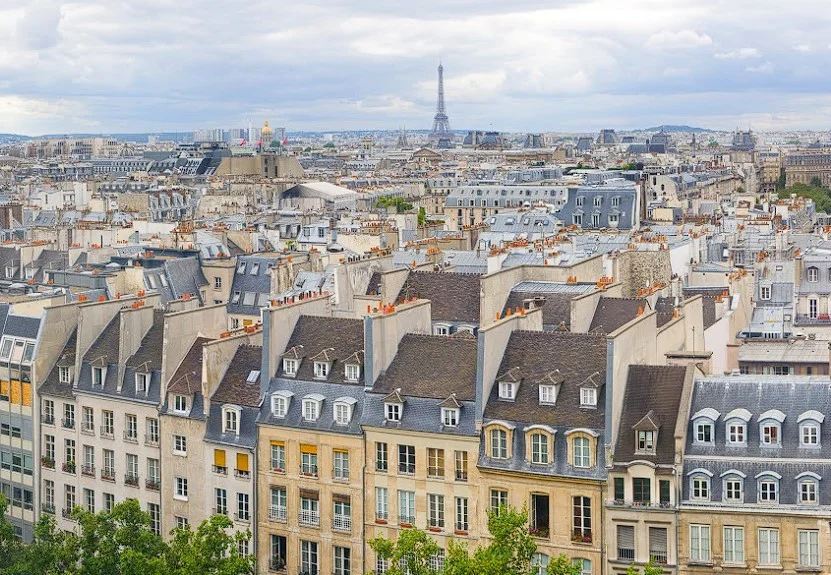
Natural light and space. Expatriates arriving from spacious cities (American cities, Singapore, Dubai, Sydney) are often shocked by the size of Parisian apartments. Prioritize upper floors (natural light), south or west orientations, and well-designed layouts over raw square meters.
Neighborhood by neighborhood: the guide by profile
The 7th arrondissement: the classic Paris of diplomats and international families
Typical profile: families with children, affluent couples, diplomats, executives of international organizations (UNESCO, OECD).
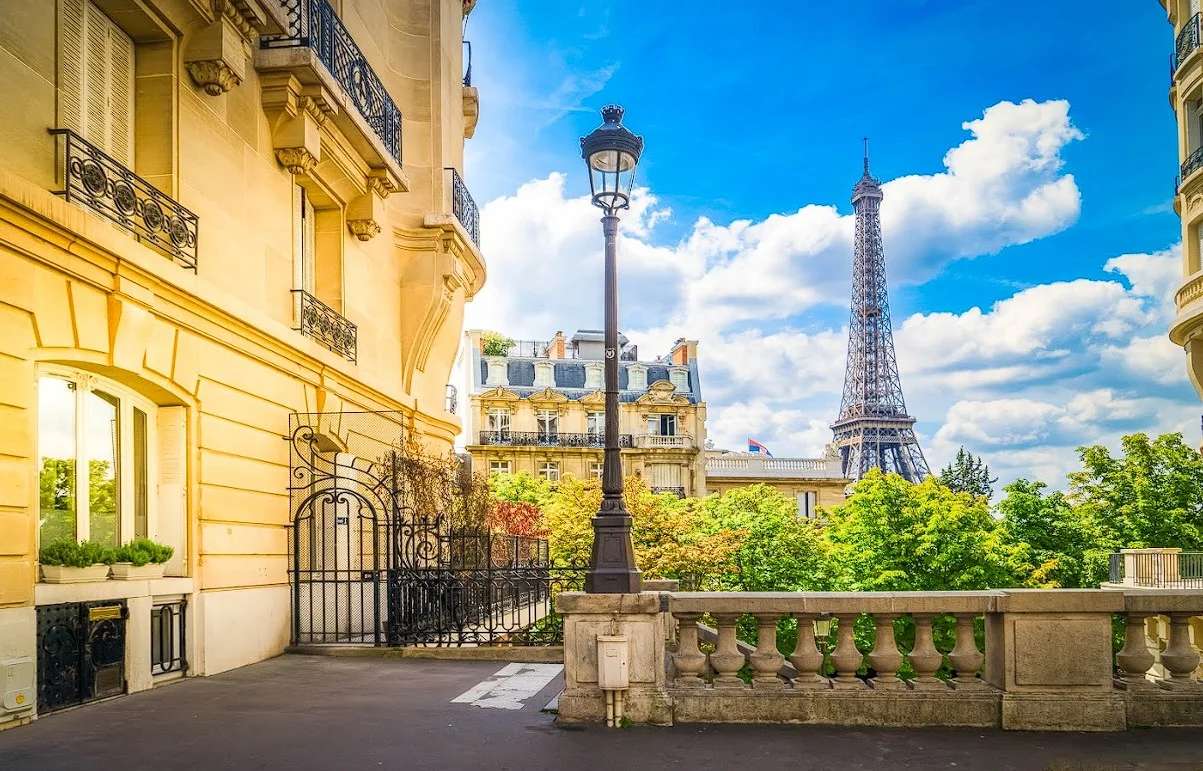
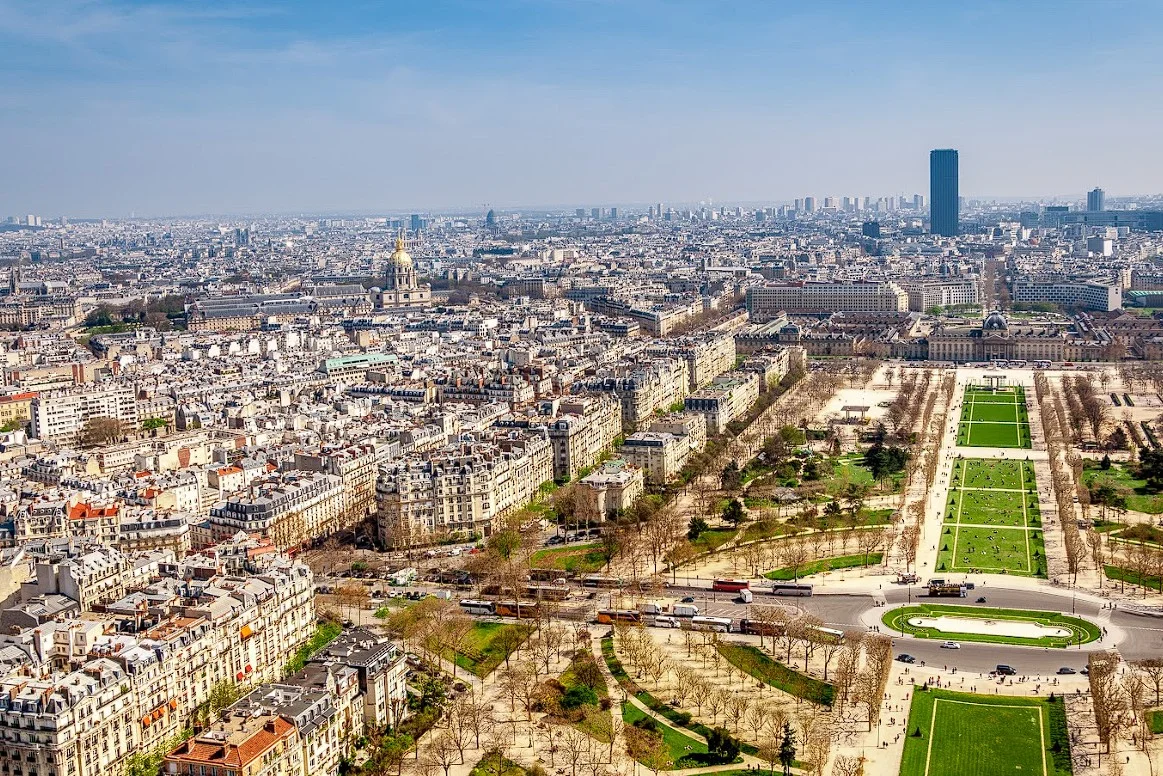
The 7th is the diplomatic quarter par excellence. UNESCO has its headquarters here, several embassies line the Boulevard des Invalides, and the concentration of international institutions creates a naturally cosmopolitan environment. It is also one of the most beautiful arrondissements in Paris: the Eiffel Tower, the Champ-de-Mars, the Esplanade des Invalides, the Seine embankments.
The Rue Cler area is a village within the city. Shopkeepers who know you by name, a daily food market, a family-friendly atmosphere. Expatriate families love it.
The Invalides-Saint-Thomas d’Aquin area is more bourgeois, quieter, with magnificent Haussmann buildings and spacious apartments.
The Breteuil-Segur area offers an excellent value-for-money compromise for the 7th, with bright apartments overlooking the Avenue de Breteuil.
Prices: 12,000 to 15,000 euros/m2 depending on the micro-neighborhood. Properties with an Eiffel Tower view exceed 18,000 euros/m2.
Nearby schools: EIB Etoile (bilingual), Academie Internationale de Paris, several very good public schools.
Airport transport: Invalides is on the RER C (not ideal for CDG), but Gare Montparnasse (Orly) and metro Line 13 (connection to Gare du Nord for CDG) are accessible.
Discover the 7th arrondissement in detail
The 16th arrondissement: the historic choice of Anglo-Saxon families
Typical profile: American and British families, senior executives, long-term family purchases.
The 16th is the largest arrondissement in Paris, and also the most contrasted. It ranges from the absolute prestige of Trocadero and Victor Hugo to the quiet residential atmosphere of Auteuil and La Muette. It is the historic neighborhood of Paris’s Anglo-Saxon community, and for good reason: proximity to the American School of Paris (ASP, in Saint-Cloud, 15 minutes by car), the International School of Paris (ISP, located in the 16th itself), and EIB Etoile.
Trocadero-Passy: the most international area. Haussmann apartments with views, quality restaurants, the Bois de Boulogne steps away. Also the most expensive part of the 16th.
La Muette-Ranelagh: the chic village atmosphere. The Ranelagh garden, the Marmottan Museum, quiet streets lined with private mansions. Ideal for families with young children.
Auteuil: the neighborhood of large surfaces. This is where you find family apartments of 100 m2+ at (relatively) reasonable prices for the 16th. Less central, more residential, but very pleasant to live in.
Prices: 10,000 to 13,000 euros/m2 on average, with peaks at 15,000 euros+ for Trocadero and exceptional properties.
Nearby schools: ISP (International School of Paris), EIB Etoile, Lycee Janson-de-Sailly, La Tour (bilingual). The ASP in Saint-Cloud is 15 minutes away.
Airport transport: not ideal. The RER C at Avenue Henri-Martin serves Orly (via connection). For CDG, count on a taxi or ride service (45 minutes to 1 hour).
Discover the 16th arrondissement in detail
The 6th arrondissement: literary and intellectual Paris
Typical profile: couples without children, intellectuals, artists, active retirees, convinced Francophiles.
Saint-Germain-des-Pres is the Paris the whole world fantasizes about, and it is the only neighborhood that fully delivers on its promise. The historic cafes (Flore, Deux Magots), the galleries, the bookshops (including the legendary Shakespeare and Company, technically in the 5th but steps away), the Jardin du Luxembourg.
This is the neighborhood of choice for expatriates who want to live cultural Paris, not postcard Paris. The British community is historically established here, and you will encounter many academics, writers, and arts professionals.
Note: the 6th is the most expensive area in Paris alongside the 7th. Surface areas are often modest: a two-room apartment of 45 m2 at 700,000 euros is not unusual.
Prices: 14,000 to 16,000 euros/m2. The Odeon-Luxembourg area is slightly less expensive than Saint-Germain-des-Pres.
Nearby schools: Alsacienne (highly reputed, but in French), bilingual Montessori in the area, excellent public secondary schools.
Airport transport: Denfert-Rochereau (RER B direct to CDG and Orly) is 10 minutes by bus or metro. This is an often-underestimated advantage.
The 8th arrondissement: the international business quarter
Typical profile: international senior executives, finance and consulting profiles, upscale pieds-a-terre.
The 8th is the neighborhood of corporate headquarters, grand hotels, and the Triangle d’Or (Avenue Montaigne, Rue du Faubourg Saint-Honore). It is less a living neighborhood than a prestige neighborhood, but the Monceau area to the north offers a quality residential atmosphere with beautiful Haussmann buildings and Parc Monceau.
The Triangle d’Or: apartments of exceptional standing, but neighborhood life is virtually nonexistent on weekends. Better suited to a pied-a-terre than a family primary residence.
Monceau: the best of the 8th for living. Beautiful buildings, a park, schools (including EIB Monceau), local shops. A calmer, more residential atmosphere.
Prices: 11,000 to 14,000 euros/m2, with exceptional properties exceeding 20,000 euros/m2 in the Triangle d’Or.
Discover the 8th arrondissement in detail
The 15th arrondissement: the pragmatic family choice
Typical profile: families with children seeking space without breaking the bank, pragmatic expatriates.
The 15th does not make anyone dream on Instagram, and that is precisely why it is an excellent choice. It is the most populated arrondissement in Paris, the most residential, and the one offering the best surface-to-price ratio for families. You can find three-bedroom apartments of 70 m2 between 600,000 and 750,000 euros: unthinkable in the 6th or 7th.
The Commerce-La Motte-Picquet area is the liveliest: a bustling shopping street, a market, metro access (Lines 6, 8, 10). Close to the Champ-de-Mars.
The Convention area is calmer, more family-oriented, with Parc Georges Brassens and pleasant residential streets.
Prices: 9,000 to 10,500 euros/m2. The most expensive part is the area bordering the 7th (Grenelle).
Nearby schools: excellent public schools, some bilingual options in the area.
Airport transport: Montparnasse (Le Bus Direct to Orly and CDG), metro Line 12 to Gare du Nord.
The 9th arrondissement: vibrant Paris for young expatriates
Typical profile: young couples, creative professionals, European expatriates, childless thirty-somethings.
The 9th has undergone a spectacular transformation in fifteen years. SoPi (South Pigalle) has become one of the trendiest neighborhoods in Paris: cocktail bars, neo-bistro restaurants, galleries. Nouvelle Athenes offers a more classic atmosphere, with its tree-lined squares and 19th-century buildings. Grands Boulevards is the theater and nightlife district.
This is the neighborhood of choice for European expatriates (many British, Germans, Scandinavians) seeking energy, social life, and authentic Paris far from tourist cliches.
Prices: 10,000 to 12,000 euros/m2. SoPi and Nouvelle Athenes are the most sought-after areas.
Airport transport: Gare du Nord (RER B direct to CDG) is 10 minutes on foot from the north of the 9th. This is a major advantage.
Le Marais (3rd-4th): cosmopolitan Paris par excellence
Typical profile: expatriates without children, art and culture lovers, international LGBTQ+ community.
Le Marais is the most cosmopolitan neighborhood in Paris: historically a Jewish quarter, then the epicenter of Parisian gay life, today a unique blend of art galleries, concept stores, international restaurants, and magnificent private mansions. The Place des Vosges is one of the most beautiful squares in Europe.
It is a neighborhood of intense life: sometimes noisy, always touristy, but incomparably stimulating. Apartments are often atypical: exposed beams, mezzanines, historic volumes.
Prices: 12,000 to 14,000 euros/m2. Properties overlooking the Place des Vosges or the Seine embankments are off the scale.
The 10th and 11th: authentic Paris for adventurous expatriates
Typical profile: young professionals, freelancers, trendy couples, European expatriates who want “the real Paris.”
The Canal Saint-Martin (10th) and Oberkampf-Charonne (11th) are the neighborhoods of the new wave of expatriates: those who do not want to live in an international bubble but immerse themselves in the Paris of Parisians. This is where the Parisian food scene is most inventive, where the covered markets (Marche Saint-Quentin, Marche de la Bastille) are in full swing, and where cultural diversity is most visible.
Canal Saint-Martin (10th): one of the most photogenic neighborhoods in Paris, with its locks, footbridges, and plane trees. The quays have become the weekend meeting point for young Parisians. The area is in high demand, and prices have risen sharply over ten years.
Oberkampf (11th): the densest nightlife in Paris, but also quiet residential streets as soon as you move away from the main drag. The Charonne area, further south, offers a village atmosphere with small buildings, interior courtyards, and converted artist studios.
Prices: 9,500 to 11,500 euros/m2 in the 10th (Canal Saint-Martin being more expensive), 9,000 to 11,000 euros/m2 in the 11th.
Airport transport: the 10th is ideally located. Gare du Nord and Gare de l’Est are in the arrondissement, with the RER B direct to CDG. This is a considerable advantage for expatriates who travel frequently.
Schools: limited international offering in these arrondissements. Families who choose the 10th or 11th typically opt for the French school system, which requires a sufficient level of French for the children.
How budget determines the neighborhood
For an expatriate discovering Paris, it helps to think in terms of budget brackets and property types.
Budget 400,000-600,000 euros (2 rooms, 35-55 m2): 10th, 11th, 12th, 14th, 15th, 17th, 18th (calm areas), 19th (Buttes-Chaumont), 20th (Gambetta). In the inner suburbs: Vincennes, Boulogne, Montreuil, Levallois.
Budget 600,000-900,000 euros (3 rooms, 55-75 m2): 9th, 15th, 17th, 12th, and the less central parts of the 7th, 8th, and 16th. In the inner suburbs: Neuilly, Saint-Mande, Saint-Cloud.
Budget 900,000-1,300,000 euros (3-4 rooms, 70-95 m2): 6th (smaller units), 7th, 8th (Monceau), 16th (Passy, Muette), Marais. The best locations in the 9th and 15th.
Budget 1,300,000 euros+ (4 rooms+, 90 m2+): 6th, 7th, 8th, and 16th with comfortable floor areas. Exceptional properties (views, terrace, upper floor) in all central arrondissements.
These brackets are indicative and vary depending on the property’s condition, floor level, orientation, and building character. A renovation-required apartment in the 7th can cost less than a fully renovated property in the 11th: that is the subtlety of the Parisian market.
Inner suburb alternatives
For expatriates who want more space without leaving the Paris orbit, several inner-ring municipalities deserve attention.
Neuilly-sur-Seine (92): the natural extension of the 16th. Same bourgeois atmosphere, same quality schools, but prices 15-20% lower (10,000-11,000 euros/m2). Proximity to the ASP and the Bois de Boulogne.
Boulogne-Billancourt (92): dynamic, well connected (metro Lines 9 and 10), with new developments offering modern floor areas. Prices: 8,500-9,500 euros/m2.
Vincennes and Saint-Mande (94): the charm of the Bois de Vincennes, a village atmosphere, attractive prices (8,000-9,000 euros/m2). Metro Line 1 puts central Paris 20 minutes away.
Saint-Germain-en-Laye (78): for families who want a house with a garden AND a top-tier international school (the Lycee International). Train from Gare Saint-Lazare in 25 minutes. Prices: 6,500-8,000 euros/m2.
Jean Mascla’s advice: Do not lock yourself into a single arrondissement before visiting. We regularly see expatriates arrive with a fixed idea (“I want the 6th”) and end up buying in the 9th or the 15th, delighted by the discovery. The role of a property hunter is also to open up possibilities. Three targeted viewings in three different neighborhoods are worth more than ten viewings in the same perimeter.
Looking for the ideal neighborhood for your move to Paris? Our 16 apartment hunters know every arrondissement inside out and speak English. Describe your profile, your constraints, your preferences, and we will guide you to the neighborhoods that truly match. Tell us about your ideal neighborhood
Key takeaways
There is no universal “best neighborhood” for expatriates in Paris. There is the neighborhood that matches your profile, your budget, and your priorities. Families with children gravitate toward the 7th, 16th, and 15th. Couples without children explore the 6th, 9th, and Le Marais. Young professionals discover the 10th and 11th. And the inner suburbs offer attractive alternatives for those who want more space.
The most structural criterion remains the school for families, and quality of daily life for everyone else. At Home Select, we always begin with an in-depth brief on your lifestyle before discussing square meters and budget. That is how we find the right neighborhood, and the right apartment within it.
To go further: our ranking of the most beautiful neighborhoods in Paris and our guide to international schools.
Frequently asked questions
What is the best Paris neighborhood for an American expatriate family?
The 16th arrondissement (Passy, Muette, Victor Hugo) is the historic choice for American families, thanks to the proximity of the American School of Paris (ASP, in Saint-Cloud in the 92), EIB Etoile, and the Lycee International. The 7th arrondissement (Invalides, Rue Cler) is also highly sought after for its calm, green spaces, and the presence of international institutions. Budget: 11,000 to 15,000 euros/m2 depending on the micro-neighborhood.
Are there affordable neighborhoods in Paris for expatriates?
Yes. The 15th arrondissement offers large family apartments between 9,000 and 10,500 euros/m2, significantly less than the 6th, 7th, or 16th. The 17th (Batignolles) is dynamic and accessible (9,500-11,000 euros/m2). The 12th (Nation, Bercy) and the 14th (Alesia, Denfert) are pleasant residential neighborhoods between 9,000 and 10,500 euros/m2, well served by transport and with genuine neighborhood life. The inner suburbs (Vincennes, Boulogne, Levallois) offer even more space for the same budget.
Should you choose your neighborhood based on your children's school?
In Paris, it is often the school that determines the neighborhood, not the other way around, especially for expatriate families seeking an international or bilingual school. The American School of Paris (Saint-Cloud) orients families toward the 16th or western 92. The International School of Paris (16th) concentrates families in the Trocadero-Passy area. The Lycee International de Saint-Germain-en-Laye draws families to the Yvelines. Our recommendation: choose the school first, the neighborhood second.