

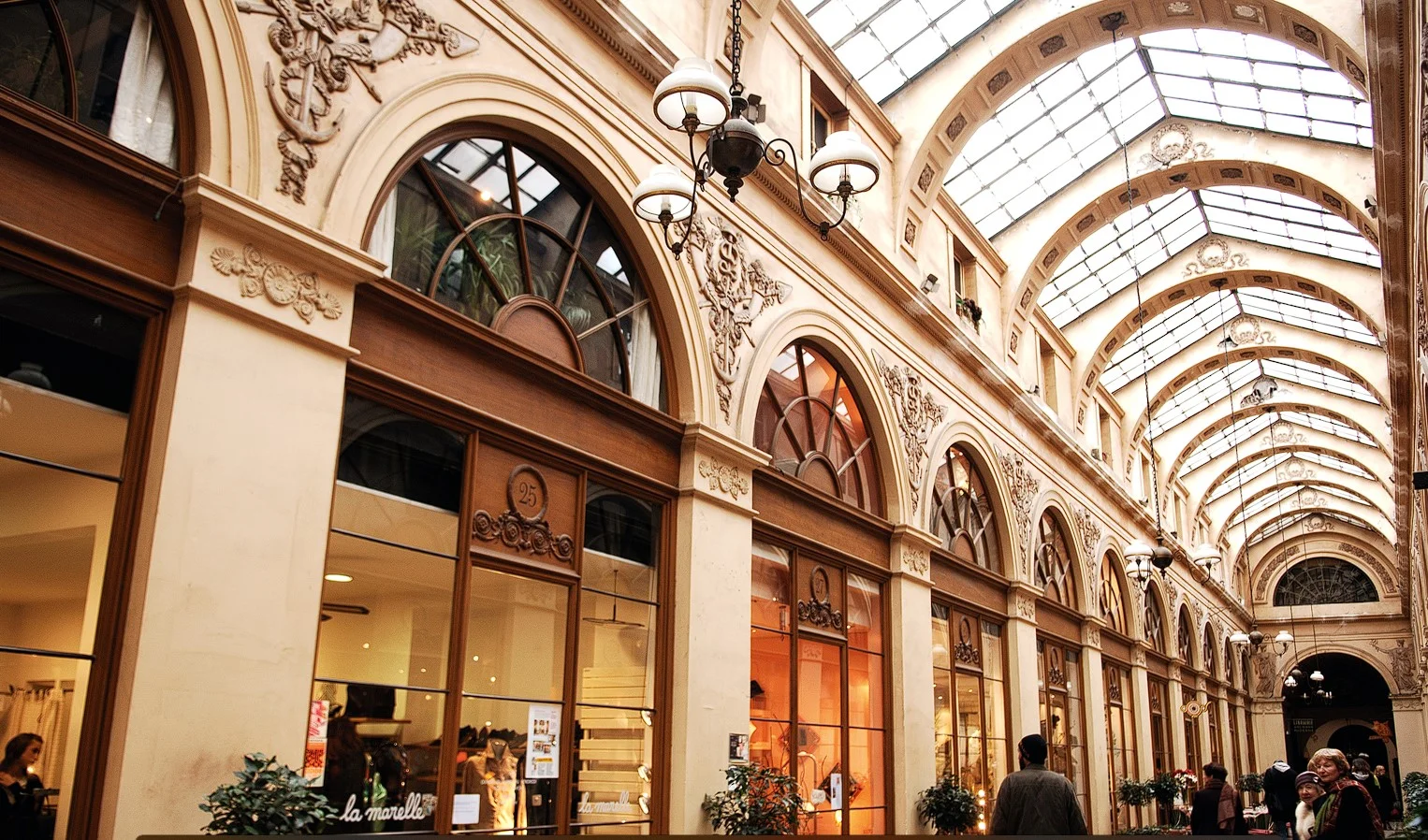
You are walking along the Grands Boulevards. The noise, the cars, the crowds. And then you push open a glass door that nothing really signals: a discreet entrance between two shops, easy to miss if you are not looking for it. One step, two steps, and the world changes. Silence falls. The light becomes that of a century-old glass roof, filtered, golden. Beneath your feet, mosaics worn smooth by two centuries of footsteps. On either side, antique shopfronts, aged woodwork, a bookshop whose door creaks. You are in a covered passage of Paris. You are in another century.
Around twenty covered passages remain in Paris. There were a hundred and fifty in the mid-19th century. They were the world’s first shopping centers, long before American malls, long before shopping galleries. And those that have survived have become something rarer and more precious than a historic monument: living, inhabited, irreplaceable fragments of the city. Places where time does not pass in the same way.
The invention of the passage: Paris before Haussmann
To understand the covered passages, you must imagine pre-Haussmann Paris. A city without sidewalks. Narrow, muddy streets, cluttered with carts, where pedestrians risked their lives at every crossing. No reliable public lighting. No umbrella yet: it was a luxury item.
The covered passages were born from this practical problem: how to allow Parisians to stroll, shop and entertain themselves sheltered from the mud, the rain and the horses. The answer appeared at the end of the 18th century: glass-covered galleries, cut through buildings, linking two streets by a protected pedestrian path, lit by gas (a revolution at the time) and lined with shops.
The first true covered passage opened in 1800: the Passage des Panoramas, in the 2nd arrondissement. The success was immediate. Within a few decades, Paris was covered with passages: they became the place to stroll, to buy, to see and be seen. Walter Benjamin, the German philosopher, would later see in them the embodiment of nascent capitalist modernity: merchandise staged, desire organized, the promenade transformed into consumption.
Then Haussmann arrived. The grand boulevards finally offered wide sidewalks, trees, space. Commerce migrated to the department stores: Le Bon Marche, Le Printemps, Galeries Lafayette. The passages declined. Many were demolished to make way for the new thoroughfares. Those that remained fell asleep, forgotten, between two eras.
Until today. For over the past fifteen years, the covered passages have been experiencing a discreet but real renaissance. Restored, reinvested by designer boutiques, restaurants and art galleries, they have become once again what they always were: places apart, suspended between past and present.
The must-see passages
Galerie Vivienne: the jewel
2nd arrondissement, between Rue Vivienne and Rue des Petits-Champs. If you can only see one covered passage in Paris, this is the one.
Built in 1823, the Galerie Vivienne is a neoclassical masterpiece. The floor is a carpet of mosaics by Giandomenico Facchina, the same artist who created the mosaics of the Opera Garnier. The fluted columns, the bas-reliefs, the caryatids, the allegorical ceiling paintings: everything breathes ambition and elegance. And the glass roof, restored in the 1990s, bathes the whole in a blonde light that changes from hour to hour.
What makes the Galerie Vivienne alive is its occupants. The Jousseaume bookshop, founded in 1826, is one of the oldest in Paris: original woodwork, rolling ladder, the scent of old paper. Nearby, a wine merchant who hosts tastings on Thursday evenings. A tea room whose tables spill out under the glass roof. A fashion designer whose boutique occupies a former haberdashery.
In the evening, when the shops close and the light from gas-style lanterns (electric, but faithful to the original design) reflects on the damp mosaics, the Galerie Vivienne is the most romantic spot in Paris. I say this without hesitation.
Passage des Panoramas: the original
2nd arrondissement, between Boulevard Montmartre and Rue Saint-Marc. The first covered passage in Paris and the first public place in the city to be lit by gas, in 1817. History is literally written into the walls.
Today, the Passage des Panoramas has become the headquarters of food lovers. Bistronomic restaurants have moved into the old shops: Gyoza Bar, Noglu (gluten-free before it was fashionable), Passage 53 (Michelin-starred for years). But the passage has kept its historic shops: the Stern engraver with its listed Art Nouveau shopfront, the stamp and antique postcard dealers, the cane and umbrella seller.
The charm of the Passage des Panoramas is its imperfection. It has not been restored with the same rigor as the Galerie Vivienne. The glass roofs are a little tarnished, the mosaics a little worn, some shopfronts are empty. But it is precisely this patina that gives it its authenticity: you can feel that this place has lived, still lives, and is not a museum.
Passage Jouffroy: the theatrical
9th arrondissement, facing the Passage des Panoramas on the other side of Boulevard Montmartre. The two face each other and you pass from one to the other by crossing the boulevard: a gesture that 19th-century Parisians made a hundred times a day.
The Passage Jouffroy is the most picturesque of the three. It houses the Musee Grevin (whose monumental entrance in stucco and gilt is worth the visit even if you do not tour the museum), a bookshop specializing in antique books, a charming hotel whose rooms overlook the glass roof, and a collection of eccentric boutiques: antique toys, walking canes, vintage posters.
The floor is checkered tile, the shopfronts are dark wood, and the glass roof casts an aquarium-like light. The atmosphere is that of a film set, and it is no coincidence that the Passage Jouffroy has served as a filming location for countless productions.
The 9th arrondissement owes much to these passages. They anchor the Grands Boulevards neighborhood in a rare heritage identity that attracts buyers who are sensitive to charm and history: exactly the profile that makes the 9th one of the rising stars of Parisian property.
Passage Verdeau: the secret one
9th arrondissement, continuing from the Passage Jouffroy. It is the third link in the chain: you can walk from the Passage des Panoramas to the Passage Verdeau by crossing two boulevards and three centuries of commercial architecture.
The Verdeau is the quietest, the most discreet of the three. And the best for treasure hunters. Antique dealers, print sellers, booksellers specializing in antique photography: it is a place for collectors and connoisseurs. On Saturday afternoons, you find gallery owners, interior decorators and art lovers leafing through 18th-century engravings in silence.
Passage du Grand-Cerf: the glass cathedral
2nd arrondissement, between Rue Saint-Denis and Rue Dussoubs. This one is different. Larger, brighter, more spectacular. Its glass roof rises to twelve meters: the highest of all Parisian passages. The effect is striking: you enter a nave of light, bordered by slender metal structures evoking the architecture of 19th-century railway stations.
The Passage du Grand-Cerf was restored in the 1990s and invested by creators and artisans: jewelers, ceramicists, furniture designers, a screen-printing workshop. It has become a living creative hub, anchored in the Montorgueil neighborhood, one of the most dynamic in Paris.
Other passages worth discovering
Paris still hides other passages that deserve a visit. The Galerie Colbert (2nd), neighbor of the Vivienne, with its spectacular neoclassical rotunda, now home to the National Institute of Art History. The Passage du Caire (2nd), the longest in Paris (370 meters), dedicated to wholesale textiles: not remotely touristy, but fascinating. The Passage Brady (10th), nicknamed “little Bombay” for its Indian and Pakistani restaurants: a guaranteed change of scenery. And the Passage Choiseul (2nd), recently restored, gradually recovering its former luster.
Jean Mascla’s advice: The best time to discover the covered passages is on a rainy day. Not out of obligation, but because that is exactly what they were invented for. The rain on the glass roof, the grey light that makes the interiors warmer, the feeling of refuge: that is when you understand why 19th-century Parisians adored them. And why Parisians in 2026 are rediscovering them.
Living near a passage: a rare charm
The covered passages are not merely heritage curiosities. They are neighborhood markers. Living on Rue Vivienne, Rue des Petits-Champs, Rue du Faubourg-Montmartre or Rue Montorgueil means living in a Paris that has kept its human scale: pedestrian or semi-pedestrian streets, local shops, neighborhood life that revolves around these galleries like around a village square.
The 2nd arrondissement, long considered a neighborhood of offices and declining passages, has undergone a remarkable transformation over the past ten years. The restored passages have attracted new shops, new restaurants, new residents. The Vivienne-Bourse sector has become one of the most dynamic micro-markets in Paris, with prices rising steadily and sustained demand.
The same phenomenon is occurring in the 9th around the Grands Boulevards. The concentration of covered passages, Panoramas, Jouffroy, Verdeau, creates a unique pedestrian ecosystem that raises the residential appeal of the area. The upper-floor apartments of buildings overlooking the passages sometimes offer views down onto the glass roofs: a rare and sought-after privilege.
This is exactly the type of property our hunters know how to identify. An apartment whose bedroom window looks onto the glass roof of the Passage Jouffroy, or whose living room overlooks the mosaics of the Galerie Vivienne: that does not appear in any listing. It is found by pushing doors, talking to caretakers, knowing the building stone by stone. It is the Paris our property hunters know: the one you will not find on Google.
If this Paris speaks to you, the one of glass roofs and mosaics, antique bookshops and designer boutiques, pedestrian streets and hidden courtyards, tell us what you are looking for. We will know exactly where to look.
To continue exploring, discover our guide to Art Nouveau architecture in Paris and our portrait of the 9th arrondissement.
Frequently asked questions
How many covered passages remain in Paris?
Around twenty covered passages survive in Paris out of the 150 that existed in the 19th century. The best preserved are concentrated in the 2nd and 9th arrondissements, around the Grands Boulevards. The most famous are Galerie Vivienne, Passage des Panoramas, Passage Jouffroy, Passage Verdeau and Passage du Grand-Cerf. Some have been recently restored and are experiencing a remarkable resurgence of interest.
Which is the most beautiful covered passage in Paris?
Galerie Vivienne (2nd arrondissement) is generally considered the most beautiful covered passage in Paris. Built in 1823, it is distinguished by its floor mosaics by Facchina, its neoclassical columns, its restored glass roof and its charming boutiques. Passage du Grand-Cerf (2nd) rivals it with its spectacular 12-metre-high glass roof, the tallest of all Parisian passages.
Does the proximity of a covered passage influence property values?
Yes. The streets adjacent to the most reputed covered passages (Galerie Vivienne, Passage des Panoramas) benefit from a heritage appeal and neighborhood life that are reflected in property prices. The Vivienne-Bourse sector in the 2nd and the Grands Boulevards area in the 9th have seen significant revaluations in recent years, driven by the revival of these iconic locations.