

Passy smells of warm croissants on Saturday mornings. This is not a figure of speech: it is what hits you as you walk up rue de l’Annonciation on market day, past the cheese stalls and the queue outside the fishmonger. The 16th arrondissement carries its reputation for bourgeois tedium like an unfair burden. Passy and La Muette tell a different story: that of a genuine village within Paris, with its habits, its regulars and its addresses passed on between neighbours.
A neighbourhood that lives: Passy from the ground
Passy has nothing in common with the postcard version of the 16th: the wide, silent avenues between Trocadero and the Porte Dauphine. Here, the streets are narrow, the shops packed side by side, and the pavements crowded at weekends. The heart beats around rue de l’Annonciation, a pedestrian street that runs down towards the Seine with a density of food shops found nowhere else in the arrondissement.
The covered market of Passy, accessible from rue Bois-le-Vent, completes the picture. You bump into regulars who have been coming for thirty years. The atmosphere is not pretentious at all: it feels closer in spirit to the marche d’Aligre than to Le Bon Marche.
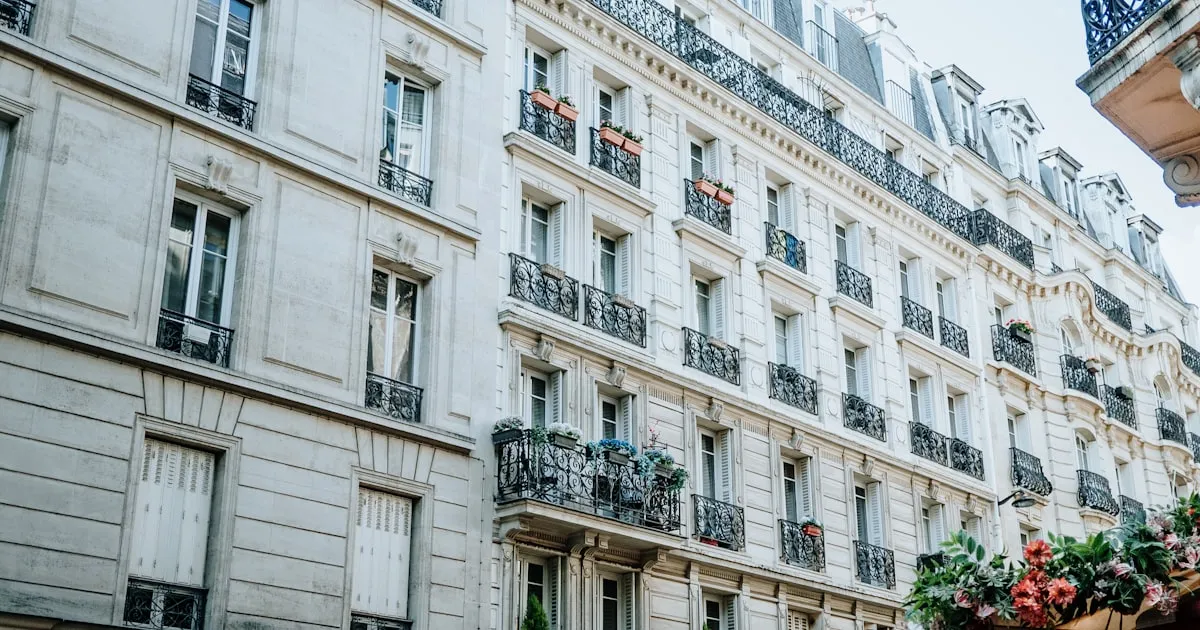
On the La Muette side, the register changes. You enter a more spacious neighbourhood, oriented towards the Ranelagh gardens and the edge of the Bois de Boulogne. The buildings are often more imposing, the entrance halls deeper, the apartments larger. La Muette is the quintessential residential 16th, but with direct access to greenery that makes all the difference for families with children.
Between the two, rue Raynouard draws a natural boundary. Above it, you are in Passy. Below, you drop towards the Seine embankments and Trocadero. It is one of the most underrated streets in the 16th: open views over the Left Bank, quality buildings, and prices that remain 10 to 15% below avenue Paul-Doumer.
Prices per sq m: what the numbers really say
The 16th arrondissement shows an average of 12,400 per sq m in 2026, but this average means nothing at the scale of Passy and La Muette. The gaps are considerable from one street to the next.
Rue de Passy, in its upper section between place de Costa Rica and the La Muette metro, trades between 12,500 and 13,500 per sq m. You pay here for commercial centrality and the immediate proximity of metro line 9. Rue de l’Annonciation, despite its undeniable charm, suffers the downside of noise and bustle: prices there are slightly lower, around 11,500 to 12,500 per sq m, especially for lower floors overlooking the street.
Around the Ranelagh and avenue Raphael, you enter another world. The bourgeois buildings from 1900-1930 show prices that flirt with 13,000 per sq m, and sometimes more for apartments with garden views. This is the most expensive sector in the area, driven by architectural quality and greenery.
The quieter streets: rue des Vignes, rue Cortambert, rue de la Cure, offer the best compromise: residential calm, well-managed condominiums, prices between 11,000 and 12,000 per sq m. This is where we often direct our family clients at Home Select, because the ratio between quality of life and price per square metre is optimal there.
For a decent 3-room apartment of 70 sq m in the area, expect between 770,000 and 950,000 euros. A family 4-room apartment of 90-100 sq m falls between 1 and 1.3 million euros depending on the floor and brightness. This is a far cry from the 1.5 million euros and above needed for the same surface area at Trocadero or avenue Victor-Hugo.
Who is it for? Buyer profiles in Passy-Muette
The dominant profile is the family with one or two children, a budget between 800,000 and 1.3 million euros, wanting to stay in Paris without giving up quality of life. The couple where one works at La Defense (metro line 9, direct) and the other in central Paris (line 6 at Trocadero) is a classic we accompany several times a year at Home Select.
We also see many international executives, particularly American and British families, attracted by the proximity of the international schools in the 16th and the Bois de Boulogne. For them, La Muette is an ideal landing point: quiet, green and well connected.
Active retirees form the third profile. They sell a suburban house for a bright 3-room apartment in Passy, with shops within walking distance and the Seine for their strolls. The covered market, the Ranelagh garden and the Trocadero cinema are enough to fill their weeks.
On the other hand, if you are looking for evening entertainment, bars or trendy restaurants, Passy is not for you. The neighbourhood goes to sleep early, and that is precisely what its residents appreciate.
The concrete advantages that make the difference
The transport network is solid without being exceptional. The La Muette metro (line 9) and the RER C (Boulainvilliers, avenue du President-Kennedy) cover the essentials. Line 6 is accessible at Trocadero, a ten-minute walk away. For those who work at La Defense, it is a direct journey on line 9 with no connection: a tangible advantage that many neighbourhoods cannot offer.
On the school front, the area is one of the best served in Paris. The college Moliere, the lycee Jean de La Fontaine and, a little further away, the lycee Janson-de-Sailly attract families from across western Paris. The nursery and primary schools in the area post results above the Parisian average.
The Bois de Boulogne is a five-minute walk from La Muette. This is no small matter: having 846 hectares of green space as your local park changes daily life, especially with children. The Ranelagh garden, more intimate, offers an ideal setting for toddlers.
The shops on rue de l’Annonciation and rue de Passy cover every need: bakeries, cheese shops, wine merchants, pharmacies, a bookshop. You can live without a car in Passy, and that is increasingly rare in the 16th.
Find out how Home Select can help you
Limitations and points to watch
Let us be frank: Passy has its drawbacks, and it is better to know them before signing.
Older condominiums are a real issue. Many buildings date from the late 19th or early 20th century, and facade restoration, lift upgrades or roof repairs can represent significant levies. We have seen condominiums vote through works costing 15,000 to 20,000 euros per unit over three years. Always request the minutes of the last three general meetings and the building maintenance log before making any offer.
The lack of nightlife is real. After 9pm, the streets are quiet: too quiet for some. Restaurants close early, bars can be counted on one hand. If you are 30 and you enjoy going out, you will feel like you are living in a sleepy provincial town.
Some apartments suffer from significant overlooking in the narrow streets of Passy. Interior courtyards, often dark, are the classic trap of the neighbourhood. A street-facing apartment on rue de l’Annonciation will be bright but noisy; a courtyard-facing apartment will be quiet but dark. The ideal compromise: a high floor on a courtyard side in a condominium with a wide courtyard, is rare and hard to negotiate.
Finally, parking is a chronic nightmare. Underground car parks are rare and expensive (between 30,000 and 50,000 euros to buy). If you have a car, factor this cost into your overall budget.
The potential: what is changing in Passy
The extension of metro line 10, planned for around 2030, should improve transport links from southern Passy to the Left Bank. This is a medium-term value driver that savvy investors are already factoring into their calculations.
The redevelopment of the Seine embankments on the 16th arrondissement side is progressing gradually, transforming the promenade between the Pont de Bir-Hakeim and the Pont de Grenelle. This improvement in the living environment directly benefits addresses in the lower part of Passy, around rue des Eaux and avenue du President-Kennedy.
The Passy property market held up better than the 16th arrondissement average during the 2023-2024 correction. Prices fell by 3 to 5% while the rest of the arrondissement lost 7 to 10%. This is a sign of the strength of demand in this micro-neighbourhood: families who want Passy do not want Auteuil or Trocadero. They want Passy, and they wait for a property to come up.
Our reading of the neighbourhood
At Home Select, we accompany between 15 and 20 families in the 16th arrondissement each year, and Passy-Muette accounts for half of those mandates. What we observe on the ground confirms the numbers: the stock of family-sized properties (3 rooms and above) is chronically insufficient. A well-located, bright 4-room apartment in a fine building sells in under two weeks if correctly priced.
Our advantage as property hunters in this area lies in our knowledge of the caretakers, managing agents and local network. Many transactions in Passy happen off-market or as previews: sellers prefer discretion. Across our 1,200 mandates completed since 2011, the 16th remains one of our most active arrondissements, with an average negotiation margin of 6% obtained for our clients.
Passy is a neighbourhood of conviction. You do not arrive there by chance; you choose it for what it offers: a village within Paris, greenery within reach, and a quality of life that never fades. If your budget allows and your priority is everyday quality of living, it is one of the best choices in the 16th, and one of the most underrated.
For more on the 16th arrondissement, read our complete guide to the 16th arrondissement. If you are looking for the best neighbourhood for your family, our article on the best arrondissement in Paris for families will help you compare. And for an overview of the most pleasant neighbourhoods to live in, discover our ranking of the most beautiful neighbourhoods in Paris.
Frequently asked questions
What is the average price per sq m in Passy in 2026?
Prices in Passy range between 11,000 and 13,000 per sq m depending on the street and floor level. The most sought-after streets such as rue Raynouard or upper rue de Passy reach 13,500 per sq m, while quieter streets towards Ranelagh remain around 11,500 per sq m.
Is Passy suitable for families with children?
Passy is one of the best choices in the 16th for families. The neighbourhood has several reputable schools (Moliere, Jean de La Fontaine, Janson-de-Sailly nearby), squares, the Ranelagh gardens and a full range of shops along rue de l'Annonciation.
What is the difference between Passy and La Muette?
Passy is more commercial and lively, centred around rue de l'Annonciation and the covered market. La Muette is more residential, oriented towards the Ranelagh gardens and the Bois de Boulogne, with often grander buildings and slightly higher prices.
Do you need a property hunter to buy in Passy?
The Passy market is tight for family-sized properties: bright 3 and 4-room apartments sell very quickly. A property hunter who knows the micro-market can access properties before they go online and negotiate with the right references.