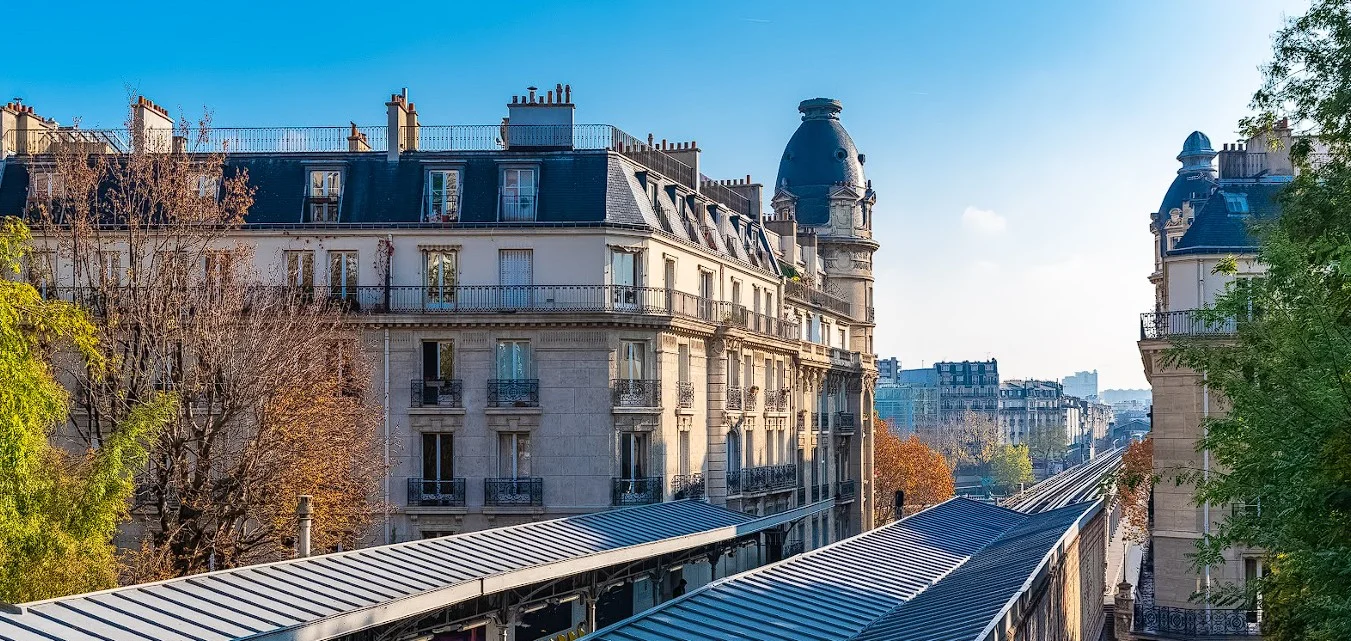


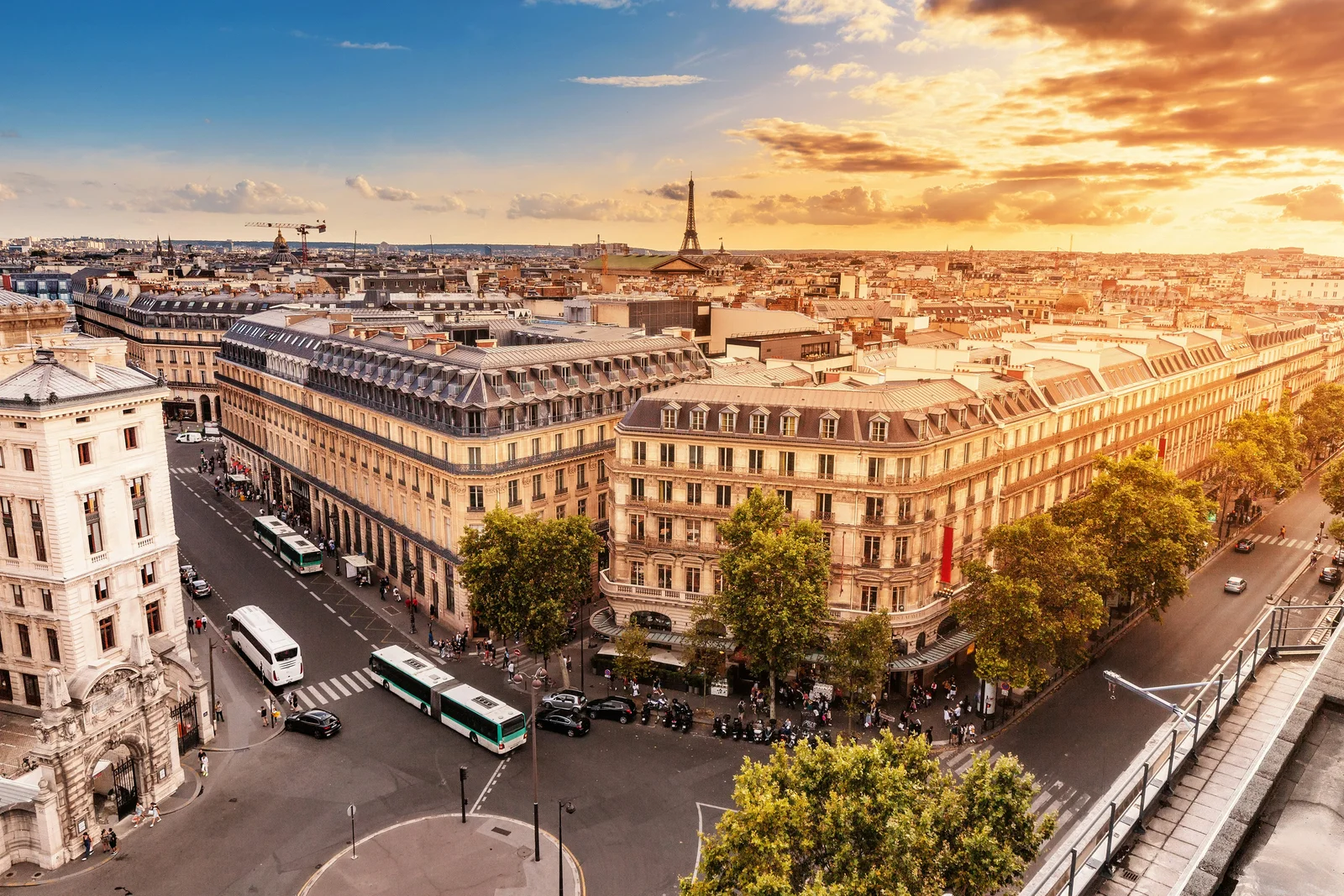
There is a moment, when you walk through Paris, where the light does something particular to the stone. It is late afternoon, usually. The limestone catches a golden tone, somewhere between honey and champagne, and the continuous balconies trace perfectly parallel lines of shadow across five or six storeys of pale stone. You look up. You think: this city is a theatre set, except people actually live in it.
That is what Haussmann is. Not a style, not an era. A way of making a city. And after fifteen years of pushing open carriage porches, climbing polished wooden staircases, assessing the condition of cornices and the light streaming through transom windows, I can state one thing with certainty: Haussmann is not a Parisian cliche. It is the very DNA of Paris. Sixty per cent of our mandates at Home Select involve Haussmann apartments. And there is a reason: nothing else produces that particular emotion.
Haussmann, the man who invented Paris
Let us start at the beginning. Or rather with the man, because his name is spoken fifty times a day in Parisian property without anyone truly knowing who he was.
Georges-Eugene Haussmann was not an architect. He was the Prefect of the Seine, an administrator, an executor of imperial will. When Napoleon III appointed him in 1853, Paris was a medieval city. Dark alleys, insalubrious buildings, cholera epidemics, a virtually non-existent sewer network. The Emperor wanted a modern capital to rival London. He gave Haussmann free rein.
What followed was the largest urban construction project in European history. In seventeen years, from 1853 to 1870, Haussmann drove boulevards through the medieval fabric, created monumental perspectives, installed water and sanitation networks, planted thousands of trees, built railway stations, markets and parks. And above all, he imposed an architectural specification of absolute rigour on every building constructed along the new roads.
This is where the Haussmann style was born. Not from an artist’s whim, but from a standard. From a regulation. And it is precisely this collective discipline that produces the extraordinary harmony of Parisian streets. Each architect worked within a strict framework: alignment of cornices, floor heights, rhythm of openings, but had freedom in ornamental detail. The result: kilometres of facades that respond to each other without repeating. A unity in diversity that no city in the world has managed to reproduce at this scale.
The codes of Haussmann: what the facade tells you
A Haussmann building reads like a musical score. Every element has a meaning, a function, a rank in the social hierarchy of the building. Here is how to decipher what you see when you look up.
Ashlar stone: the king of materials
The Haussmann facade is built from limestone ashlar, quarried in Ile-de-France: Saint-Maximin, Chantilly, sometimes Burgundy for the most prestigious buildings. Not painted plaster, not render: real stone, cut and assembled block by block. It is this Lutetian limestone that gives Paris its distinctive colour, that creamy white that shifts to gold depending on the light.
The finest Haussmann buildings use dressed stone, large perfectly joined blocks, on the noble floors, and more common stone on the upper floors. A trained eye spots the difference at first glance. It is one of the first signs we check at Home Select when evaluating a building’s quality.
The noble floor: the second floor
In a classic Haussmann building, the second floor is the noble floor. It offers the highest ceilings (often 3.20 metres, sometimes 3.50 metres), the most ornate continuous balcony, and the largest apartments. In the 19th century, this was the floor of the upper bourgeoisie, high enough to escape street noise but not so high as to suffer the stair climb (the lift would not arrive until the 1890s-1900s).
The hierarchy reads from bottom to top. The mezzanine, with low ceilings, housed shops and service quarters. The first floor, decent but still close to the street, accommodated the middle bourgeoisie. The second: the upper bourgeoisie. The third and fourth: still noble apartments but with progressively lower ceilings. The fifth, with its continuous balcony (the second on the facade), marked the limit of bourgeois comfort. And the sixth, under the zinc eaves: the servants’ quarters.
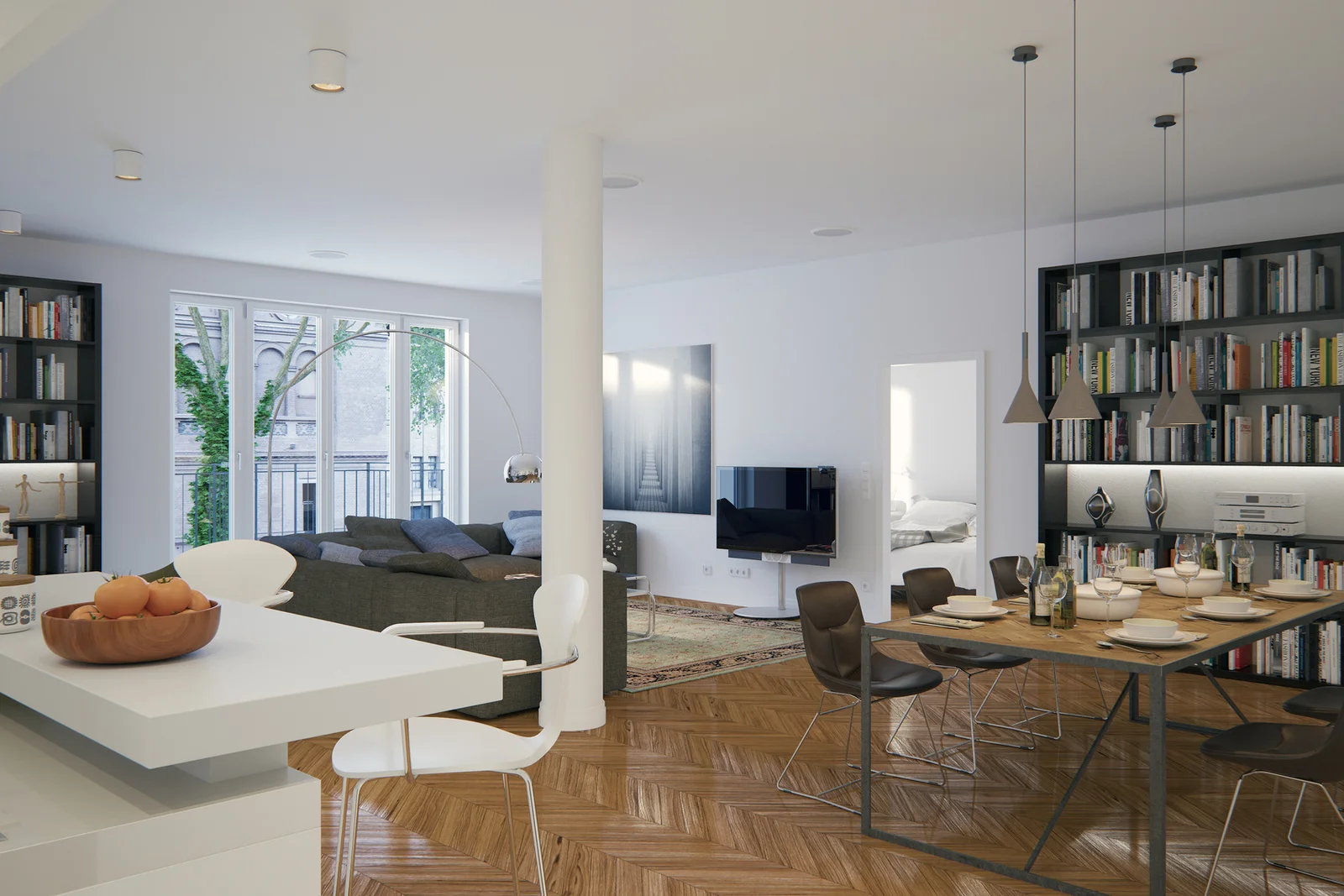
In 2026, this hierarchy has partly been inverted. Top floors with views and light have become the most sought-after, provided there is a lift. But the second floor has lost none of its prestige. A ceiling height of 3.20 metres, original mouldings, a marble fireplace, herringbone parquet: this is the Haussmann experience in its quintessence.
Continuous balconies: the visual signature
Two rows of continuous balconies. That is the signature. The first on the second floor, the second on the fifth. These balconies run the full width of the facade, from one party wall to the other, creating the horizontal line so characteristic of the Parisian landscape. The wrought-iron railings are works in their own right: scrollwork, interlacing, plant motifs, sometimes the initials of the original owner.
The intermediate floors have individual balconettes, more discreet, that punctuate the facade without breaking its horizontal continuity. The ensemble composes a visual rhythm of extraordinary elegance: horizontal (cornices, continuous balconies), vertical (tall windows, pilasters), and the modular repetition from one building to the next creates the urban perspective that makes certain Parisian boulevards masterpieces of town planning.
The zinc roof: the fifth wall of Paris
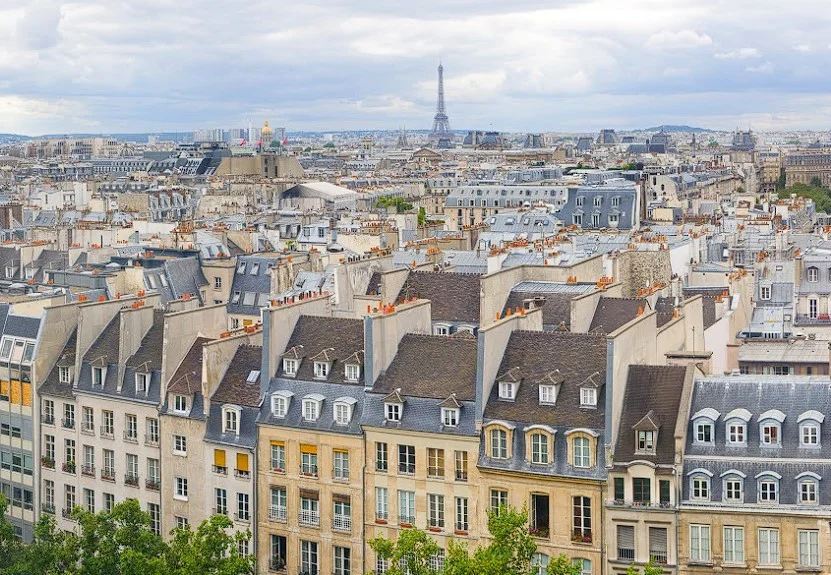
The rooftops of Paris are a subject in their own right, and we have devoted a dedicated article to them. But in the Haussmann context, the zinc mansard roof at 45 degrees is an essential component of the architectural vocabulary. The brisis (the near-vertical lower section) houses the former servants’ rooms, punctuated by stone or zinc dormer windows. The terrasson (the nearly flat upper section) is covered in zinc, the grey-blue metal that has become the other symbol of Paris.
These attics, once reserved for domestic staff, are today the most exciting hunting ground on the Parisian market. Combined, renovated, fitted with glass roofs, the former sixth floors become loft-style apartments under the rooftops with breathtaking views. A niche market where a property hunter makes all the difference, because these properties never pass through conventional channels.
The inner courtyard: the hidden lung
You cannot see it from the street, but it is there. The inner courtyard is a fundamental element of the Haussmann building, both functional (ventilation, light for rear rooms) and social (circulation space, access to shared areas). The finest courtyards are cobbled, planted with a tree or flower bed, sometimes adorned with a fountain.
A detail that escapes the uninitiated: the quality of the courtyard is a reliable indicator of the building’s quality. A handsome staircase, a well-kept concierge lodge, brass letter boxes, a black-and-white chequered floor: all of this tells the story and standing of a building far better than any listing.
Haussmann and post-Haussmann: the distinction that matters
Here is a subtlety that few people know, including some estate agents: not all “Haussmann” buildings are actually Haussmann.
True Haussmann dates from the Haussmann period: 1853-1870. These buildings are the most restrained, the most rigorous. Strictly aligned facades, contained ornamentation, perfect symmetry. It is the Second Empire aesthetic at its most disciplined.
Post-Haussmann covers the period from approximately 1880 to 1910. After the fall of Napoleon III and the Commune, construction resumed under the Third Republic, but with revised urban planning regulations in 1882 and then 1902. These new rules allowed greater height, more projection (bow windows, oriels), and more decorative freedom. Facades became more exuberant: caryatids, atlantes, mascarons, ceramics, Art Nouveau ironwork.
The two eras coexist harmoniously in the Parisian landscape, but a connoisseur distinguishes them at first glance. And on the market, the difference has an impact: post-Haussmann, with its often even higher ceilings and more spectacular decorations, can command a premium over strict Haussmann in the same location.
Jean Mascla’s advice: When you visit a “Haussmann” apartment, look at the construction date on the title deed or in the technical survey. A building from 1865 and one from 1905 do not have the same structure, the same features, or the same heritage value. Our property hunters systematically check this point before every viewing.
The boulevards and streets: where to see the finest Haussmann buildings
You could write an entire book on this subject. In the meantime, here are the addresses I recommend to anyone who wants to understand Haussmann at its finest.
Boulevard Saint-Germain (6th-7th)
The most literary of the Haussmann boulevards. Driven through between 1855 and 1877, it crosses the Left Bank from east to west, from Pont de Sully to Pont de la Concorde. The most spectacular section runs between Carrefour de l’Odeon and Rue du Bac: facades of impeccable regularity, ground-floor shops that have preserved their period frontages, and that particular Left Bank light that skims the facades in late afternoon.
Apartments facing Boulevard Saint-Germain are among the most sought-after on the Parisian market. This is the heart of the 6th arrondissement, between Saint-Germain-des-Pres and the Luxembourg. Prices regularly exceed 16,000 euros/m2 for a property in good condition on the noble floor.
Boulevard Haussmann (8th-9th)
The boulevard that bears his name. And one of the finest examples of Haussmann perspective on a grand scale. From the Madeleine to the Republique, it is a parade of monumental facades: those of the great department stores (Printemps, Galeries Lafayette, with their spectacular domes), but also residential buildings that rank among the most imposing in the capital.
The stretch between Boulevard des Italiens and Rue de Rome, in the 9th arrondissement, is particularly remarkable. This is where Haussmann reaches a form of austere majesty: seven-storey facades, cornices at dizzying height, stone main staircases with wrought-iron bannisters.
Avenue Kleber (16th)
If the 8th is ceremonial Haussmann, the 16th is residential Haussmann par excellence. Avenue Kleber, descending from the Etoile to the Trocadero, features some of the finest bourgeois buildings in Paris. Wide pavements, aligned plane trees, impeccably maintained ashlar facades. Here, Haussmann is calm, affluent, almost secretive.
Apartments on Avenue Kleber are spacious, 150 to 300 m2 is not unusual, with enfilades of reception rooms, herringbone parquet, and marble fireplaces in every room. This is family Haussmann, the Haussmann of large families and Sunday dinners.
Rue de Rivoli (1st-4th)
The ancestor. Rue de Rivoli, in its western section (between the Concorde and the Louvre), predates Haussmann: it dates from Napoleon I, designed by Percier and Fontaine from 1802. But it laid the foundations for what Haussmann would systematise fifty years later: aligned arcades, regular facades, uniformity without monotony.
The eastern section of Rue de Rivoli, extended by Haussmann to the Hotel de Ville, is a masterclass in Haussmann urbanism applied to an existing medieval fabric. The perspective when you stand at the level of the Louvre and look east is simply striking.
The Plaine Monceau (8th-17th)
The best-kept secret of Parisian Haussmann. Around Parc Monceau, in a triangle between the Boulevards de Courcelles, Malesherbes and Haussmann, there is an exceptional concentration of spectacular post-Haussmann buildings. This is where the Third Republic bourgeoisie built their most sumptuous residences: sculpted stone facades, bow windows, loggias, decorative ceramics.
Boulevard Malesherbes, Rue de Prony, Rue Murillo: these addresses appear in no tourist guide, yet they contain some of the finest buildings in Paris. And apartments whose proportions defy the imagination: 50 m2 salons, rotunda entrance halls, spiral service staircases.
Jean Mascla’s advice: The Plaine Monceau is an area where the off-market is particularly active. Owners of these large family apartments often prefer a discreet sale. This is precisely the type of property that a property hunter can uncover through their network: opportunities that will never appear on SeLoger or Le Bon Coin.
Haussmann in detail: what makes the difference
Beyond the facades, it is inside that Haussmann reveals its full richness. Here are the features that distinguish an exceptional Haussmann apartment from an ordinary one.
The parquet
Point de Hongrie, Versailles, baton rompu: each pattern has its era and its pedigree. Point de Hongrie (chevrons at 45 degrees) is the most common in fine Haussmann apartments. Versailles parquet (large square panels with a geometric pattern) is reserved for the most prestigious buildings. The wood species also matters: solid oak is standard, but some exceptional apartments feature walnut or cherry.
An original parquet in good condition is a considerable selling point. Its restoration (sanding, sealing) costs between 40 and 80 euros/m2. Replacing it with new parquet of equivalent quality: 150 to 250 euros/m2. The economic difference is significant, and the aesthetic difference even more so: 150-year-old parquet has a patina and depth of tone that no new wood can reproduce.
Mouldings and cornices
Ceiling mouldings are the calling card of a Haussmann apartment. Staff cornices (a plaster and fibre mix), central ceiling roses for chandeliers, decorative friezes: the vocabulary is rich and hierarchical. The more complex and high-relief the mouldings, the more noble the apartment.
An apartment whose mouldings have been removed (a crime of the 1960s-1970s, when the fashion was for “clean lines”) loses a significant part of its charm and value. The good news: mouldings can be replicated by a plasterer, but the cost is substantial, around 80 to 150 euros per linear metre of restored cornice.
Fireplaces
Carrara marble for the noble reception rooms, black or red marble for the bedrooms, stone for the service rooms. Each Haussmann fireplace tells the rank of the room it occupies. The finest feature sculpted mantels, trumeau mirrors, and solid marble shelves.
Even when sealed (most are), fireplaces remain major heritage features. Removing them is rarely a good idea: they are often load-bearing and their disappearance disrupts the room’s proportions.
Ceiling heights
This is perhaps the most irreplaceable luxury of a Haussmann apartment: vertical space. A 3.20-metre ceiling changes everything. Light circulates differently. Room proportions become generous. You breathe. No modern construction offers this height as standard: current norms run around 2.50 metres.
On the market, ceiling height is directly correlated with price. An apartment with 3.50-metre ceilings (the noble floor of a grand Haussmann building) can trade at 15 to 20% more than an identical apartment in surface area but with 2.70 metres of height on the upper floors of the same building.
Haussmann on the market: what the numbers say
Haussmann represents approximately 60% of the housing stock in the central arrondissements of Paris (1st to 9th, 16th, 17th). That is how dominant it is on the market. But not all Haussmann apartments are equal, and the price differences are considerable.
In 2026, price ranges for a Haussmann apartment in good condition sit between 10,000 and 18,000 euros/m2, based on three main criteria: location (the arrondissement, the street, the orientation), floor level (noble floor vs. upper floors), and state of preservation (original mouldings, parquet, fireplaces). The “Haussmann premium” compared to an equivalent property in a 1960s or 1970s building in the same neighbourhood is estimated at 10 to 20%.
The rarest properties, a noble floor with continuous balcony, original mouldings and parquet, dual aspect, in an ashlar stone building on a grand boulevard in the 8th or 7th, reach prices limited only by the imagination of buyers. And these properties do not stay on the market long. Most sell off-market, privately, between connoisseurs.
Haussmann represents 60% of our mandates at Home Select, and that is no coincidence. Our sixteen property hunters spend their days walking through these buildings, assessing structural quality, negotiating with sellers who know the value of their property. This heritage is not bought on a whim. It is earned. And that is precisely why a property hunter changes the equation.
Living in a Haussmann building: daily life behind the decor
It would be dishonest to discuss Haussmann without addressing the realities of daily life. Because living in a 150-year-old building also means working around certain constraints.
Co-ownership
Haussmann buildings are managed as co-ownerships, and charges can be significant: maintenance of common areas, facade renovation (mandatory every 10 years in Paris, and an ashlar facade is expensive to restore), collective oil or gas heating, concierge service. A complete facade renovation of a six-storey Haussmann building can cost between 200,000 and 500,000 euros, divided among co-owners in proportion to their shares.
Energy rating
The elephant in the room. Haussmann buildings, despite their thick stone walls (which offer interesting thermal inertia), are often rated E, F or G on the energy performance diagnostic. Original single-glazed windows, uninsulated attics, outdated collective heating: all of this weighs on the rating. The question of energy renovation for Haussmann buildings is a burning issue, particularly as the law is progressively banning the rental of thermal sieves.
But there is a silver lining: properties with a poor energy rating offer opportunities for negotiation. An experienced property hunter knows how to exploit this lever to secure significant discounts, sometimes 5 to 10% off the listed price.
Noise
A Haussmann building on a boulevard is a noisy building. Wooden floors transmit impact sound, original windows provide poor noise insulation from the street. Courtyard-facing apartments are quieter, but often darker. The choice between street and courtyard is a fundamental trade-off in any Haussmann purchase, a topic our property hunters address systematically from the very first conversation with a client.
Why Haussmann still fascinates
I will close with a personal conviction, forged over fifteen years of accompanying buyers through these buildings.
Haussmann fascinates because it embodies an idea of the city that has stood the test of time. An idea of elegant density, of organised collective living, of shared beauty. When you walk along a Haussmann boulevard, you are participating in an urban project conceived one hundred and seventy years ago that still works. The proportions are right. The perspectives are beautiful. The stone ages with grace.
In an era when global metropolises stack interchangeable glass towers, Paris remains the exception: a city where everyday architecture is heritage. Where the building you live in tells a story. Where the carriage porch, the stone staircase, the creaking parquet floor beneath your feet connect you to one hundred and fifty years of Parisian history.
That is why buyers from around the world dream of a Haussmann apartment. And that is why we, as property hunters, never tire of searching for them.
If you are looking for your Haussmann apartment, the right building, the right floor, the right neighbourhood, tell us about your project. Our sixteen property hunters know these buildings by heart. They can distinguish fine stone from tired stone, original parquet from a copy, the real noble floor from a pretender. And they have access to properties you will not find anywhere else.
Enjoyed this article? Also discover our complete guide to the Haussmann apartment and our selection of the best neighbourhoods in Paris for living.
Frequently asked questions
How do you recognise a genuine Haussmann building in Paris?
A genuine Haussmann building (constructed between 1853 and 1870) is recognisable by its limestone ashlar facade, continuous balconies on the 2nd and 5th floors, decreasing ceiling heights from the 1st to the 6th floor, an inner courtyard, and a zinc roof at 45 degrees. The facade follows strict street alignment and features a symmetrical composition with cornices and mouldings. Post-Haussmann buildings (1880-1910) adopt these codes with greater decorative freedom.
What is the average price of a Haussmann apartment in Paris in 2026?
In 2026, a Haussmann apartment in Paris trades between 10,000 and 18,000 euros/m2 depending on the arrondissement, floor level and condition. The most sought-after addresses (6th, 7th, 8th arrondissements) regularly exceed 15,000 euros/m2 for properties in good condition on the noble floor. The 'Haussmann premium' represents 10 to 20% more than an equivalent property in a modern building in the same neighbourhood.
Which arrondissements in Paris have the most Haussmann buildings?
The most densely Haussmann arrondissements are the 8th (around Boulevard Haussmann and Avenue de Friedland), the 9th (Grands Boulevards, Nouvelle Athenes), the 16th (Avenue Kleber, Victor Hugo), the 17th (Plaine Monceau) and the 6th (Boulevard Saint-Germain). The 7th and 1st also have very fine examples, particularly along Rue de Rivoli and around the Invalides.