

In Paris, any stone building with balconies and mouldings is often labelled “Haussmannian.” In reality, there are marked differences between the strict Haussmannian style (1853-1870) and the post-Haussmannian (1870-1914). Knowing how to distinguish them allows you to better evaluate a property and understand what you are buying.
Strict Haussmannian: 1853-1870
Buildings constructed under Prefect Haussmann’s administration followed precise regulations. The facade is in cut limestone, the floors are aligned on the street, and the height is capped according to the street width. Continuous balconies are required on the 2nd and 5th floors. The roof is in zinc, mansard-style.
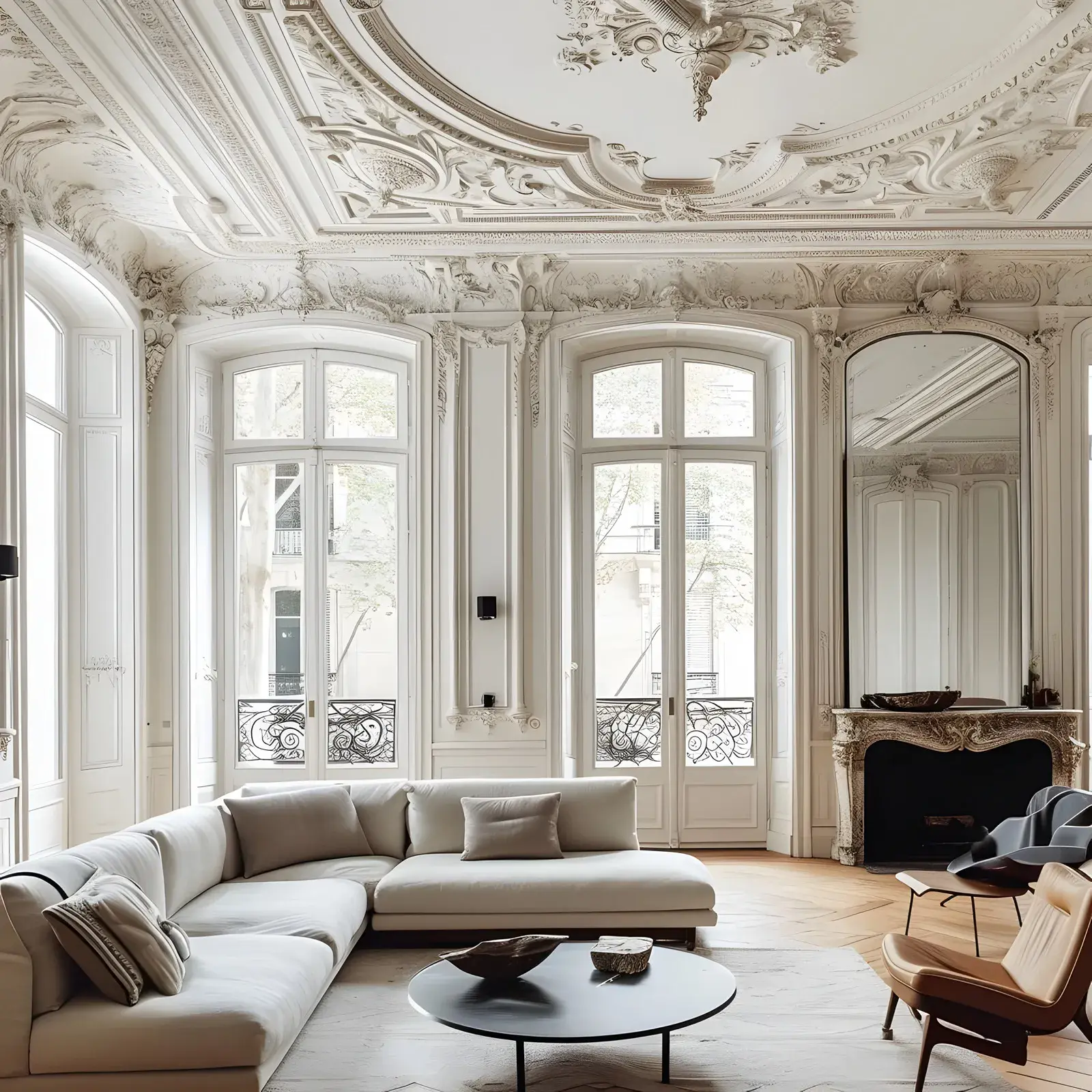
Inside, the noble floor (2nd floor) offers the highest ceilings (3 to 3.20 metres), the largest rooms and the most elaborate ornamentation: mouldings, ceiling rosettes, marble fireplaces. The upper floors see ceilings progressively lower. There is no lift.
The aesthetic is sober and geometric. No whimsy in the ironwork (repetitive motifs), no colour on the facade, no projections (bow windows). Uniformity is the rule.
Post-Haussmannian: 1870-1914
After Haussmann’s fall in 1870, urban planning regulations evolved. Builders retained the height and alignment principles but freed themselves from the imposed sobriety. This was the era of architectural eclecticism, then Art Nouveau.
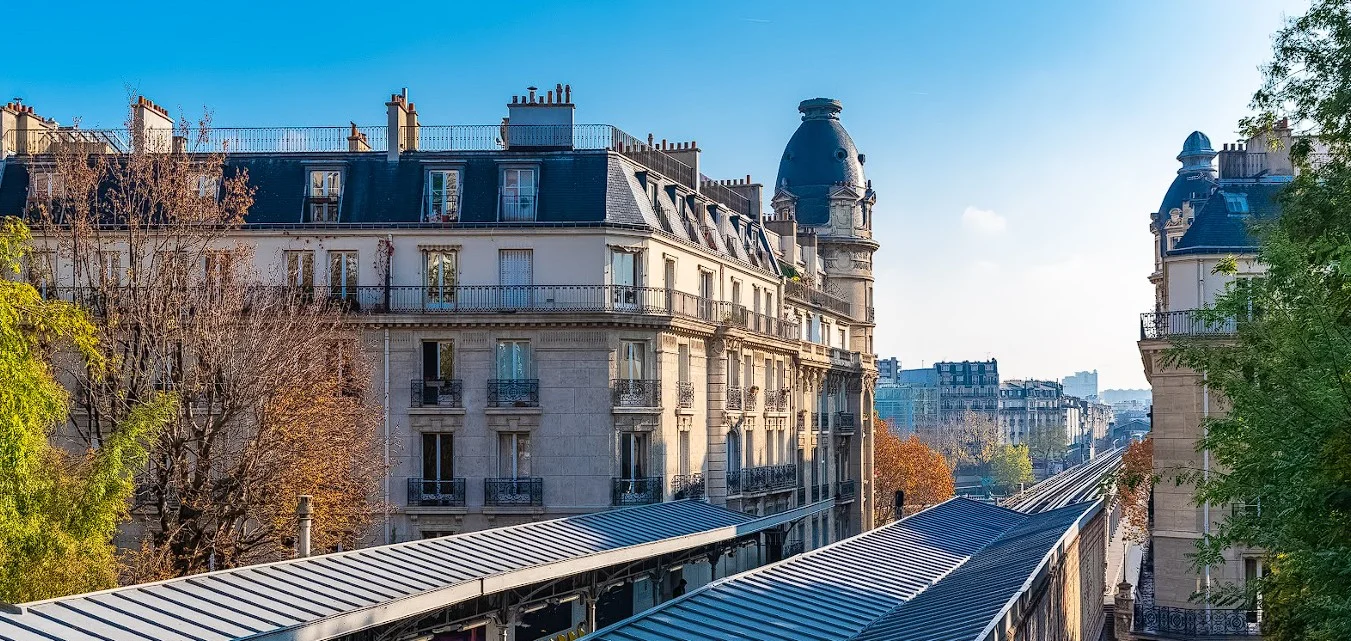
Facades became more elaborate: bow windows (projecting windows), loggias, wrought-iron balconies with plant motifs, coloured ceramics, exposed brick combined with stone. Buildings gained personality and diversity.
Inside, technical innovations appeared: the first hydraulic lifts (from 1880), central heating, integrated bathrooms. Floor plans evolved with more compact reception rooms but better designed water rooms and circulation spaces.
The concrete differences for a buyer
The facade
A strict Haussmannian building presents a uniform stone facade, sober, with balconies on the 2nd and 5th floors only. A post-Haussmannian building offers more depth: bow windows, loggias, sculpted or ceramic decor, balconies on multiple floors.
The common areas
Strict Haussmannian has a massive stone staircase, often monumental, with no lift. Post-Haussmannian frequently has an original lift (small, often added within the stairwell) and stained glass in the common areas.
The interior
Haussmannian offers more generous volumes (especially on the noble floor) but sometimes awkward layouts (rooms in a line). Post-Haussmannian offers more functional layouts, with better designed circulation and water rooms integrated from the outset.
The ceilings
Haussmannian: 3 to 3.20 metres on the noble floor, decreasing on upper floors. Post-Haussmannian: 2.80 to 3 metres more consistently across all floors.
Art Nouveau: late post-Haussmannian (1895-1910)
The last post-Haussmannian buildings, constructed between 1895 and 1910, incorporate Art Nouveau elements: organic ironwork (vine and flower motifs), stained glass, glazed ceramics on facades, sculpted entrances. The finest examples are found in the 16th arrondissement (rue de la Fontaine, buildings by Guimard) and the 7th arrondissement.
These buildings are among the most sought-after on the Parisian market for their unique character. Each building is different, in contrast to Haussmannian uniformity.
Impact on the property market
The term “Haussmannian” is used loosely in property listings. An estate agent will often describe a “beautiful Haussmannian” that is actually post-Haussmannian, or even a 1920s building that borrows its codes.
For a buyer, the distinction matters: a true strict Haussmannian often offers superior quality of stone and construction, but without a lift and with constraining layouts. A post-Haussmannian offers more modern comfort while preserving the charm of high ceilings and mouldings.
Our property hunters can identify these differences during viewings and advise buyers on the true value for money of a property, beyond the “Haussmannian” label in the listing. Our guide to the Haussmannian apartment details these characteristics in depth.
Are you looking for an authentic Haussmannian or post-Haussmannian apartment? Contact our team for on-the-ground expertise.
Frequently asked questions
Is a building from 1900 Haussmannian or post-Haussmannian?
A building from 1900 is post-Haussmannian. The strict Haussmannian style corresponds to buildings constructed between 1853 and 1870 under Prefect Haussmann. The post-Haussmannian period (1870-1914) retained the height and alignment codes but broke free in ornamentation, with the appearance of bow windows, ceramics and Art Nouveau ironwork.
Which is more expensive, Haussmannian or post-Haussmannian?
At equivalent location and surface area, prices are comparable. Strict Haussmannian (2nd floor noble, continuous balcony, high ceilings) often commands a premium, but some post-Haussmannian buildings offer superior features: original lifts, luminous bow windows, decorative wall ceramics. The building's condition and co-ownership management weigh more than the exact period.
How can you verify the construction date of a Parisian building?
Three reliable sources: the online cadastre (cadastre.gouv.fr), the City of Paris archives (building permits), and the mandatory renovation plaques on facades. A property hunter can also identify the period by architectural details: mouldings, ironwork, type of stone.