





In brief
In Paris, the neighbourhood market is a reliable property indicator of an area's vitality. In 2026, flats near rue Cler (7th) sell at 13,000 to 15,000 euros/sqm with a 5 to 8% premium tied to the market's proximity, those around the Raspail bio market (6th) reach 14,000 to 16,000 euros/sqm, while the surroundings of the Marché d'Aligre (12th), one of the last working-class markets within the city, sit around 9,800 to 10,500 euros/sqm. The Marché des Enfants Rouges (3rd), created in 1615, remains the oldest covered market in the capital. Home Select advises visiting the market on a Sunday morning before buying, a method applied since 2011.
Key takeaways
- Visiting the neighbourhood market on Sunday morning reveals more about an area than ten flat viewings
- Rue Cler (7th) flats sell at a 5 to 8% premium over streets further from the market
- The Marché des Enfants Rouges (3rd) is the oldest covered market in Paris, created in 1615
- A quality market signals a vibrant neighbourhood, which supports property prices long term
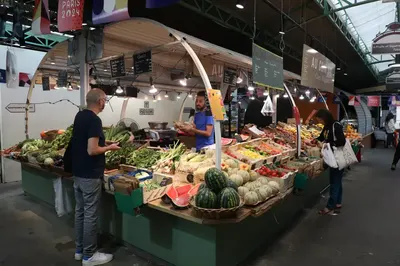
Six o’clock in the morning, Place d’Aligre. The greengrocers unfold their stalls, stack crates of tomatoes, hang bunches of aromatic herbs. The smell of coffee escapes from Le Baron Rouge, on the corner of rue Théophile-Roussel. In an hour, the square will be thronging: families with pushchairs, retirees with their checked shopping bags, restaurateurs choosing their vegetables for the day. The market is the pulse of a neighbourhood, and for a property hunter it is a more reliable gauge than any price barometer.
Why visit the market before buying in a neighbourhood?
Because a market says everything a property listing does not: who lives there, for how long, and whether people live their neighbourhood or merely sleep in it. A good market signals a living neighbourhood, and a living neighbourhood holds its prices even when the property market slows.
When Home Select’s property hunters advise a buyer on choosing a neighbourhood, they therefore ask a question that often surprises the buyer: “Have you been to the market on a Sunday morning?” The answer is almost always no.
A market says everything that a property listing does not. It tells you who lives in the neighbourhood, not in statistics, but in flesh and blood. It tells you whether the neighbourhood is family-oriented, cosmopolitan, ageing, gentrified. It tells you whether the traders have been established for twenty years or change every season. It tells you whether the residents are loyal to their neighbourhood or merely sleep there.
A good market signals a living neighbourhood, and a living neighbourhood is a safe bet in property. The correlation is not magical, it is logical. Neighbourhoods where people do their shopping on foot, know their fishmonger, bump into each other on Sunday morning, are neighbourhoods where people want to stay. And neighbourhoods where people want to stay are those where prices hold, even when the property market slows down.
Rue Cler: what is the chicest market in Paris worth?
A concentration of high-end food shops over 300 metres, from Tuesday to Sunday, in the 7th arrondissement. Flats on rue Cler and the adjacent streets sell for 13,000 to 15,000 euros/sqm, a premium of 5 to 8% over streets further away.
The rue Cler is not strictly an open-air market. It is a pedestrianised shopping street whose stalls spill onto the pavement from Tuesday to Sunday. But the effect is the same: a concentration of food shops of exceptional quality over 300 metres.
Fromagerie, fishmonger, bakery, charcuterie, greengrocer: every shop on rue Cler displays a level of quality that reflects the neighbourhood’s clientele. Prices are high, the products impeccable, the service attentive. You encounter diplomats on weekends, families from the bourgeoisie of the 7th, and American tourists photographing the cheese displays with religious devotion.
Flats on rue Cler and the adjacent streets (rue de Grenelle, rue Saint-Dominique) sell between 13,000 and 15,000 euros/m², at the upper end of the 7th. Market proximity is an explicit selling point in listings, and the premium compared to streets further away is real, in the order of 5 to 8%.
The typical buyer profile on rue Cler: a couple in their 50s-60s, often senior executives or professionals, seeking a neighbourhood where everything can be done on foot within a 200-metre radius.
Aligre: what does the most authentic market look like?
Like a loud, working-class market: keenly priced stalls on the square, the covered Beauvau market, and a permanent flea market along rue d’Aligre. Around it, prices reach 9,800 to 10,500 euros/sqm, against an arrondissement average of 9,400 euros/sqm.
The Marché d’Aligre, in the 12th arrondissement, is the opposite of rue Cler. No polished standing here: fruit and vegetable stalls at tight prices on the square, a covered market (the Beauvau) with its butchers and cheese makers, and a permanent flea market along rue d’Aligre.
The atmosphere is working-class, noisy, joyful. The greengrocers shout out prices, customers bargain, children run between the crates. It is the Paris of the middle classes, of families who watch their spending, of old-timers who have been coming here for forty years.
The 12th arrondissement has average prices of 9,400 euros/m2, among the most reasonable in inner Paris. Around the Marché d’Aligre, prices are slightly above average (9,800 to 10,500 euros/m2), pulled upward by the attractiveness of the Aligre-Bastille quarter.
The typical profile: thirty- and forty-somethings, often in creative industries or tech, with one or two children, wanting to live in a “real” neighbourhood without paying the price of the neighbouring Marais.
Raspail bio: which neighbourhood does this Sunday market reveal?
The 6th arrondissement, twenty-first-century version: publishers, psychoanalysts and French-American families, in a relaxed and discreetly affluent atmosphere. Flats around the Boulevard Raspail sell for 14,000 to 16,000 euros/sqm, a level the market does not push up but does make irreplaceable.
Every Sunday, the Boulevard Raspail between the rue du Cherche-Midi and the rue de Rennes hosts the most famous organic market in Paris. The stalls offer forgotten vegetables, sourdough breads, farmhouse goat’s cheeses, cold-pressed juices: all at prices that would make an Aligre greengrocer pale.
The Marché Raspail bio is a concentrate of the sociology of the 6th arrondissement, 21st-century version: publishers in Breton-stripe jumpers, psychoanalysts in Birkenstocks, Franco-American families with Yoyo pushchairs. The atmosphere is relaxed, cultured, discreetly affluent.
Flats around the Boulevard Raspail sell between 14,000 and 16,000 euros/m², the heart of the 6th arrondissement. The Sunday market is more of a lifestyle argument than a price one: it does not push up prices (which are already at the ceiling), but it contributes to making the neighbourhood irreplaceable for those who live there.
Batignolles: why do young families settle here?
For the space, the village life around the organic market on rue Lemercier and the Martin-Luther-King park next door. Prices of 10,000 to 11,000 euros/sqm around the market place the quarter between the bourgeois western 17th and the working-class northern 18th.
The Batignolles organic market, on the rue Lemercier in the 17th, is the Right Bank counterpart of the Raspail. Smaller, more intimate, more family-oriented, it attracts residents of the Batignolles-Epinettes quarter every Saturday morning.
The stalls are laid out over a few hundred metres, between 19th-century faubourg buildings. The atmosphere is that of a village: the traders know the children’s first names, neighbours catch up over a coffee, dogs wait patiently tied to barriers.
The Batignolles neighbourhood is on the rise. Prices (10,000 to 11,000 euros/m² around the market) reflect a positioning between the bourgeois western 17th and the working-class northern 18th. It is one of the areas where Home Select accompanies the most young families: buyers looking for space, neighbourhood life and proximity to Martin-Luther-King park.
Bastille: what does the biggest market in Paris reveal?
More than 100 stalls over 600 metres along the Boulevard Richard-Lenoir, every Thursday and Sunday morning, from Metro Bastille to Metro Breguet-Sabin. It is the largest open-air market in the capital, and an exact reflection of the 11th arrondissement.
The scale is impressive, but the atmosphere remains convivial. The Marché Bastille is a reflection of its neighbourhood, the 11th arrondissement: diverse, animated, slightly chaotic, fundamentally friendly. You find everything here: from the organic grower to the halal butcher, from the Breton fishmonger to the Lebanese caterer.
Flats on the Boulevard Richard-Lenoir, on the even-numbered side (overlooking the market and the promenade trees), sell between 10,000 and 11,000 euros/m². That is a good indicator for the 11th, an arrondissement at 10,200 euros/m² on average, in steady rise.
Discover how Home Select can support you
Enfants Rouges: is the oldest market in Paris worth a visit?
Yes, but on a weekday. Created in 1615, this covered market in the 3rd arrondissement has become a gathering of food stalls from around the world, so crowded at weekends that it feels closer to a food court than to a neighbourhood market.
The Marché des Enfants Rouges, on rue de Bretagne, is the oldest covered market in Paris still in operation. It survived Haussmann’s transformations, several closure threats and a complete renovation in the early 2000s.
Today, the Enfants Rouges is an atypical market: rather than a traditional food market, it is a gathering of food stalls from around the world, Japanese, Moroccan, Italian, Caribbean, where people come to have lunch as much as to do their shopping. The queue in front of the couscous stand has become a tourist landmark.
The downside: the Marché des Enfants Rouges has become an attraction. On weekends, the queue spills out onto rue de Bretagne, and the atmosphere is more that of a food court than a neighbourhood market. Residents of the Haut-Marais frequent it mainly during the week, when the crowd is more manageable.
Prices around the market are those of the 3rd arrondissement: 12,800 euros/m² on average, with peaks at 14,000 euros/m² for the finest properties on rue de Bretagne.
Which other Paris markets are worth a detour?
Paris has 82 food markets, 69 open-air and 13 covered. Three stand out: Président-Wilson in the 16th for its standing, Montorgueil in the 2nd for its pedestrian street, and Belleville in the 20th for its cosmopolitanism.
Each tells a different story.
The Marché President-Wilson (16th), along the avenue of the same name between Trocadéro and Alma, is a market of standing that reflects the affluent sociology of the area. The greengrocers offer fruit and vegetables of exceptional quality, the florists compete with spectacular arrangements. Flats on the Avenue du President-Wilson sell for over 14,000 euros/m².
The rue Montorgueil market (2nd) is not a market in the strict sense, but a pedestrianised shopping street that functions as one. Between the Bourse and Les Halles, this medieval thoroughfare lines up fishmongers, cheese makers, bakers and caterers over 500 metres. Property prices in the area (12,000 to 13,000 euros/m²) reflect the dynamism of this food micro-economy.
The Marché de Belleville (20th), along the Boulevard de Belleville every Tuesday and Friday, is the most cosmopolitan market in Paris. North African spices, Asian vegetables, African fabrics: it is a journey in itself. Property prices in the 20th arrondissement (8,400 euros/m2) make it one of the last affordable areas in Paris, and the Marché de Belleville contributes by maintaining an intense neighbourhood life.
When should you visit a neighbourhood before buying?
On a Sunday morning, between 9 and 11 o’clock, when the market is in full swing. Not a Tuesday afternoon, not a Friday evening: in one hour on the spot you will learn more about a neighbourhood than in ten flat viewings.
This is the advice Home Select gives to every client who hesitates between two neighbourhoods.
Walk the streets, observe the passers-by, step into the bakery, have a coffee at the counter of the nearest bar. Listen to the conversations, look at the shop windows, count the pushchairs.
It is one of the most valuable lessons Home Select has drawn from fifteen years of property hunting: the ideal flat in the wrong neighbourhood is a bad purchase. You choose a neighbourhood on foot, not on a screen, and the Sunday morning market tells you more than anything else.
The flat viewing checklist developed by Home Select includes this step: visit the neighbourhood at different times and different days of the week. It is an investment of time that, in Home Select’s view, is well worth the hours spent comparing listings online. The ranking of the best neighbourhoods in Paris can serve as a starting point, but nothing replaces the sensory experience of a Sunday morning at the market.
Frequently asked questions
01 Why visit the neighbourhood market before buying a flat in Paris?
The market reveals the real sociology of a neighbourhood: the profile of residents, their purchasing power, the dominant atmosphere. It is a more reliable indicator than a property listing for understanding daily life in an area.
02 What are the most reputed markets in Paris?
The rue Cler market (7th) for its standing, the Marché d'Aligre (12th) for its authenticity, the Marché Raspail bio (6th) for its bobo-chic clientele, and the Marché des Batignolles bio (17th) for its family atmosphere are among the most reputed.
03 Does the neighbourhood market influence property prices?
Indirectly, yes. A good market signals a vibrant, attractive neighbourhood, which supports prices. The shopping streets around markets tend to be more expensive than purely residential streets in the same area.
04 What is the oldest covered market in Paris?
The Marché des Enfants Rouges, in the 3rd arrondissement, is the oldest covered market in Paris still in operation. Created in 1615, it survived Haussmann's transformations and today hosts a mix of food stalls from around the world.