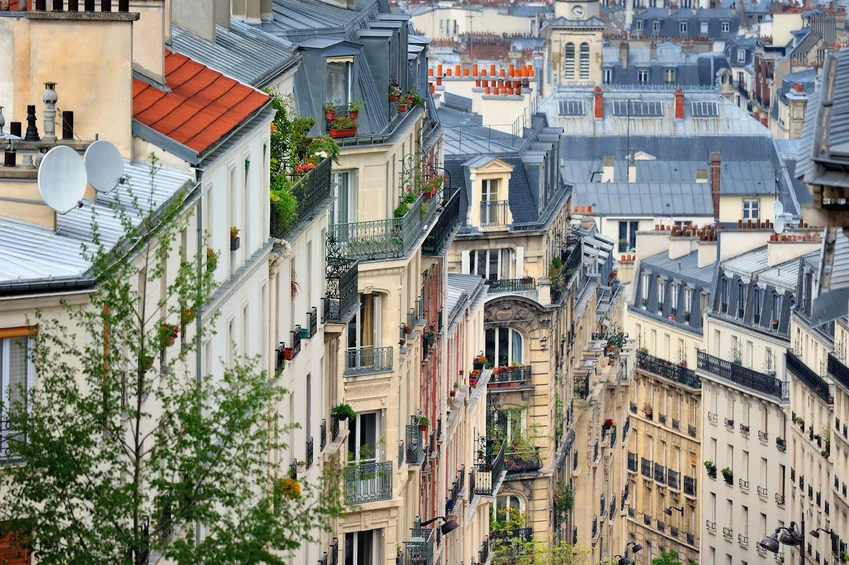


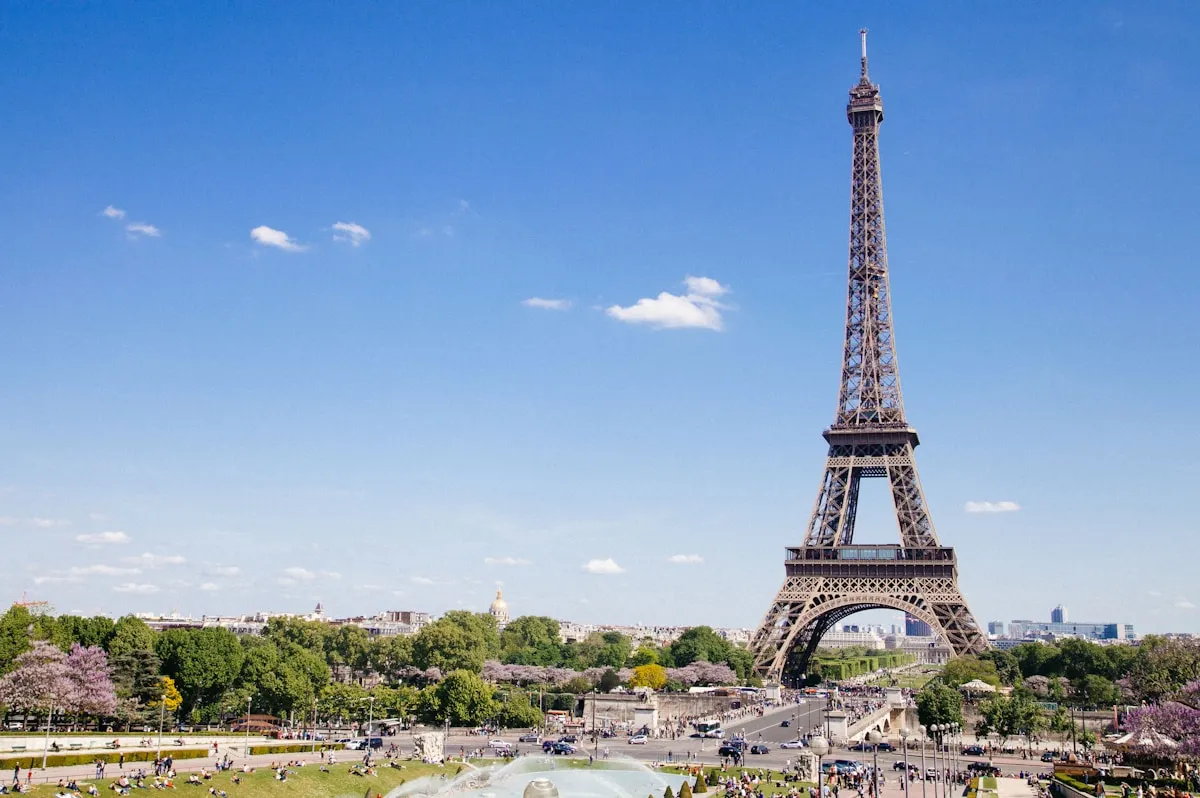
There is a moment at dawn when the zinc rooftops of Paris catch the first rays and reflect an almost liquid light. From the sixth floor of a Haussmannian building on Rue de l’Universite, the Eiffel Tower stands out, still dark, against a sky shifting from pearl gray to pink. This spectacle, which thousands of Parisians observe every morning from their windows, is one of the most sought-after privileges on the Parisian property market.
The view: a criterion that transforms prices
In Paris, two identical apartments, same surface area, same floor, same condition, can show a price gap of 15 to 25% depending on what you see when you open the window. This is not a whim: the view is a real estate asset in its own right, impossible to reproduce, impossible to relocate.
The premium varies depending on the nature of the panorama. An open view over zinc rooftops, without any identifiable monument, already adds 8 to 12% to a property’s value. As soon as the Eiffel Tower appears in the frame, even partially, even at an angle, the premium rises to 15-20%. And for head-on views, framed like a postcard, prices soar beyond 25%. We have assisted buyers in the 7th arrondissement who agreed to pay 14,500 euros/sqm for an 80 sqm apartment on the 6th floor with an Eiffel Tower view, while comparable properties without a view were selling around 11,800 euros/sqm on the same street.
What makes the view so valuable is its structural rarity. Paris is a low-rise city, Haussmannian buildings top out at 6 or 7 floors, and it is dense. Perspectives are rare, open views even more so. When an apartment offers a panorama, it typically owes it to its position in the city: a street corner, a square, a crossroads, proximity to a public garden or the Seine.
Eiffel Tower: the holy grail of Parisian views
The Eiffel Tower view is the most prized on the Parisian market. It must be earned: you need to be in a precise perimeter, on a high enough floor, and oriented in the right direction.
The best addresses are concentrated in the 7th arrondissement, more precisely along an axis from Rue de l’Universite to the Champ-de-Mars. Rue de l’Universite, between Rue du Bac and Rue de Bellechasse, offers striking perspectives from the upper floors: the Tower appears at the end of the street, framed by ashlar stone facades. Avenue de Suffren, on the odd-numbered side, provides head-on views from the higher floors. Avenue de La Bourdonnais, more discreet, conceals a few gems on the 6th and 7th floors.
But Eiffel Tower views are not limited to the 7th. From the 16th arrondissement, Avenue du President-Kennedy, Rue Raynouard, Place du Trocadero, the panorama is spectacular, often wider, with the Seine in the foreground. Prices are sometimes more accessible than across the river: expect around 12,400 euros/sqm on average in the 16th, compared to 14,200 euros/sqm in the 7th. From the Montmartre hill in the 18th, some apartments on Rue Lepic or Rue Caulaincourt offer distant views of the Eiffel Tower above the sea of zinc, at significantly lower prices, around 9,200 euros/sqm.
Our property hunters know every building, every orientation, every floor likely to offer this view. It is meticulous reconnaissance work, accumulated over more than 1,200 mandates since 2011. When a property with an Eiffel Tower view becomes available, it disappears within days, often before even appearing on listing portals.
Sacre-Coeur: the romantic view
The Sacre-Coeur is visible from far away. Its white silhouette, perched on the Butte Montmartre, appears from dozens of Parisian streets. But seeing it from afar and truly seeing it are two different things.
The best perspectives on the Sacre-Coeur are found in the 9th and 10th arrondissements. Rue La Fayette, in its upper section, offers a magnificent alignment with the basilica as the vanishing point. Rue des Martyrs, narrower, more intimate, frames the monument between its colorful facades. From Square d’Anvers or Rue de Steinkerque, you see it in majesty, but apartments overlooking these addresses are rare and highly sought-after.
The “Sacre-Coeur view” premium is more modest than the Eiffel Tower’s, in the range of 10 to 15%, but it applies to neighborhoods where base prices are more affordable. An apartment with a Sacre-Coeur view in the 9th arrondissement (10,800 euros/sqm on average) remains significantly cheaper than an equivalent with an Eiffel Tower view in the 7th.
Zinc rooftops: the quintessential Parisian panorama
The most typically Parisian view is not of a monument. It is of the rooftops. That blue-gray expanse of zinc and slate, punctuated by brick chimneys and antennas, undulating to the horizon. It is the view you discover when pushing open the mansard window of a top floor, the view that inspired Gustave Caillebotte and the humanist photographers.
The central arrondissements, the 1st, 2nd, 3rd, and 4th, offer the densest perspectives over the rooftops. From a 6th floor in the Marais, you take in an ocean of zinc stretching to the towers of La Defense. From the Latin Quarter, your gaze carries to the bell towers of Saint-Sulpice and Saint-Germain-des-Pres. From Belleville, you overlook all of eastern Paris.
The premium for an open view over the rooftops, without any particular monument but with a sweeping panorama, ranges between 8 and 12%. It is less spectacular than an Eiffel Tower view, but it is a daily pleasure that our property hunters warmly recommend: an apartment with a terrace or balcony offering this panorama takes on considerable sentimental value for its occupants.
The Seine and its quays: living by the water
The Seine offers a double advantage: the view over the water and a guaranteed open aspect. No building will ever block the perspective of an apartment overlooking the river.
Quai Voltaire, in the 7th, is one of the most prestigious addresses in Paris. From its windows, you contemplate the Louvre, the Pont des Arts, the Pont-Neuf. Prices regularly exceed 16,000 euros/sqm. Quai d’Orleans, on the Ile Saint-Louis, offers a view of the apse of Notre-Dame that has no equivalent, but apartments there change hands once per generation, rarely more.
On the Right Bank, Quai de Bethune (Ile Saint-Louis) and Quai des Celestins (4th arrondissement) provide perspectives over the Seine and the Left Bank facades. Further west, Quai de Passy (16th) and Quai Louis-Bleriot offer broad views over the river and the Eiffel Tower in the distance.
The “Seine view” premium is comparable to the Eiffel Tower view: +20 to 30% for a direct first-row view over the river. But beware: the quays are also traffic arteries. Road noise, barges, fire truck sirens from the Cite fire station: all of this is part of daily life. An experienced property hunter always checks the actual noise level before recommending a quayside property.
Find out how Home Select can help you
The floor: a decisive criterion
In Paris, the view begins on the 5th floor. Below that, except in special cases (street corner, garden opposite, square), you see only the buildings across the way. This is a reality that many buyers discover during their first viewings: a 3rd floor in the 7th arrondissement often looks onto a courtyard or the gray facade of the neighboring building, four meters away.
The 5th floor is the threshold: you start to rise above the roofs of lower buildings and see sky. The 6th floor is the Haussmannian ideal: it is the floor with continuous balconies, where the view truly opens up. The 7th floor, often under the eaves, sometimes offers the most spectacular panoramas, but at the cost of a sloped roof that reduces living space.
Post-Haussmannian buildings, taller (8 to 10 floors with elevator), allow you to dominate the roofline. In the 15th arrondissement, some residential towers from the 1970s offer 360-degree views over Paris, at incomparably lower prices than the 7th or 16th. A 65 sqm apartment on the 12th floor of a Front de Seine tower, with panoramic views, can be found around 9,600 euros/sqm. The same panorama in a upscale building in the 7th would cost double.
Streets that offer the best perspectives
Paris is a city of perspectives. Its great Haussmannian thoroughfares were designed for the eye as much as for traffic. Some streets offer remarkable views that few Parisians suspect.
Rue de Rivoli, in its western section, frames the Arc de Triomphe at the end of a long alignment. Rue Soufflot, in the 5th, offers a framed view of the Pantheon from the Jardin du Luxembourg: the apartments overlooking this perspective are among the most expensive in the neighborhood. Avenue de l’Opera, cut by Haussmann to link the Louvre to the Opera Garnier, offers one of the finest architectural alignments in the capital.
But the finest surprises are found on side streets. Rue de Verneuil, in the 7th, offers glimpses of the Saint-Germain rooftops from its upper floors. Rue Cremieux, in the 12th, the most colorful street in Paris, is an open-air film set, even if the view from the windows remains modest. Rue de l’Abbaye, in the 6th, overlooks Place Furstenberg and one of the most photographed corners of Paris.
Our property hunters catalog these addresses: every street, every number, every floor is noted in our accumulated field knowledge since 2011. When a client tells us they want “a view,” we know exactly where to look, and at what price.
The threatened view: what nobody tells you
A view can be contemplated, but it cannot be owned. This is the great fragility of this real estate asset: a building permit, an elevation, an urban project can radically change an apartment’s panorama.
Paris strictly regulates building heights through the Plan Local d’Urbanisme (PLU). But building elevations, permitted under certain conditions since the ALUR law of 2014, can add one or two floors to a neighboring building and block a previously open view. Elevation projects are filed at the arrondissement town hall and are available for consultation: this is a reflex we systematically adopt before validating a property for a client.
The price of apartments with outdoor spaces is all the higher when the view is guaranteed: a balcony overlooking a public garden or the Seine offers a perspective that nothing will ever obstruct. This is a long-term valuation argument that we integrate into our recommendations.
Neighborhoods in transition carry the most risk. The ZAC Paris Rive Gauche (13th), the Batignolles (17th), the Bercy-Charenton area (12th): in these zones, the urban landscape evolves rapidly. A clear panorama today can become a direct vis-a-vis in five years. The ranking of the most beautiful neighborhoods in Paris takes this visual stability into account: the historic central neighborhoods offer a guarantee that developing neighborhoods cannot.
The role of the property hunter when it comes to views
When a buyer places the view among their priority criteria, the search becomes considerably more complex. It is not enough to filter by floor on a listing portal: you need to know the orientations, the open aspects, the heights of neighboring buildings, the projects underway.
Our 16 property hunters cover Paris daily and have done so for more than fourteen years. This field knowledge is irreplaceable. We know that at number 12 on street X, the 6th floor offers an open view to the south, but the 5th is obstructed by the corner building. We know that a certain building on Quai de la Tournelle loses its Notre-Dame view if you are on the courtyard side rather than the quay side. No listing mentions these details.
The ranking of the most expensive streets in Paris confirms what we observe in the field: the most valued addresses are almost always those that offer a perspective, an open aspect, a view. Ashlar stone and moldings matter, but it is the light coming through the window, and what you see through it, that makes the difference between an apartment and a home.
Frequently asked questions
What is the price premium for an apartment with an Eiffel Tower view in Paris?
An apartment with a direct view of the Eiffel Tower commands a premium of 15 to 25% compared to an equivalent property without a view in the same building. For a lateral or partial view, expect 8 to 12%.
From which floor can you expect a beautiful view in Paris?
As a general rule, you should aim for at least the 5th floor to rise above the roofline. The ideal is the 6th or 7th floor, where the view truly opens up over monuments and distant perspectives.
Can an unobstructed view be threatened by new construction?
Yes, a building permit, an elevation of a neighboring building, or an urban planning project can alter a view. A property hunter systematically checks filed permits and the local urban plan before recommending a property for its view.
Which streets offer the best views of Paris monuments?
Rue de l'Universite and Avenue de Suffren for the Eiffel Tower, Quai de Bethune for Notre-Dame, Rue Lepic for the Sacre-Coeur, and the Left Bank quays for the panorama of the Marais rooftops.