
In brief
Paris has more than 200 performance venues, from the Opera Garnier (opened in 1875) to Le Grand Rex, the largest cinema in Europe with 2,700 seats. The Comedie-Francaise, founded in 1680, is the oldest active theatre company in the world, and the half-price kiosks at La Madeleine and Montparnasse offer same-day tickets at 50% off. In 2026, the cultural density of a neighbourhood remains correlated with its property value, a criterion that Home Select property hunters factor into their reading of areas such as Opera, Chatelet and Bastille.
Key takeaways
- Paris has more than 200 performance venues, from intimate pocket theatres to the 2,700-seat Opera Bastille
- The Comedie-Francaise, founded in 1680, is the oldest active theatre company in the world
- Half-price ticket kiosks at Place de la Madeleine and Montparnasse offer same-day tickets at 50% off
- The cultural density of a neighbourhood is correlated with higher property values in Paris
- Home Select, a property hunter in Paris since 2011, covers the 20 arrondissements and 68 Ile-de-France municipalities with 16 hunters.
Paris has more than 200 performance venues, from intimate pocket theatres to the Opéra Garnier. This density of culture is one of the hallmarks of Paris quality of life. Here are the essential venues, their history and the neighbourhoods around them.
What is the Olympia and how many seats does it have?
The Olympia is a 2,000-seat music hall at 28 boulevard des Capucines, in the 9th arrondissement, the one that is home to the Palais Garnier. It was founded in 1888 by Joseph Oller, the creator of the Moulin Rouge.
Its standing pit puts the audience unusually close to the performers. Édith Piaf, Jacques Brel, the Beatles, Jeff Buckley: the list of artists who have made history here is staggering.
Its iconic red letters on the facade are one of the visual landmarks of boulevard des Capucines. The neighbourhood (Opéra, Madeleine) is one of the most central in Paris, with property prices between 11,000 and 14,000 euros/sqm.
Why is the Opera Garnier as much a monument as a venue?
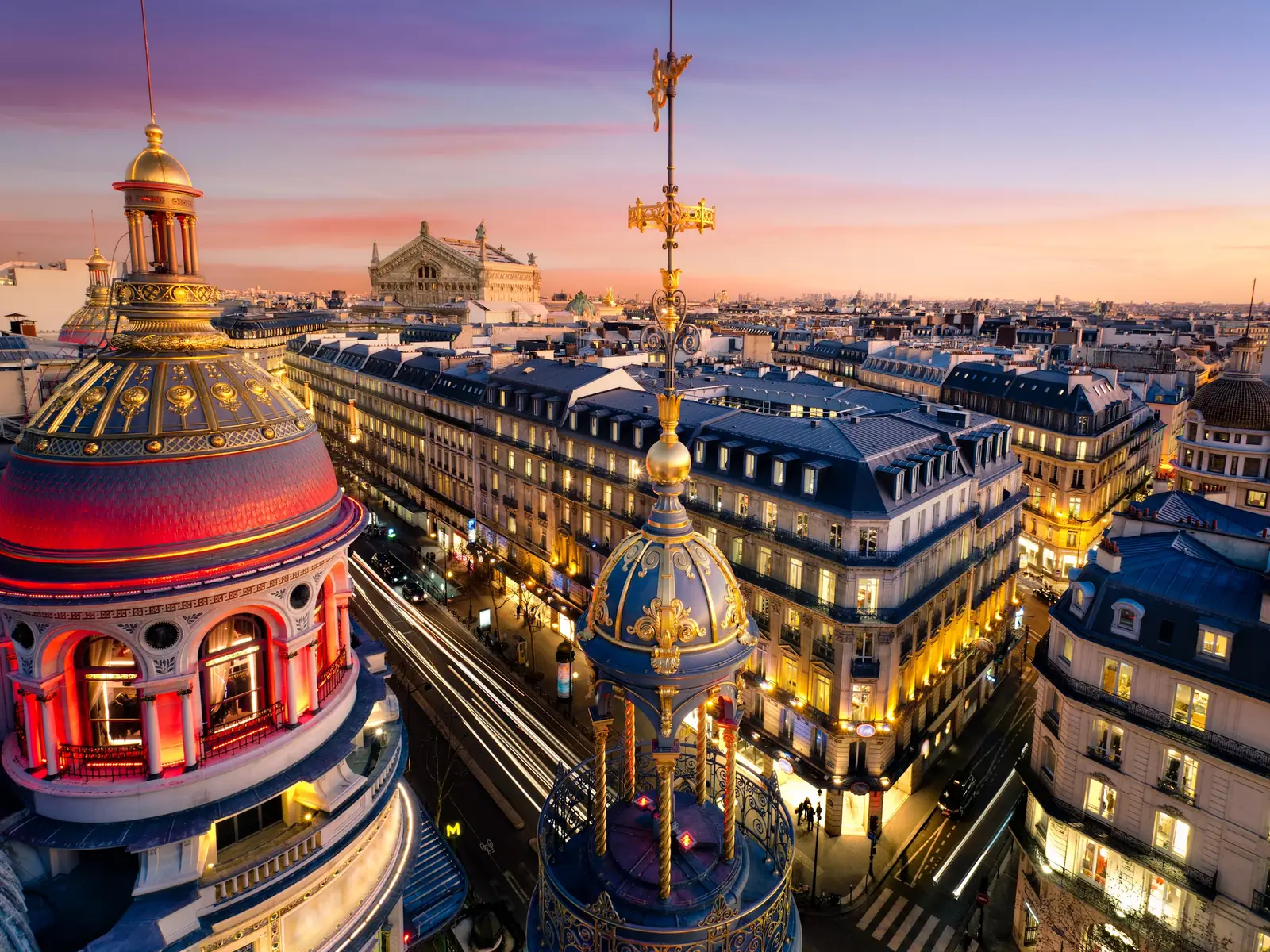
Opened in 1875, the Palais Garnier combines a grand marble staircase, a ceiling painted by Chagall in its 2,000-seat auditorium and an underground lake, the one that inspired The Phantom of the Opera. Those three features make it a building you visit as much as a place you see a show, widely considered one of the most beautiful opera houses in the world.
The programme alternates between ballet and opera.
The Opéra neighbourhood, straddling the 9th and 2nd arrondissements, gathers the grand department stores (Galeries Lafayette, Printemps) and some of the most imposing Haussmann buildings in Paris.
What is the largest theatre in Paris?
The Théâtre du Châtelet, with 2,500 seats, is the largest theatre in Paris. It stands on the Place du Châtelet in the 1st arrondissement, facing the Seine, and has staged musicals, operas and symphonic concerts since it was built in 1862.
Its recent renovation modernised the facilities while preserving the Second Empire decor.
What makes the Bouffes-du-Nord so unusual?
The Bouffes-du-Nord, in the 10th arrondissement, are known for their deliberately raw, patinated walls, their 500 seats and the absence of a stage curtain, which creates a rare intimacy. The venue became legendary under Peter Brook’s direction, from 1974 to 2010.
The programme blends theatre, music and contemporary dance.
What is the largest cinema in Europe?
Le Grand Rex, on boulevard Poissonnière in the 2nd arrondissement, is the largest cinema in Europe: 2,700 seats in its Grande Salle alone. Its Art Deco decor from 1932, starlit ceiling and special events (premieres, festivals, Christmas water shows) make it a one-of-a-kind venue.
Backstage guided tours run year-round.
What does the Casino de Paris stage today?
The Casino de Paris, on rue de Clichy in the 9th, now stages concerts, comedy and musicals in a 1,500-seat auditorium with lavish decor, renovated in the 1990s. Founded in 1730, this historic music hall hosted Mistinguett, Maurice Chevalier and Joséphine Baker.
How does the Opera Bastille differ from the Opera Garnier?
The Opéra Bastille is the modern house of the Opéra National de Paris: 2,700 seats against 2,000 at the Palais Garnier, opened in 1989 and designed by the architect Carlos Ott. It is where the major lyric productions are staged, while the older, smaller Palais Garnier alternates between ballet and opera.
The Bastille neighbourhood, at the crossroads of the 11th, 12th and 4th arrondissements, is one of the liveliest in Paris.
Where can you hear live music in Montmartre?
The foot of the Butte Montmartre gathers three neighbouring venues on boulevard de Rochechouart, in the 18th: Le Trianon, the Élysée Montmartre and La Cigale. Le Trianon, built in 1894, is a 1,000-seat venue with Belle Époque decor that stages contemporary music concerts in a sumptuous setting of gilt and velvet.
Does being close to a performance venue matter when buying?
It does not raise a price on its own, but the cultural density of a neighbourhood is correlated with its property value: the areas best served by venues (Opéra, Châtelet, Bastille, Montmartre) are also among the most sought-after in Paris. Cultural density is rarely the first thing buyers mention, but it strongly shapes how happy they are once they have moved in. Having a theatre, a cinema or a concert hall a few minutes’ walk away changes daily life. It is a factor Home Select’s property hunters weigh in their neighbourhood analysis.
Would you like to live in a culturally rich neighbourhood? Contact Home Select’s team for a targeted search.
Explore the panorama of Paris neighbourhoods to get to know the city better.
Sources
Frequently asked questions
01 What is the oldest performance venue in Paris?
The Comedie-Francaise, founded in 1680, is the oldest active theatre company in the world. Its main auditorium, the Salle Richelieu, is located at the Palais-Royal in the 1st arrondissement. The Opera de Paris, founded in 1669, is the oldest lyric institution.
02 How much does a show ticket cost in Paris?
Prices vary considerably. Half-price kiosks (Place de la Madeleine, Montparnasse) offer same-day tickets at 50% off. Subsidized theatres offer seats between 10 and 35 euros. Major private venues (Olympia, Mogador) range from 30 to 150 euros. The Opera Garnier offers seats from 10 euros with restricted visibility.
03 Does living near a performance venue increase property value?
Not directly, but the cultural density of a neighbourhood is correlated with its property value. Neighbourhoods rich in performance venues (Opera, Châtelet, Bastille, Montmartre) are also among the most sought-after and highest-valued in Paris.
04 Which are the essential performance venues in Paris?
The essential venues include the Olympia, a legendary 2,000-seat music hall founded in 1888 on boulevard des Capucines, the Opera Garnier opened in 1875, the Theatre du Chatelet, the Bouffes-du-Nord and Le Grand Rex, the largest cinema in Europe with 2,700 seats. The Comedie-Francaise, at the Palais-Royal, has hosted classical theatre since 1680. These venues are concentrated mainly in the Opera, Chatelet, Bastille and Montmartre neighbourhoods, among the most central and sought-after in Paris. Home Select, a property hunter in Paris since 2011, covers all 20 arrondissements and 68 municipalities of the Ile-de-France region with 16 hunters organised by sector.