

The first time I showed a seventh-floor apartment in a building on boulevard de La Tour-Maubourg, in the 7th, the client did not say a word for thirty seconds. He walked into the living room, went to the window, and stopped. Before him, above a sea of grey-blue zinc, the Eiffel Tower stood so close it felt as if you could touch it. The rooftops of Paris rolled in gentle waves down to the Seine. The sky was pink. It was six in the evening in October.
He bought the apartment the next day. Without negotiating.
The rooftops of Paris have that effect. They transform a rational purchase into love at first sight. And after fifteen years of showing apartments on the top floors of the capital, I can confirm: the view is the only property criterion that provokes a physical emotion. You calculate the surface area. You rationalize the floor. You weigh up the neighborhood. But the view over the rooftops of Paris is something you feel. In your chest.
Anatomy of a landscape: zinc rooftops
Before talking property, let us talk about what you see from these windows. Because the rooftops of Paris resemble no other skyline in the world.
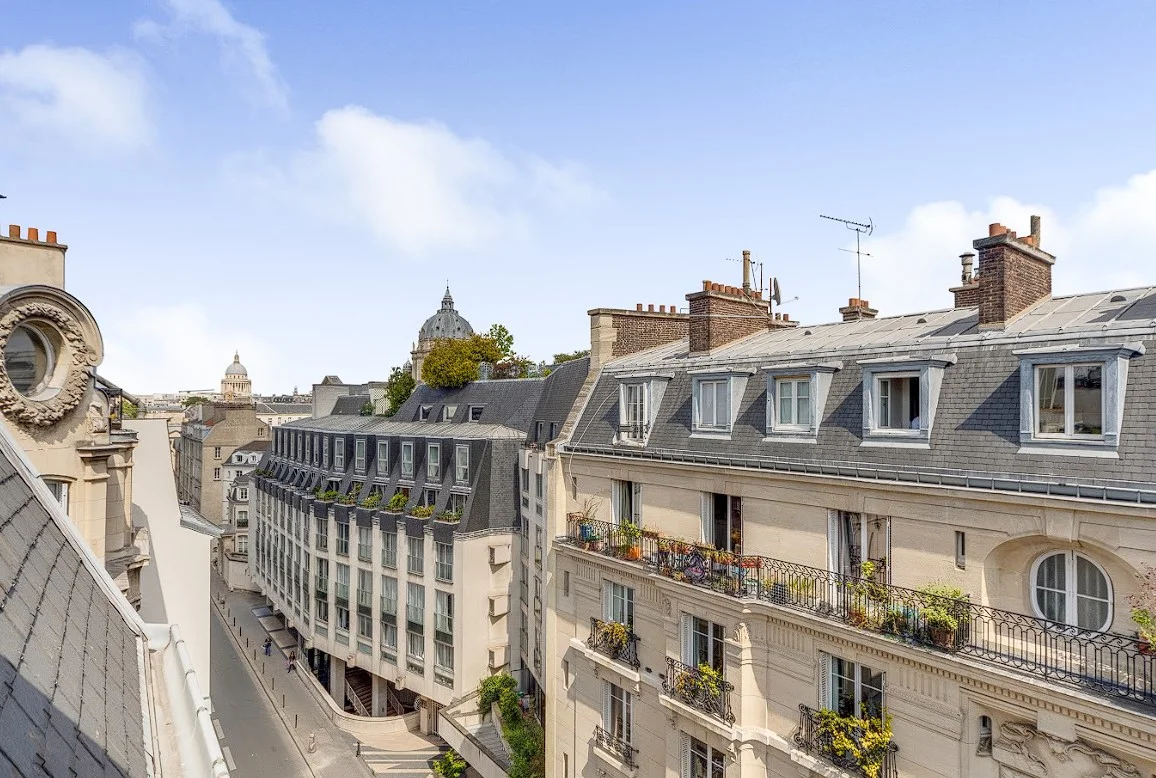
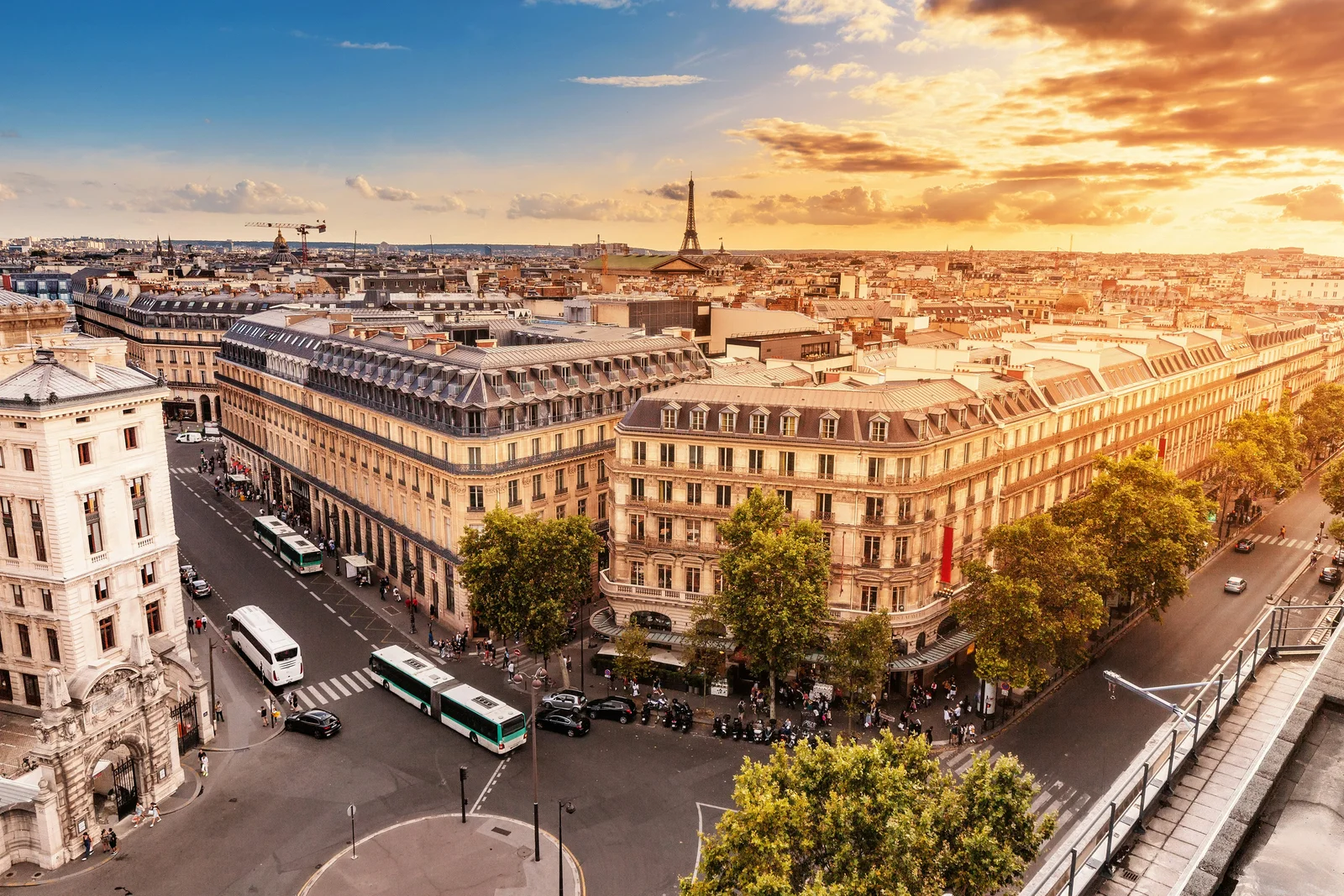
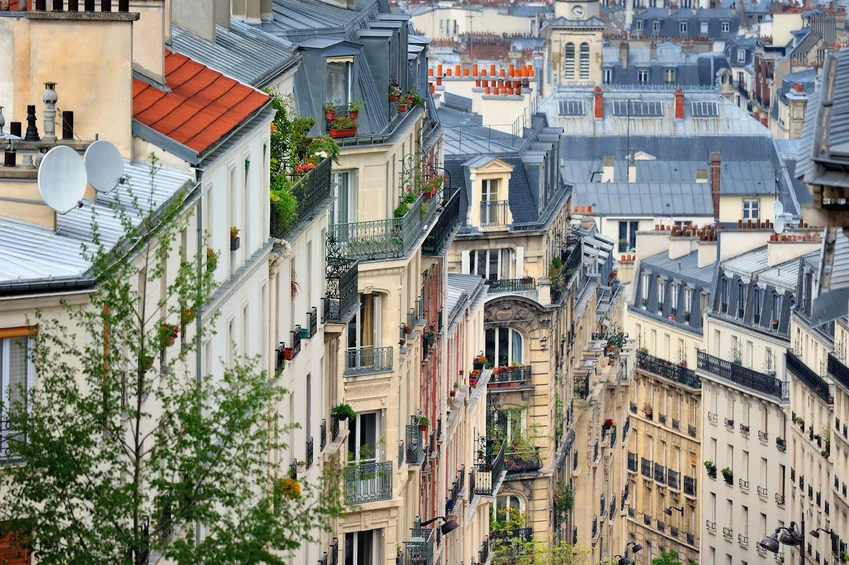
The dominant material is zinc. This grey-blue metal that Baron Haussmann imposed for the roofs of his buildings, cheaper than slate, lighter than tile, and above all a color that changes with the light. In the morning, the zinc is silver. At noon, it turns matte grey. At sunset, it takes on purple, pink and golden reflections. In the rain, it shines like mercury. It is a living material that makes every hour of the day a different spectacle.
What makes the Parisian rooftop landscape so distinctive is the uniformity of height. Haussmannian buildings top out at six or seven stories, a norm imposed in the 19th century and never truly surpassed within Paris proper (with a few exceptions: Montparnasse, Front de Seine, the towers of the 13th). This constant height creates a gentle, undulating horizon line, punctuated by brick chimneys, zinc dormer windows, domes and bell towers. No towers piercing the sky: just this expanse of zinc stretching to the hills of Belleville and Montmartre.
And then there are the monuments. The Eiffel Tower, of course, visible from a quarter of Parisian rooftops, omnipresent, reassuring, always surprising from a new angle. The dome of the Invalides, gilded with pure gold, catching the light like a beacon. The towers of Notre-Dame, the Sacre-Coeur on its hill, the Pantheon, the dome of the Opera, the silhouette of La Defense on the horizon. Each monument punctuates the landscape and gives each view its own signature.
It is this combination, the zinc, the horizontality, the monuments, that has earned the rooftops of Paris their UNESCO World Heritage classification. And it is this combination that makes an apartment with a view an object of absolute desire on the property market.
The geography of views: arrondissement by arrondissement
Not all views are equal. Here are the areas offering the most spectacular and most sought-after panoramas.
The 7th: the Eiffel Tower view
This is the holy grail. A top-floor apartment in the 7th arrondissement with an Eiffel Tower view is the most sought-after property on the Parisian market, across all categories. The most spectacular addresses: boulevard de La Tour-Maubourg (frontal view), avenue de Suffren (close lateral view), rue de l’Universite (view over the rooftops), quai d’Orsay (view with the Seine in the foreground).
The “Eiffel Tower view” premium is considerable. An apartment with a direct, unobstructed view of the Iron Lady can sell for 40 to 50% above the neighborhood average for an equivalent surface area. And these properties do not stay on the market: they sell within days, often off-market, before ever being listed on a portal.
The 6th: discreet elegance
Views from the 6th are less spectacular but perhaps more intimate. From the top floors of rue de Rennes, you see the bell tower of Saint-Germain-des-Pres and the Pantheon dome. From boulevard Raspail, the spire of the Chapelle de la Medaille Miraculeuse and the rooftops of the 7th come into view. From buildings bordering the Luxembourg Gardens, the view plunges into the garden’s canopy, a rare privilege.
The 6th offers the quintessence of the Parisian view: no iconic monument in full frame, but a tableau of rooftops, bell towers and light that embodies the very idea of Paris. It is the view that filmmakers seek for their movies.
The 18th: the total panorama
Montmartre is the natural belvedere of Paris. From the top floors of buildings on the Butte, rue Lepic, rue Caulaincourt, rue du Mont-Cenis, the gaze sweeps across the entire city. It is the only truly panoramic view within Paris proper: from the Sacre-Coeur in the foreground, the rooftops cascade down to the towers of La Defense to the west and the hills of Belleville to the east.
The top-floor market in Montmartre is a segment of its own. Prices are more accessible than in the central arrondissements (10,000-13,000 euros/sqm depending on the street and condition), but properties with a genuine view are extremely rare. The topography of the Butte means that only certain streets and orientations offer the panorama. Our hunters know these micro-locations building by building.
The 5th: Notre-Dame and the Pantheon
The historic Left Bank offers views charged with symbolism. From the quais de la Tournelle and de Montebello, top floors overlook the Seine and face Notre-Dame, a spectacle made even more moving since the cathedral’s restoration. From the Montagne Sainte-Genevieve, around the Pantheon, the view opens northward over the Latin Quarter rooftops and Notre-Dame’s towers.
The 16th: Seine and Eiffel Tower
The Trocadero and Passy offer another perspective on the Eiffel Tower, face-on, with the Seine and the Trocadero Gardens in the foreground. This is the “postcard” view, the one used for film openings and magazine covers. Apartments on the avenues descending from the Trocadero toward the Seine (avenue du President-Wilson, avenue d’Iena) are among the most expensive in Paris, and among the most contested by international buyers.
Belleville and Menilmontant: the accessible secret
The hills of eastern Paris, Belleville (20th), Menilmontant (20th), Telegraphe (19th), offer spectacular panoramic views at prices still well below the central arrondissements. The Parc de Belleville reaches 108 meters above sea level, the highest point in Paris alongside Montmartre. From the top floors of buildings on rue de Belleville or rue des Envierges, the view extends from the Eiffel Tower to the Sacre-Coeur, encompassing the entire center of Paris.
This is an area we regularly recommend to buyers who dream of a view but whose budget does not stretch to the 7th or 16th. A top floor with a terrace and panoramic view in upper Belleville sells for 8,000 to 10,000 euros/sqm, three to four times less than the equivalent in the 7th.
Terraces, balconies, roof terraces: the outdoor hierarchy
In Paris, private outdoor space is an extreme luxury. Fewer than 2% of Parisian apartments have a genuine terrace. It is this absolute rarity that explains sometimes irrational price premiums.
The private terrace
The holy grail. A top-floor terrace, accessible from the living room, with a view over the rooftops. These properties can be counted on two hands in each arrondissement. They sell almost exclusively off-market, often privately between the seller and a buyer identified by a trusted intermediary.
The terrace premium depends on size and orientation. A 15-20 sqm terrace facing south-west with an open view can add 30 to 40% to the property price. On an 80 sqm apartment in the 7th, that represents 300,000 to 500,000 euros more than an identical property without a terrace. The square meter of Parisian terrace is the most expensive square meter in France.
The continuous balcony
In a Haussmannian building, the continuous balcony (balcon filant) on the second or fifth floor offers a linear outdoor space, often 8 to 12 meters long and 60 to 80 centimeters deep. Not wide enough for a table, but enough to lean on, place flower boxes and breathe. The continuous balcony premium is more modest, 5 to 10%, but it exists.
The private roof terrace
Some buildings have a roof terrace accessible from a top-floor apartment, often a former sixth-floor mansard that has been combined with the attic and benefits from exclusive roof access. These properties are extremely rare and are traded as townhouses suspended above Paris. A roof terrace of 30-50 sqm with a panoramic view in a good arrondissement can justify a price per square meter 50 to 60% above the neighborhood average.
The modern terrace apartment
New-build programs and recent rooftop extensions increasingly incorporate terraces, which is one of the few advantages of new over old in Paris. Contemporary buildings in the 13th (Bibliotheque), the 15th (Front de Seine), the 17th (Batignolles-Clichy) and the 19th (Bassin de la Villette) offer apartments with loggias or terraces at prices below those of Haussmannian buildings in the central neighborhoods.
Jean Mascla’s advice: Properties with views and terraces sell off-market in the overwhelming majority of cases. The owners of these exceptional apartments prefer a discreet sale: no photos on the internet, no viewings by browsers, no public negotiation. This is exactly the type of property our hunters uncover through their network: direct contacts with building caretakers, relationships with local notaries, word of mouth among owners. These apartments exist. They are not waiting for you on property portals.
Living above Paris
Something changes when you live on the top floor. Your relationship with the city is transformed. You are no longer IN Paris: you are ABOVE it. Street noise fades. Light enters from above, more generous, more changeable. The sky occupies a greater part of the window. And in the evening, when the Eiffel Tower lights up and the zinc rooftops take on their nocturnal hue, that deep blue-grey that exists only in Paris, you understand why people agree to pay a premium for a few extra meters of altitude.
The constraints exist. A top floor without an elevator is athletic, especially with shopping bags, a stroller or a sofa to carry up. Rain on zinc is charming the first night and tiring by the twentieth. Summer heat under the eaves can be formidable without air conditioning (and installing air conditioning in a heritage-listed area is an obstacle course). Co-ownership charges are often higher on top floors: elevator share, roofing maintenance.
But these constraints weigh little against the privilege. Living above the rooftops of Paris means living in a painting that changes every hour. It means watching the city awaken at dawn and fall asleep at night. It means having an intimate, almost secret relationship with the most beautiful urban landscape in the world.
If this is what you are looking for, the view, the light, the sky, tell us. These properties are rare, but they exist. And our hunters know exactly where to look.
To go further, discover our article on the most beautiful Haussmannian buildings in Paris and our analysis of the luxury property market in Paris.
Frequently asked questions
What is the price premium for a top-floor apartment with a view in Paris?
In Paris, a top-floor apartment with an open view over the rooftops commands a premium of 15 to 25% compared to an equivalent property on lower floors of the same building. If the property has a private terrace, the premium can reach 30 to 40%. An apartment with a direct view of a monument (Eiffel Tower, Sacre-Coeur, Notre-Dame) can sell for up to 50% above the neighborhood average for an equivalent surface area.
Which arrondissements have the most beautiful views of Paris?
The most spectacular rooftop views in Paris are found in the 7th (Eiffel Tower and Invalides), the 6th (Saint-Sulpice bell tower, Pantheon dome), the 18th (Sacre-Coeur and panoramic view over all of Paris), the 5th (Notre-Dame towers and Pantheon), the 16th (view over the Seine and Eiffel Tower from Passy-Trocadero) and the 4th (view over Ile de la Cite and the Marais rooftops). The hills of Belleville (20th) and Menilmontant also offer remarkable panoramas at more accessible prices.
How do you find an apartment with a terrace in Paris?
Apartments with terraces represent less than 2% of the Parisian housing stock, making them extremely rare and sought after. The majority sell off-market, privately, without ever appearing on property portals. Engaging a property hunter specializing in Paris is the most effective method for accessing these properties. The professional network and direct contacts with owners are essential for identifying these opportunities before they become public.