


In brief
In Paris, the stairwell is a reliable property indicator: it reveals the period of construction, the original standing and the health of the co-ownership. A fine staircase can add 5 to 10% to an apartment's value, and an Art Nouveau building with original communal areas carries an 8 to 12% premium in 2026. Conversely, a deteriorated stairwell often signals a co-ownership in financial difficulty. Materials date the building: cut stone in the 17th-18th century, wrought iron in the Haussmann era, concrete and metal in the 20th century. Home Select, which has completed more than 1,200 mandates since 2011, makes it one of its first selection filters.
Key takeaways
- A Parisian stairwell reveals the building's age, original standing and current co-ownership health within 30 seconds of entry.
- A prestigious Haussmann building with a remarkable staircase commands a 5 to 10% price premium compared to an ordinary Haussmann building in the same area.
- Art Nouveau buildings with original communal areas (wrought iron banisters, stained glass, flamed stoneware tiles) carry an 8 to 12% premium.
- A deteriorated stairwell is almost always a sign of a co-ownership in difficulty, indicating deferred maintenance and potential future works costs.
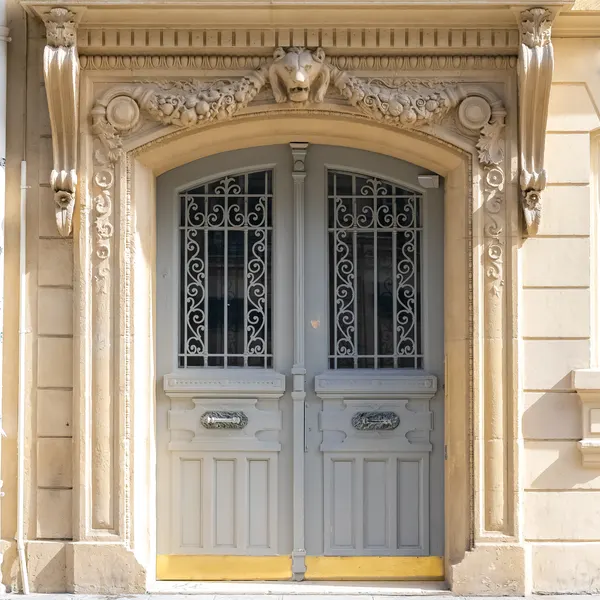
Push open the carriage door. Cross the porch. There, in the cool half-light of the inner courtyard, the staircase begins. The first stone step, worn smooth by three centuries of footsteps. The wrought iron banister describes an elegant curve towards the first landing, where a stained-glass window filters an amber light. Before you have even seen the apartment, you already know what world you are entering. The stairwell is the first chapter of a Parisian building’s story, and for a property hunter, it is the most revealing chapter.
What does a Parisian stairwell actually reveal?
Three things, readable in thirty seconds of climbing: the period of construction in the materials, the original standing in the proportions, and the state of the co-ownership in the maintenance. A Parisian staircase is not simply a tool for vertical circulation. It is an architectural document, a social mirror, an economic indicator. In thirty seconds of climbing, a trained eye can date the building, estimate its original standing, assess the state of the co-ownership and guess the profile of the occupants.
The period of construction can be read in the materials. Cut stone for 17th and 18th-century buildings. Turned wood for Restoration and Louis-Philippe era buildings (1820s-1850s). Stone and wrought iron for Haussmann buildings (1860-1910). Concrete and metal for the 20th century. Each material, each technique tells of a period, and that period has a value on the property market.
The original standing can be read in the proportions. A wide staircase with generous landings, shallow steps and an ornate banister signals a bourgeois building intended for wealthy occupants. A narrow, steep staircase with cramped landings betrays a rental building designed to maximise living space at the expense of circulation comfort.
The state of the co-ownership can be read in the maintenance. A clean, well-lit staircase with fresh paintwork and regularly replaced carpets indicates a functioning co-ownership: invested owners, an efficient managing agent, properly managed charges. A dirty, dark staircase with peeling paint is a warning signal that our property hunters never fail to note.
Where are the oldest staircases in Paris?
In the Marais and on the Île Saint-Louis, where 17th-century hôtels particuliers and buildings still have spiral staircases carved from Paris stone. Rue de Turenne, rue des Francs-Bourgeois, rue Saint-Louis-en-l’Île: some have not changed in four hundred years.
The oldest staircases in Paris are found in the Marais and on the Île Saint-Louis. The hôtels particuliers and buildings of the 17th century feature spiral staircases (escaliers en vis) carved from Paris stone, a blonde limestone that develops a honey-coloured patina over the centuries.
Rue de Turenne, rue des Francs-Bourgeois, rue Saint-Louis-en-l’Île: these addresses harbour staircases that have not changed in four hundred years. The massive stone central column, the radiating steps worn at their centre by millions of footsteps, the light descending from a skylight at the top: it is an architecture of functional beauty that never goes out of style.
The property value of these staircases is indirect but real. A 17th-century building with a fine stone staircase in the Marais sells for more than a building from the same period whose staircase has been spoiled by unfortunate renovations. The authenticity of the communal areas is a valuation criterion that the most discerning buyers, often expatriates or heritage enthusiasts, take very seriously.
How do you recognise a prestigious Haussmann staircase?
By its proportions and materials: stone steps, a wrought iron or turned wood banister, spacious landings, sometimes a stained-glass window. A Haussmann building with a remarkable staircase sells at a 5 to 10% premium over an ordinary Haussmann building in the same neighbourhood.
The Haussmann staircase follows strict codes, dictated by Haussmann’s urban planning regulations and the social conventions of the Second Empire.
In a classic Haussmann building, the main staircase serves the noble floors, from the first to the fifth, with generous proportions: stone steps, a wrought iron or turned wood banister, spacious landings sometimes featuring a stained-glass window or a decorative niche. A service staircase, narrower and steeper, serves the former servants’ rooms (chambres de bonne) on the sixth floor.
The quality of the Haussmann staircase varies considerably from one building to another. Buildings on the grands boulevards, in the 8th and 16th, have monumental staircases: double flights, gilded wrought iron banisters, marble floors, large landings lit by glass roofs. Rental buildings in the 10th or 18th make do with functional staircases, narrow, in stone and painted wood.
This gradation is reflected in prices. A prestigious Haussmann building with a remarkable staircase sells at a 5 to 10% premium compared to an ordinary Haussmann building in the same neighbourhood. The staircase is never mentioned in listings, but it is always the first element the buyer perceives during a viewing.
Does an Art Nouveau staircase raise a building’s price?
Yes: an Art Nouveau building that has kept its original communal areas commands 8 to 12% more than a standard Haussmann building in the same area. The finest examples are in the 16th around rue La Fontaine, in the 7th and in the 10th.
Art Nouveau left some of its finest creations in Parisian stairwells. Between 1895 and 1910, ironworkers competed in inventiveness to transform staircase banisters into works of art: plant scrolls, stylised irises and lilies, curves and counter-curves of organic fluidity.
The finest examples are found in the 16th arrondissement (around rue La Fontaine, where Hector Guimard built several buildings), in the 7th (École Militaire quarter), and in the 10th (around the Gare de l’Est). The Art Nouveau facades of Paris are well documented, but the interiors, staircases, stained glass, floor mosaics, are often even more spectacular.
An Art Nouveau building with its original communal areas, wrought iron banister, flamed stoneware floor tiles, stained-glass window in the stairwell, is a rare heritage asset. The prices of these buildings include an “Art Nouveau premium” that our property hunters regularly observe: in the order of 8 to 12% compared to a standard Haussmann building in the same area.
Discover how Home Select can support you
Where can you see the great Parisian marble entrance halls?
In the bourgeois buildings of the 6th, 7th, 8th and 16th built between 1890 and 1930, where some halls reach 30 to 40 sqm: black-and-white chequered floors, panelled walls, a period lift in wrought iron and frosted glass.
In the bourgeois buildings of the 6th, 7th, 8th and 16th arrondissements built between 1890 and 1930, the stairwell reaches its decorative zenith. The marble entrance hall, with its black-and-white chequered floor, panelled walls, period lift in wrought iron and frosted glass, is an airlock between the street and the privacy of the apartment.
These entrance halls are rooms in their own right. Some measure 30 to 40 sqm, with coffered ceilings, bronze wall sconces, a mirror above the concierge’s fireplace. The concierge, who still exists in these buildings, presides over a space that has remained virtually unchanged for a century.
The period lift deserves special mention. These wood-and-glass cabins, originally operated by a hydraulic system and later electrified, are collector’s items in their own right. Keeping them running is expensive (specialist maintenance, custom parts), but replacing them with a modern lift is experienced as a loss by co-owners attached to the building’s heritage.
Should a deteriorated staircase make you walk away?
It should at least make you investigate: a deteriorated stairwell, peeling paint, fluorescent lighting, battered letterboxes, is almost always the sign of a co-ownership in difficulty. At Home Select, the stairwell is our first selection filter. Before we even push open the apartment door, we have already formed a judgement on the building, and that judgement is rarely contradicted afterwards.
A deteriorated stairwell, peeling paint, fluorescent lighting, battered letterboxes, stained carpet, musty smell, is almost always the sign of a co-ownership in difficulty. The owners cannot agree, the managing agent does the bare minimum, works are deferred year after year. Buying in this building means buying a problem, even if the apartment itself is attractive.
Conversely, a carefully maintained stairwell, repainted within the last five years, warm lighting, clean floor, letterboxes in good condition, indicates a healthy co-ownership. The owners invest, the managing agent does their job, decisions are made and funded. It is a guarantee of peace of mind for the buyer.
This criterion is all the more important because the communal areas are the first element your guests, your friends, your future buyers will see of your building. You do not just buy an apartment: you buy an address, a porch, a staircase, a landing. The whole must be coherent.
The apartment viewing checklist we give our clients includes a full section on communal areas: state of the stairwell, quality of the lighting, state of the letterboxes, cleanliness of the entrance hall, operation of the lift, presence of a concierge. These details never appear in listings, but they weigh heavily in the daily reality of life in a Parisian building.
How do you read a Parisian staircase during a viewing?
By looking at five things in order: the steps (the age), the banister (the standing), the walls (the maintenance), the lighting (the co-ownership’s budget) and the smell (everything else). The exercise is accessible to everyone, provided you know where to look.
The steps tell the age and footfall. Stone steps worn into a concave shape at their centre signal an old building (17th-18th century) with heavy use. Regular, clean stone steps indicate a well-maintained Haussmann building. Polished concrete or tiled steps signal the 20th century.
The banister tells the standing. Ornate wrought iron signals a quality building, regardless of the period. Simple turned wood signals a decent but unpretentious building. Tubular metal signals a post-war building or a recent renovation.
The walls tell the maintenance story. Fresh paint in a chosen shade (off-white, pearl grey, eau de nil) indicates an aesthetic choice, therefore a co-ownership that cares about appearance. Faded, yellowish paint with damp marks indicates the opposite.
The lighting tells the budget. Wall sconces, even simple ones, indicate an investment. A ceiling strip light indicates an economy.
The smell tells everything else. A staircase that smells clean is a well-maintained staircase. A staircase that smells musty, damp or of cooking is a neglected staircase. This sensory detail, which cannot be perceived in a photo or a listing, is one of the first elements our property hunters assess during a viewing.
In fifteen years and more than 1,200 completed mandates, we have learnt to read the staircases of Paris like open books. Every step, every banister, every landing tells a story, and that story, more often than you might think, predicts the future of your investment.
Sources
Frequently asked questions
01 Why is the stairwell important in assessing a property in Paris?
The stairwell reveals the period of construction, the original standing of the building, the quality of co-ownership maintenance and the commitment of the owners. A fine staircase can add 5 to 10% to a property's value.
02 What types of staircases are found in Parisian buildings?
The main types are 17th-century stone spirals (Marais, Île Saint-Louis), Haussmann staircases with wooden or stone balusters, Art Nouveau wrought iron banisters (16th, 7th) and marble entrance halls with period lifts in bourgeois buildings (8th, 6th).
03 Is a deteriorated staircase a warning sign when buying?
Yes. A deteriorated stairwell, with peeling paint, worn carpet, or failing lighting, is often a sign of a co-ownership in financial difficulty or collective disinterest in maintenance. It is a reliable indicator of future works to budget for.
04 Does an Art Nouveau staircase increase a Parisian building's value?
Yes. An Art Nouveau building (1895-1910) that has kept its original communal areas, wrought iron banister, flamed stoneware floor tiles, stained glass in the stairwell, is a rare heritage asset. Prices carry a premium of around 8 to 12% compared with a standard Haussmann building in the same area. The finest examples are found in the 16th arrondissement (around rue La Fontaine), the 7th and the 10th. The authenticity of communal areas is a value criterion taken seriously by informed buyers.