

Buyer's Guide | | 18 min read

Complete guide: buying an apartment in Paris in 2026

Buying in Paris in 2026: average prices by arrondissement (10,450 euros/m2), key steps, financing, negotiation. Expert guide by Home Select, property hunters since 2011.

Jean Mascla

Jean Mascla

Founder of Home Select

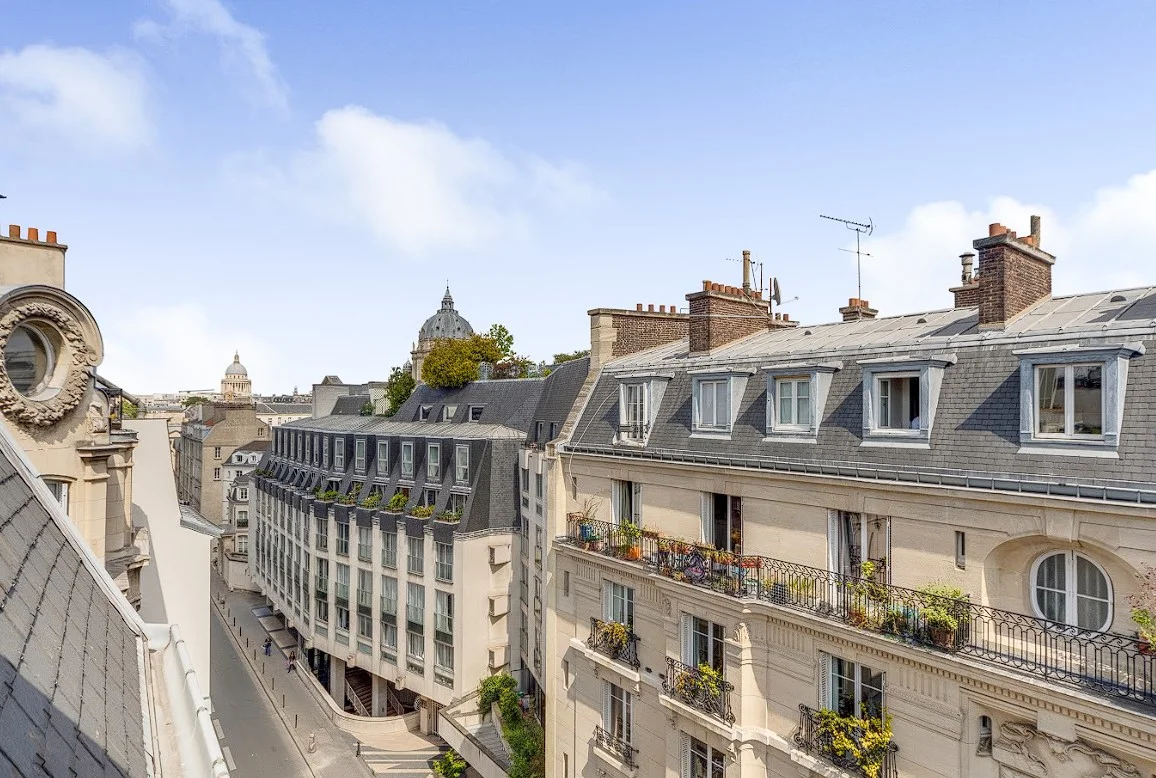
View over the rooftops of Paris from a Haussmann apartment with mouldings and parquet

Buying an apartment in Paris in 2026 costs an average of 10,450 euros per square metre, with variations ranging from 7,500 euros/m2 in the 19th arrondissement to over 15,000 euros/m2 in the 6th. The complete process, from the first property you like to receiving the keys at the notaire’s office, takes between 4 and 6 months, and requires a total budget 10 to 12% above the listed price once ancillary costs are factored in.

After fourteen years supporting buyers in Paris and more than 1,200 completed projects, I have found that the buyers who succeed are not those with the largest budget. They are those who understand the game before entering it. This guide is exactly that: everything you need to know to buy in Paris in 2026, without sugar-coating, with the real figures and the real pitfalls.

The Parisian market in 2026: what to understand before searching

The Paris property market in 2026 is a market in transition. After the 2023-2024 correction (approximately -8% across inner Paris), prices stabilized at the end of 2025 and are showing signs of moderate recovery, around +1.5 to +2% over twelve months depending on the arrondissement. Interest rates, which have come back down to around 3.2% over 20 years at the start of 2026, have revived demand without triggering a surge.

In practical terms, the balance of power between buyers and sellers is more even than it has been for ten years. It is a good time to buy, provided you know which neighbourhood and at what price.

Prices per m2 by arrondissement in 2026

Here are the average prices observed in 2026, arrondissement by arrondissement. This data synthesizes transactions supported by Home Select and DVF (Demandes de Valeurs Foncieres) data published by the State.

The most expensive arrondissements remain the 6th (Saint-Germain-des-Pres, around 15,800 euros/m2), the 7th (Tour Eiffel, Invalides, around 14,200 euros/m2) and the 4th (Le Marais, around 13,600 euros/m2). At the other end of the spectrum, the 19th (Buttes-Chaumont, around 7,800 euros/m2), the 20th (Belleville, Gambetta, around 7,500 euros/m2) and the 13th (Butte-aux-Cailles, around 8,200 euros/m2) offer the best entry points.

Between these two extremes, the 9th (10,800 euros/m2), 11th (10,200 euros/m2) and 10th (9,600 euros/m2) represent the best compromise between quality of life, dynamism and reasonable prices. These are arrondissements I particularly recommend to first-time buyers and couples with a first child.

The opportunities map

Not all arrondissements are equal in terms of potential. In 2026, several areas deserve particular attention.

The 9th arrondissement is in the midst of transformation. The Nouvelle Athenes and SoPi (South Pigalle) neighbourhoods attract a young, active, international population. Prices there are still 30% lower than the 6th for a comparable quality of life. The Haussmann buildings there are magnificent, often better preserved than in the more expensive arrondissements, paradoxically.

The 10th arrondissement, around the Canal Saint-Martin, continues its transformation. The neighbourhood has matured: shops have diversified, families are settling in. Prices remain contained and negotiation margins are among the best in Paris.

The 18th and 19th arrondissements, long overlooked, offer genuine opportunities for buyers willing to venture off the beaten track. Montmartre (the real one, not the tourist summit), Jules Joffrin, the Buttes-Chaumont: all neighbourhoods where family apartments at accessible prices can still be found.

Defining your project: budget, criteria, compromises

Before walking into an agency or contacting a property hunter, you need to do some clarification work that determines everything that follows. I have seen too many buyers waste months visiting properties that did not match their financial reality, or their actual needs.

The real budget: beyond the listed price

When you calculate your budget, the purchase price of the property represents only part of the total envelope. Here is what you need to add.

Notaire fees for older stock (the vast majority of the Parisian market) represent between 7% and 8% of the price. On an apartment at 500,000 euros, expect 38,000 to 40,000 euros. For new builds, they drop to 2-3%, but new stock in Paris is rare and expensive.

Agency fees, when they are the buyer’s responsibility, add 3% to 5% more. When you use a property hunter like Home Select, our fee of 2.5% of the net seller price replaces these fees and includes an incomparably more complete service. I will return to this below.

Renovations are the most underestimated item. A Haussmann apartment “to refresh” rarely requires less than 800 euros/m2 in work. A full renovation (electrics, plumbing, kitchen, bathroom) falls between 1,500 and 2,500 euros/m2 depending on the finishes. On a 60 m2, that represents 90,000 to 150,000 euros: a sum that radically transforms the budget.

Finally, do not forget moving costs (1,500 to 5,000 euros in Paris depending on volume and floor), monthly co-ownership charges (150 to 500 euros/month depending on size and building amenities) and property tax (between 500 and 2,500 euros/year depending on arrondissement and surface area).

For a detailed calculation of all these costs, see our dedicated article.

The criteria: knowing what you really want

In fourteen years, I have observed a recurring phenomenon: most buyers start their search with a list of ideal criteria and end up buying a property that ticks less than half of those boxes. Not out of disappointment, but because their real criteria were different from those they thought they had.

My advice: distinguish non-negotiable criteria (those for which you would turn down an otherwise perfect property) from wishes (those you would like but could give up). Generally, non-negotiable criteria fit in three or four points: a maximum budget, a minimum floor area, a geographical area, and one or two structural elements (high floor, natural light, no overlooking, outdoor space).

The classic trap is wanting everything: parquet, mouldings, high floor, lift, balcony, view, quiet, metro proximity, shops, school 200 metres away, and all within budget. In Paris, such a property exists, but it goes within 48 hours and at full asking price. The key is to accept trade-offs.

The impossible triangle: location, space, condition

Every property purchase in Paris boils down to a triangle of which you can only optimize two sides out of three.

A great location and a property in perfect condition? Prepare for a modest floor area. A large apartment in good condition? It will probably be in a less central arrondissement. A large, well-located apartment? It will need renovations.

Understanding this triangle saves months of searching. The question is not “what do you want?” but “what would you rather sacrifice?”

Financing: getting the best possible mortgage

Financing is the foundation of everything. In 2026, with rates fluctuating between 3% and 3.5% over 20 years, the question of deposit and borrowing capacity has become central again.

The minimum deposit in Paris

Banks generally require a deposit covering at least the notaire fees, meaning 8% to 10% of the purchase price. On a property at 500,000 euros, that means 40,000 to 50,000 euros. But in practice, to obtain the best terms, aim for 15% to 20%. Beyond that threshold, rate negotiation becomes significantly more favourable.

For first-time buyers, the PTZ (Pret a Taux Zero, interest-free loan) remains a significant lever in 2026 for new builds and older stock with renovations in zone A bis (Paris). It can represent up to 50,000 euros of additional interest-free financing, an aid that changes the monthly repayment calculation. Conditions change each year; check your eligibility before finalizing your financing plan.

Borrowing capacity

The 35% maximum debt-to-income ratio (including insurance) is the absolute limit imposed by the Haut Conseil de Stabilite Financiere. In concrete terms, a couple earning 6,000 euros net per month can repay approximately 2,100 euros in monthly instalments, which corresponds to a loan of approximately 430,000 euros over 25 years at a rate of 3.3%.

Add the deposit and you get the total budget. It is a simple calculation but it is THE calculation to make before anything else. Too many buyers start viewing before knowing their real capacity, and fall in love with properties they cannot afford.

Direct bank or broker?

A good broker knows the specific criteria of each bank and can guide you towards the one that will accept your profile. Their cost (approximately 1% of the borrowed amount, or 4,000 to 5,000 euros on average) is often offset by the rate reduction obtained. For a complete guide to financing, see our article Mortgages in Paris in 2026.

My advice: consult at least three banks and one broker. Compare not only the nominal rate but also the TAEG (Annual Effective Rate), which includes insurance and processing fees. The difference between two offers can represent 20,000 to 30,000 euros over the full term of the loan.

Jean Mascla’s advice: Get your bank’s agreement in principle BEFORE starting viewings. In Paris, when a property appeals to you, you need to be able to make an offer within 24 to 48 hours. If your financing is not sorted, you lose the property. I have seen this situation dozens of times. The best-prepared buyer wins, not necessarily the one who offers the most.

The search: methods, pitfalls and reality on the ground

Once the budget is defined and financing validated, the search begins. It is the longest and most gruelling phase when you go it alone.

Searching alone: what nobody tells you

The reality of property searching in Paris in 2026 is that good properties go fast. A correctly priced apartment in a sought-after neighbourhood receives between 5 and 15 viewing requests in the first 48 hours. The best ones are never even published on portals: they sell off-market, through professional networks.

Searching alone means facing a marathon: on average, a Parisian buyer views 40 to 50 apartments before finding the right one. That represents 6 to 8 months of searching, dozens of hours spent on portals, entire weekends devoted to viewings, not to mention the psychological wear of repeated disappointments.

It also means exposure to biases: emotional attachment to a property that is objectively not the right one, search fatigue that pushes you to accept one compromise too many, the lack of expertise to detect real flaws behind tasteful decoration.

Using a property hunter

The property hunter profession exists precisely to solve this equation. A property hunter works exclusively for the buyer, unlike the estate agent who represents the seller. They know the market, have network access to off-market properties, and above all, they have the eye: they know within ten minutes whether a property is worth pursuing or not.

At Home Select, our 16 hunters find the property in 45 days on average, with 3 viewings for the client. Three viewings, not forty. These are not the same viewings: each property shown has been pre-visited, analysed, verified. The hunter only shows you properties that genuinely match your project.

The complete support process with a hunter covers the search, pre-viewings, technical analysis of the property, negotiation, and legal follow-up through to completion. It is end-to-end support.

Property hunter fees in Paris range from 2% to 5% of the net seller price depending on the firm. At Home Select, our fees are 2.5%, payable only on success. It is an investment, but when you know that our hunters achieve an average 6% negotiation on the seller’s price, the maths is straightforward. On a property at 500,000 euros, 6% negotiation represents 30,000 euros in savings. The hunter’s fees are often self-financing.

Off-market: myth or reality?

Off-market is neither a myth nor a marketing gimmick. In Paris, between 15% and 25% of transactions take place without publication on portals, through professional networks. These are properties whose owners prefer to sell discreetly, for reasons of confidentiality, convenience, or simply because they trust their network.

A well-established property hunter in Paris accesses this invisible market. At Home Select, our network of more than 3,000 partners (agencies, notaires, wealth managers, building managers) allows us to regularly offer our clients properties that appear on no portal. It is not magic: it is fourteen years of professional relationships.

Viewings: what to check

Whether you visit alone or with a hunter, every viewing must be methodical. Emotion is a poor advisor when 500,000 euros are at stake.

The ten critical points

Certain defects are deal-breakers and invisible to the untrained eye. Here are the ten points our hunters systematically check.

True brightness. Visit at different times if possible. A south-facing apartment can be dark on the ground floor overlooking a courtyard. Orientation is an objective criterion; perceived brightness during a viewing is not.

The state of the co-ownership. Ask for the last three general assembly minutes. They reveal voted works (facade renovation, roof, lift), unpaid charges, disputes. A planned facade renovation can cost 10,000 to 25,000 euros per unit, information that the seller is under no obligation to highlight.

Noise. Open the windows. Stand still for two minutes. The sound insulation of Haussmann buildings is often poor between floors. Street noise, neighbours, the inner courtyard: all of this can be heard if you take the time to listen.

Electrics and plumbing. An old electrical panel (porcelain, fabric wiring) means a complete rewiring: 8,000 to 15,000 euros depending on the area. Lead pipes require replacement. These items, often hidden behind partition walls, represent the most costly works.

The DPE (Energy Performance Certificate). In 2026, thermal sieves (classes F and G) are banned from rental and their value is discounted by 10 to 20% compared to an equivalent property rated C or D. It is a constraint if you plan to rent one day, but also a negotiation opportunity if you are buying to live in and are willing to renovate.

Damp. Marks on walls, blistering paint, musty smell: all signs of a structural damp problem that can be very expensive to resolve. Check particularly walls facing outside and wet rooms.

Ceiling height. In Paris, it varies enormously. A 50 m2 apartment with 3-metre ceilings gives a sense of space; the same with 2.40 m feels claustrophobic. Height is not always mentioned in listings.

Co-ownership charges. Ask for the breakdown: central heating, hot water, concierge, maintenance, lift. High charges (more than 6 euros/m2/month) must be justified by concrete services. Abnormally low charges may mask a maintenance deficit.

The layout. A 3-room apartment of 55 m2 can be perfectly laid out or completely dysfunctional. Observe the circulation, the size of individual rooms (a bedroom under 9 m2 is barely liveable), the position of the kitchen and bathroom.

The immediate surroundings. Overlooking, the view from each room, the floor, the lift (or lack thereof), the staircase, the entrance hall. These elements determine your daily life as much as the apartment itself.

For an exhaustive checklist, see our article Apartment viewing in Paris: the complete checklist.

The purchase offer: strategy and timing

You have found the property. This is the most delicate moment: formulating an offer that will be accepted without overpaying.

What price to offer?

The answer depends on three factors: how long the property has been on the market, the price per m2 in the neighbourhood, and the competition.

A property on the market for less than two weeks, correctly priced, in a sought-after neighbourhood: you need to offer at or very close to the asking price. Attempting a 10% negotiation on a fresh listing in the Marais means losing it for certain.

A property on the market for more than three months, overpriced relative to the neighbourhood market: the negotiation margin is real, sometimes 5 to 10%. The seller has had time to realize their price was not in line with the market.

A property with an objective defect (poor DPE, co-ownership works, low floor without lift): this is a legitimate negotiation lever. Quantify the cost of the defect and build it into your offer.

The mechanics of the offer

The purchase offer is a written document (email or letter) that morally binds the buyer. It must specify the proposed price, the financing conditions, the validity period and any conditions precedent. A clear, documented offer, accompanied by a financing attestation, is always better received than a vague verbal offer.

Jean Mascla’s advice: Do not play poker with the seller. In Paris, correctly priced properties find buyers. If your offer is too low “to see what happens”, you risk offending the seller and losing all negotiating possibility. Propose a price you can justify, and be prepared to stand by it. Property negotiation is not an arm-wrestling match: it is a conversation between adults seeking an agreement.

At Home Select, negotiation is our hunters’ core skill. We achieve an average 6% reduction on the seller’s price, approximately 30,000 euros on a property at 500,000 euros. This performance is explained by our intimate knowledge of actual prices (not listed prices, the prices at which properties actually sell) and our credibility with sellers and agents.

From compromis to keys: the final steps

The offer is accepted. The race is not over: two to three months of procedure remain before moving in.

The compromis de vente

The compromis (or promesse synallagmatique de vente) is the contract that binds seller and buyer. It is generally signed at the notaire’s office or at the agency, two to four weeks after the offer is accepted.

On the day of signing, the buyer pays a deposit (sequestre) of 5% to 10% of the price, usually held by the notaire. This amount is deducted from the final price on the day of the acte authentique.

The compromis includes conditions precedent, the most common being mortgage approval. If the bank refuses your loan within the specified period (usually 45 to 60 days), you recover your deposit in full. This is an essential protection.

After signing, you have a 10-calendar-day cooling-off period. During this period, you can withdraw from the purchase without justification or penalty. After this period, the only grounds for withdrawal without penalty is the non-fulfilment of a condition precedent.

For a thorough understanding of this crucial step, see our guide Compromis de vente in Paris.

Obtaining the final mortgage offer

Once the compromis is signed, the clock starts ticking to obtain your final mortgage offer. Your broker or bank generally has 45 days. Anticipating this step, by having your agreement in principle before signing the compromis, puts you in a position of strength and reassures the seller.

Once the mortgage offer is received, you have a mandatory 10-day reflection period before accepting it. This period cannot be shortened.

The acte authentique at the notaire’s office

The acte authentique is the final signing, the one that officially makes you the owner. It generally takes place 2 to 3 months after the compromis.

On the day, you pay the balance of the price (less the deposit) and the notaire fees. The notaire hands you the keys. You are home.

A few points of attention: check that the apartment is in the agreed condition (a final viewing the day before is recommended), that the meters have been read, and that all diagnostics are compliant. The notaire is there to secure the transaction: do not hesitate to ask all your questions, that is their role.

The most common mistakes, and how to avoid them

Over 1,200+ supported transactions, I have identified the mistakes that recur most often among Parisian buyers.

Starting viewings before sorting out financing. This is the number one mistake. You fall in love with a property, make an offer, the seller asks for your bank attestation, and you do not have one. The property goes to another buyer while you chase your banker.

Underestimating renovations. The apartment “to refresh” that only needs “a lick of paint” rarely costs less than 800 euros/m2. The apartment “to fully renovate” can reach 2,000 to 2,500 euros/m2. Get renovation costs quoted BEFORE signing the compromis, not after.

Ignoring the co-ownership. The apartment is perfect but the building has a 300,000 euro facade renovation voted for next year? Your share could represent 15,000 to 25,000 euros of surprise. Read the general assembly minutes. All of them.

Focusing on the price per m2 rather than the total price. A 40 m2 at 12,000 euros/m2 (480,000 euros) in the 7th can be a better investment than a 55 m2 at 8,000 euros/m2 (440,000 euros) in the 13th: it all depends on your project, your holding period and the property’s liquidity on resale.

Negotiating too aggressively. In Paris, a seller who receives an offer at -15% does not counter-offer: they ignore it. A realistic, reasoned, respectful negotiation succeeds. An arm-wrestling match loses the property.

Buying under emotional pressure. “It’s the last one like this,” “I have three other offers,” “you need to decide today”: every agent says these things. Sometimes it is true. Often, it is a pressure lever. Keep a cool head. If a property escapes you, another will come. Paris has 1.4 million homes.

The typical timeline of a purchase in Paris

To give you a clear picture, here is the realistic timeline of a purchase in 2026.

Weeks 1 to 2 are devoted to preparation: defining the project, bank consultation, obtaining the agreement in principle. This is the foundation: do not neglect it.

Weeks 3 to 10 are the active search phase: viewings, property analysis, criteria adjustment. Alone, allow 3 to 6 months. With a property hunter, this phase lasts an average of 6 weeks.

Week 10 or 11 is the purchase offer and negotiation. If the offer is accepted, the notaire is contacted immediately.

Weeks 12 to 14 see the signing of the compromis, payment of the deposit and the start of the cooling-off period.

Weeks 14 to 22 are the interim period: obtaining the final mortgage offer, notarial checks, lifting of conditions precedent.

Weeks 22 to 24, the acte authentique at the notaire’s office. You receive the keys.

In total, from first thought to moving in: 5 to 6 months with a hunter, 8 to 12 months searching alone.

Paris in 2026: is it the right time to buy?

This is the question 90% of buyers ask me at the first meeting. My answer is always the same: the right time to buy is when your personal project justifies it and your financing allows it. Waiting “for prices to fall further” or “for rates to come down more” is a losing strategy, because the market is unpredictable and the cost of the rent you pay while waiting is very real.

That said, 2026 offers an objectively favourable context. Prices have corrected by 8% from the 2022 peak, a significant discount in absolute terms in a market as expensive as Paris. Rates, while higher than in 2021, have stabilized at historically reasonable levels. Supply is plentiful, selling times have lengthened, and negotiation margins are real.

It is a buyer’s market, not a seller’s market. For those who have the means and the project, it is a very good vintage.

In summary

Buying an apartment in Paris in 2026 is a demanding project but perfectly achievable if you are methodical. Sort out your financing first. Define your real criteria. Accept the trade-offs. View methodically. Negotiate intelligently. And above all, surround yourself well.

At Home Select, we have been doing this since 2011. Our 16 property hunters have supported more than 1,200 buyers in Paris, with a 96% satisfaction rate and a Google rating of 4.9/5 on 250+ verified reviews. If you have a purchase project in Paris, tell us about it: your dedicated hunter will call you back within 24 hours, free of charge and without obligation. Tell us about your project

#purchase #guide #Paris #financing #first-time buyer #negotiation
Share

Frequently asked questions

What budget is needed to buy an apartment in Paris in 2026?

The average price per m2 in Paris in 2026 is approximately 10,450 euros. For a 2-room apartment of 40 m2, expect between 350,000 euros in the 19th and over 650,000 euros in the 6th. On top of this, add 7 to 8% in notaire fees for older stock, meaning 25,000 to 50,000 euros extra.

How long does it take to buy an apartment in Paris?

From the start of the search to receiving the keys, allow 4 to 6 months when searching alone. At Home Select, our property hunters find the property in 45 days on average, then 2 to 3 months are needed between the compromis and the acte authentique at the notaire's office.

Can you still negotiate the price of an apartment in Paris in 2026?

Yes. The Parisian market in 2026 offers negotiation margins of 3 to 8% depending on the arrondissement and the property. Thermal sieves (DPE F-G) and properties on the market for more than 3 months are the most negotiable. At Home Select, we achieve an average 6% negotiation for our clients.

Related reading

WhatsApp