

In brief
The 10th arrondissement of Paris posts a median price of 9,400 euros/m² and an average price of 10,100 euros/m² in 2026 (DVF data, April 2026 vintage), with a 35% gap between the canal Saint-Martin (10,500 to 11,500 euros/m²) and the area around Gare du Nord and Gare de l'Est (8,500 to 9,500 euros/m²). The Sainte-Marthe quarter ranges from 9,500 to 10,500 euros/m² and the Faubourg Saint-Denis from 9,000 to 10,500 euros/m². Home Select, a Paris property hunter since 2011 and member of the FCI, supports buyers in the 10th with a 6% average negotiation and 1,200+ buyers already supported.
Key takeaways
- The 10th arrondissement posts a median price of 9,400 euros/m² and an average price of 10,100 euros/m² in 2026, with a 35% price gap between the canal Saint-Martin (11,500 euros) and the station area (8,500 euros)
- The canal Saint-Martin neighbourhood has undergone complete gentrification since 2010, making it one of the most sought-after lifestyle areas in Paris
- Proximity to Gare du Nord (Eurostar, Thalys) makes the 10th a natural choice for bi-national couples and international professionals
- Safety and cleanliness around Gare du Nord and Gare de l'Est remain the main points of caution for buyers
The 10th arrondissement is the one that has changed the most in fifteen years. In 2010, the canal Saint-Martin was a canal and nothing else: a body of water bordered by warehouses and workers’ cafes. In 2026, it is the epicentre of a Parisian lifestyle the rest of the world looks to. That transformation has a price, and it is worth understanding what the numbers conceal behind the Instagram facade.
How is the 10th arrondissement divided?
Into two halves separated by the canal Saint-Martin: to the east a gentrified, expensive 10th, to the west the train stations, the noise and the lowest prices in the arrondissement. Between the canal quays (10,500 to 11,500 euros/m²) and the area around Gare du Nord and Gare de l’Est (8,500 to 9,500 euros/m²), the gap reaches 3,000 euros/m² over less than two kilometres.
The 10th is a divided arrondissement. The canal Saint-Martin draws a line between the east (gentrified, desirable, expensive) and the west (the train stations, the noise, the contrasts). Buying in the 10th without understanding this geography is buying blindfolded.
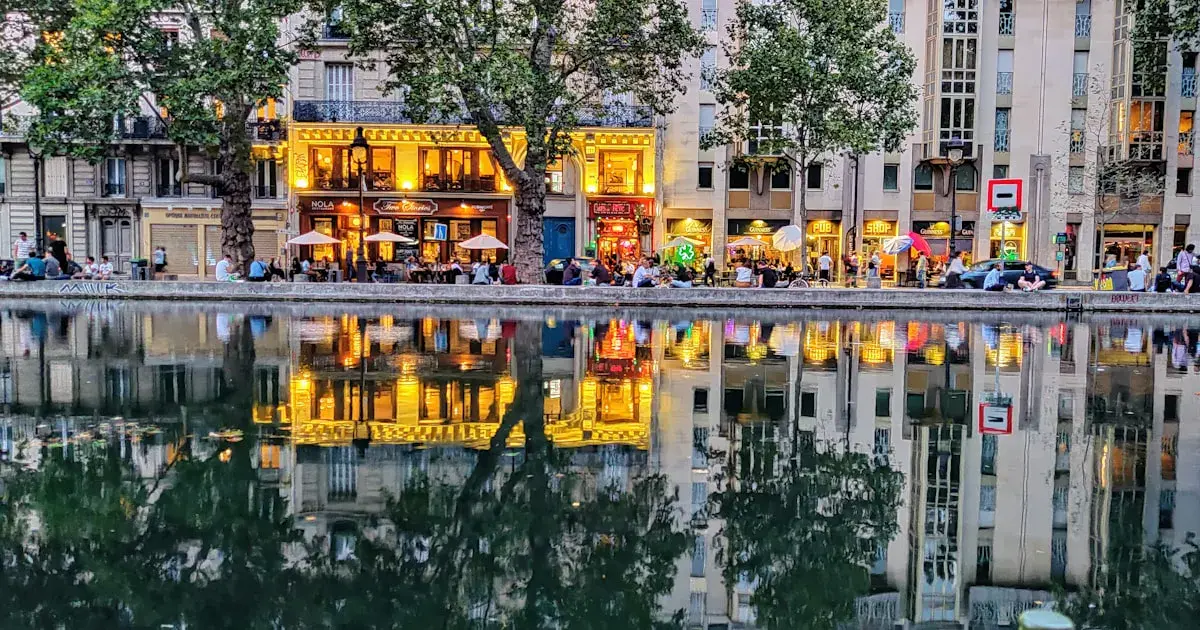
The canal Saint-Martin, between Place de la République and rue des Récollets, is the premium 10th. The Quai de Jemmapes and Quai de Valmy, lined with plane trees and colourful facades, concentrate the most sought-after addresses. Sunday brunches, designer boutiques, independent bookshops: everything contributes to a lifestyle neighbourhood atmosphere that drives the prices. And the prices are there: 10,500-11,500 euros/m² on the quays, 11,000-12,000 euros for apartments with direct canal views from upper floors.
The Faubourg Saint-Denis is the most contrasted street in Paris. Over one kilometre, you go from 5-euro kebabs to 15-euro cocktail bars, from phone shops to pop-up art galleries, from questionable hotels to boutique hotels. It is fascinating, disorienting, and this translates into prices: 9,000 euros/m² on the station side, 10,500 euros on the canal side. The gap between two sections of the same street is the largest in Paris.
The surroundings of Gare du Nord and Gare de l’Est constitute the most challenging part of the 10th. Railway noise, car traffic, safety and cleanliness issues create an unwelcoming environment. The streets immediately adjacent to the stations (rue de Maubeuge, rue du Faubourg-Saint-Denis on the north side, boulevard de Magenta) trade between 8,500 and 9,500 euros/m², the lowest prices in the 10th, and for good reason.
The Sainte-Marthe / Hôpital Saint-Louis quarter is the secret 10th. A network of quiet little streets, converted workshops and discreet restaurants, away from the bustle of the canal and the stations. Place Sainte-Marthe, with its terraces and village atmosphere, is one of the most charming spots in northeast Paris. Prices: 9,500-10,500 euros/m².
What is the price per m² in the 10th arrondissement in 2026?
The 10th posts a median price of 9,400 euros/m² and an average price of 10,100 euros/m² in 2026 (DVF data, April 2026 vintage), up 1.5% over twelve months. That is 500 euros below the Paris median of 9,900 euros/m², but this central value hides a 3,000 euros/m² gap between the canal and the stations.
That median of 9,400 euros places the 10th in a mid-range bracket, more expensive than the 18th (9,000 euros median) and the 19th (8,200 euros), less expensive than the 11th (10,000 euros) and the 3rd (12,200 euros). But the central value is misleading: the gap between the canal (11,500 euros) and the stations (8,500 euros) is 3,000 euros/m², a 35% difference.
A 2-room apartment of 40 m² on the canal costs between 420,000 and 460,000 euros. In the Sainte-Marthe quarter, expect 380,000-420,000 euros. Around the stations, 340,000-380,000 euros.
A 3-room of 60 m² trades between 630,000 and 690,000 euros along the canal, 570,000-630,000 euros in the rehabilitated Faubourg Saint-Denis, and 510,000-570,000 euros near the stations. A 4-room of 75 m², rare in the 10th, sits between 790,000 and 860,000 euros on the canal.
Who buys in the 10th arrondissement?
Young professionals and bi-national couples, with a typical budget of 400,000 to 700,000 euros for a 2 or 3-room along the canal. Investors form the second contingent, drawn by gross yields of 4 to 5% on small units around the stations; families remain a minority.
Young professionals and bi-national couples are the dominant profile. The proximity of international train stations, Eurostar to London in 2h15, Thalys to Brussels in 1h20, ICE to Frankfurt in 3h50, makes the 10th the natural neighbourhood for Parisians who work internationally. At Home Select, we regularly help Franco-British or Franco-Dutch couples who choose the 10th for exactly this reason.
Young upper-income professionals, freelancers, tech and creative workers, form the core of demand along the canal. Typical budget: 400,000-700,000 euros for a 2 or 3-room. They want to live in a neighbourhood that reflects who they are: dynamic, cosmopolitan, open. The 10th checks every box.
Investors target small units around the stations. Gross yields reach 4-5% on studios and 2-room apartments, driven by strong rental demand (students, young professionals, frequent travellers). This is one of the best yields in central Paris.
Families are less present in the 10th. The living spaces are modest, the schools uneven, and the nuisances (noise, safety) make certain areas unsuitable for children. Families who settle in the 10th target the canal or Sainte-Marthe, and accept compromises on space.
What are the strengths of the 10th arrondissement?
International connectivity with no equal in Paris: Eurostar, Thalys, TGV and ICE depart from Gare du Nord and Gare de l’Est, putting London 2h15 away and Brussels 1h20 away. Add a rare density of cultural and culinary venues, the canal Saint-Martin as a breathing space, and a diversity that lets you eat well at every budget.
Connectivity is exceptional. Gare du Nord (Eurostar, Thalys, TGV Nord) and Gare de l’Est (TGV Est, ICE) make the 10th the international gateway to Paris. The metro is dense: lines 4, 5, 7 (stations), lines 3, 5, 8, 9, 11 (Republique). RER B, D and E complete the coverage.
Cultural and culinary life is remarkably rich. From the Marché Saint-Quentin (the largest covered market in Paris) to the restaurants of rue du Faubourg-Saint-Denis (Chez Michel, Abri, Vivant), by way of the Point Éphémère and the Lavoir Moderne Parisien, the 10th offers a density of cultural and culinary venues few neighbourhoods can match.
The canal Saint-Martin itself is a unique urban amenity. The walk along the water, the locks, the footbridges, the trees: it is a breathing space in the heart of the city that structures the neighbourhood and gives it its identity.
Diversity is a real asset. The 10th is one of the most cosmopolitan arrondissements in Paris: Indian (passage Brady), Turkish (Faubourg Saint-Denis), African, Chinese. This diversity translates into the culinary and commercial offerings. It is a neighbourhood where you eat well at every budget.
Find out how Home Select can help you
What should you watch out for before buying in the 10th?
Safety around Gare du Nord and Gare de l’Est comes first: drugs, pickpockets and unsanitary conditions concentrate in a limited but very real perimeter. Then come permanent noise on the major arteries, very uneven cleanliness, and quality gaps that play out from one street to the next.
Safety around the stations is the major issue. The surroundings of Gare du Nord concentrate real problems: drugs (crack, in adjacent streets), pickpockets, unsanitary conditions. Boulevard de Magenta, rue de Maubeuge and rue du Faubourg-Saint-Denis on the station side are areas where caution is essential, especially in the evening and at night.
Noise is permanent on major arteries. Boulevard de Magenta, rue La Fayette and boulevard de Strasbourg are major transit routes, with heavy car traffic and constant background noise. Addresses along these axes are penalized, and prices reflect it.
Cleanliness is uneven. Some streets in the 10th are regularly cleaned and well maintained. Others, especially around the stations, suffer from chronic neglect. This is a criterion to verify on site, at different times of day.
The 10th requires knowledge of micro-neighbourhoods. The gap between two parallel streets can be staggering, in price, in atmosphere, in safety. Rue Lucien-Sampaix is a haven of peace 200 meters from the chaos of Gare de l’Est. Rue des Vinaigriers is charming, while rue du Château-d’Eau is challenging. This is an arrondissement where a property hunter who knows every street makes the difference between a good and a bad purchase.
How will the 10th evolve?
At two speeds: the canal and the rehabilitated Faubourg Saint-Denis remain on an upward path, while the station surroundings stagnate. The arrondissement median is up 1.5% over twelve months, after falling from 10,800 to 9,300 euros/m² between 2021 and 2024.
The Gare du Nord renovation project, scaled down after controversies, should nonetheless improve the immediate environment of the station. The redevelopment of Place de la Chapelle and the area north of the station will be decisive for how the neighbourhood holds its value.
The canal Saint-Martin benefits from the progressive pedestrianization of its surroundings. The reduction of car traffic on the quays and the development of bike lanes strengthen the residential attractiveness of the area.
The 10th has gained 25% in ten years on prices, and the trend is upward on the canal and the rehabilitated Faubourg Saint-Denis. The station surroundings, however, are stagnating: the catch-up depends on urban renovation projects that are advancing slowly.
Should you buy in the 10th arrondissement?
Yes, provided you choose your street before you choose your building: at 9,400 euros/m² median against 9,900 for Paris, the 10th remains affordable, but the gap between two neighbouring addresses reaches 3,000 euros/m². The canal and Sainte-Marthe for quality of life, the rehabilitated Faubourg Saint-Denis for the compromise, the station surroundings only if your budget demands it.
The 10th is an arrondissement of contrasts where field knowledge is more decisive than anywhere else. At Home Select, we recommend it to our clients with an honest assessment: the canal is magnificent but expensive, the stations are accessible but challenging, and the gap between two streets can justify or cancel a purchase.
Our advice: target the canal or Sainte-Marthe if your priority is quality of life. Target the rehabilitated Faubourg Saint-Denis if you are looking for the compromise between price and atmosphere. And avoid the immediate surroundings of the stations unless your budget is tight and you accept the nuisances in exchange for the price.
Out of our 1,200+ completed mandates since 2011, the 10th ranks among our most active arrondissements. Our 96% satisfaction rate comes down to one thing: we tell the truth about every address, and we only help our clients buy properties we would recommend to our own family.
For further reading, see our guide to canal Saint-Martin and Oberkampf. Our article on the 9th arrondissement, a rising star offers a counterpoint on the other side of the Faubourg Poissonnière. And to understand market dynamics, consult our analysis of high-demand zones in Paris.
Sources
Frequently asked questions
01 What is the average price per m² in the 10th arrondissement in 2026?
The 10th posts a median price of 9,400 euros/m² and an average price of 10,100 euros/m² in 2026 (DVF data). The canal Saint-Martin reaches 10,500-11,500 euros, the Faubourg Saint-Denis area trades between 9,000 and 10,500 euros, and the vicinity of the train stations drops to 8,500-9,500 euros.
02 Is the 10th arrondissement noisy?
Some areas are, others are not. The surroundings of Gare du Nord and Gare de l'Est are noisy and bustling at all hours. The canal Saint-Martin is calm on weekdays but lively on weekends. Streets set back from the main arteries (rue Lucien-Sampaix, rue des Vinaigriers) offer surprising tranquility.
03 Is safety around the train stations a concern?
Yes, it is the main point of caution in the 10th. The vicinity of Gare du Nord and Gare de l'Est concentrates real safety issues: drugs, pickpockets, unsanitary conditions. The gap between two parallel streets can be staggering.
04 Is the 10th suitable for expatriates?
Yes, the 10th attracts many expatriates thanks to the proximity of international train stations (Eurostar, Thalys, ICE). The Paris-London journey in 2h15 and Paris-Amsterdam in 3h20 from Gare du Nord makes the 10th a natural neighbourhood for bi-nationals.