









In brief
In 2026, renovating a Haussmannian apartment in Paris costs 1,200 to 1,500 euros/m2 for a refresh, 1,800 to 2,500 euros/m2 for a complete renovation and 3,500 to 4,500 euros/m2 for a prestige renovation, with full electrical rewiring for an 80 m2 flat (20,000 to 30,000 euros) remaining the most underestimated expense. Heritage elements to preserve include mouldings, herringbone parquet, marble fireplaces and double doors. A tastefully renovated Haussmannian gains 15 to 25% in value, an estimate that Home Select property hunters factor in before the purchase offer.
Key takeaways
- A complete Haussmannian renovation in Paris costs 1,800 to 2,500 euros per sqm in 2026, or 144,000 to 200,000 euros for an 80 sqm flat
- Full electrical rewiring for an 80 sqm flat costs 20,000 to 30,000 euros and is the most underestimated expense
- Heritage elements like mouldings, fireplaces and herringbone parquet must be preserved to maintain property value
- Lead paint treatment adds 3,000 to 8,000 euros for pre-1948 apartments
- Co-ownership approval is required for works affecting common parts or the building facade
- Home Select, a property hunter in Paris, costs the works before the offer: that cost feeds the negotiation, which averages 6% off the seller's price.
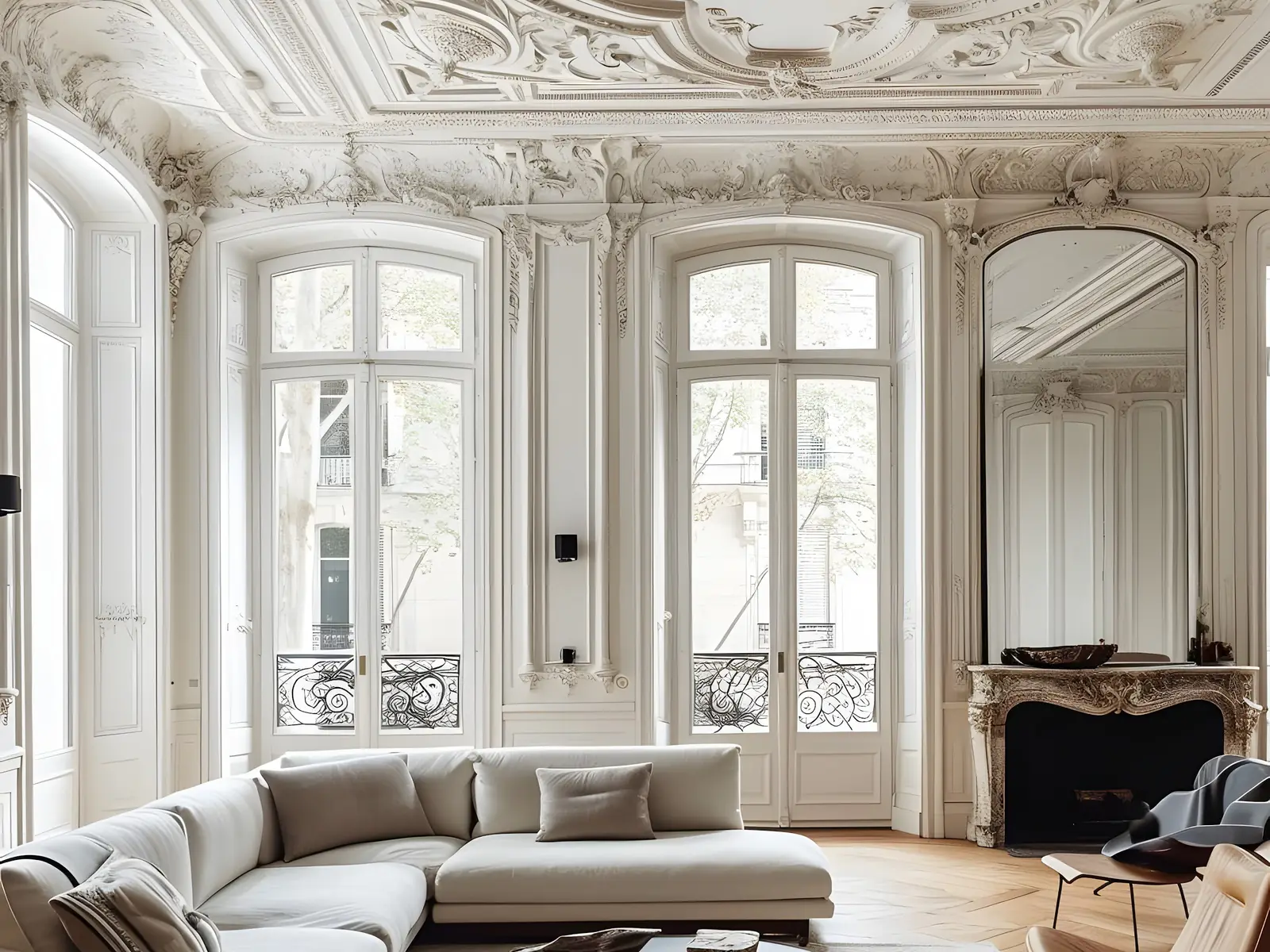
The parquet creaks underfoot. The ceiling mouldings trace garlands of acanthus leaves that two coats of white paint have thickened. The white marble fireplace, darkened by a century of use, is waiting to be restored to its full brightness. Renovating a Haussmannian apartment means entering a dialogue with one hundred and fifty years of history, and accepting that this dialogue comes at a cost.
How much does renovating a Haussmannian apartment cost?
In Paris in 2026, expect 1,200 to 1,500 euros/m² for a refresh, 1,800 to 2,500 euros/m² for a complete renovation and 3,500 to 4,500 euros/m² for a prestige job. For an 80 m² flat, that runs from 96,000 euros to 360,000 euros depending on the ambition of the project.
| Level | Price per m² | For 80 m² | What the budget covers |
|---|---|---|---|
| Refresh | €1,200 to €1,500/m² | €96,000 to €120,000 | Paint, floors, kitchen, possibly one bathroom |
| Complete renovation | €1,800 to €2,500/m² | €144,000 to €200,000 | Electrics to standard, plumbing, kitchen, bathroom, walls, parquet |
| Prestige renovation | €3,500 to €4,500/m² | €280,000 to €360,000 | High-end materials, plasterwork, new herringbone parquet, marble, home automation |
These prices sit well above those for an ordinary Paris flat: Haussmannian buildings demand specific skills (mouldings, period parquet, ceiling heights) and heavier site constraints. The upper end of the complete-renovation range applies to flats requiring asbestos removal, lead treatment or structural work.
The figures circulating online are often fanciful, pulled downward by national estimates that do not account for the Parisian reality. In Paris, qualified tradespeople charge more than in the provinces, logistical constraints are heavier (access, parking, hoists), and the specific features of Haussmannian construction demand skills that not all trades possess.
A refresh, covering painting, floor restoration, kitchen replacement and possibly a bathroom, sits between 1,200 and 1,500 euros/m² in 2026. For an 80 m² flat, that represents 96,000 to 120,000 euros. This budget assumes the electrics and plumbing are in acceptable condition and the structure requires no intervention.
A complete renovation, bringing electrics up to standard, overhauling plumbing, new kitchen, new bathroom, walls and ceilings redone, parquet sanded or replaced, costs between 1,800 and 2,500 euros/m². For the same 80 m² flat, expect 144,000 to 200,000 euros. The upper end applies to apartments requiring asbestos removal, lead treatment or structural repairs (beams, floors).
Above 2,500 euros/m², you enter the realm of prestige renovation: high-end materials, mouldings restored by specialist plasterers, new solid herringbone parquet, marble bathrooms, home automation. Budgets can then reach 3,500 to 4,500 euros/m², or 280,000 to 360,000 euros for an 80 m² flat.
These figures are averages. Every apartment is a unique case. This is why Home Select systematically includes a works estimate in its analysis before drafting a purchase offer, a practice that has saved its clients considerable sums across more than 1,200 buyers supported since 2011.
How much does rewiring to current standards cost?
Bringing the electrics of an 80 m² flat up to standard costs between 20,000 and 30,000 euros in 2026: consumer unit, new cabling, sockets in the numbers required by the NF C 15-100 standard, and an earthing circuit. It is the most underestimated item, because an installation that works is not necessarily compliant.
If Home Select had to identify the most frequent mistake made by buyers purchasing a Haussmannian apartment to renovate, this would be it: underestimating the electrics.
A Haussmannian apartment built between 1860 and 1910 was designed for gas lighting. Electricity was added after the fact, often in the 1920s or 1930s, then partially modernised in subsequent decades. The result, in many Parisian apartments, is a patchwork of wiring from different eras, insufficient sockets, and an obsolete consumer unit.
A full electrical upgrade for an 80 m² flat costs between 20,000 and 30,000 euros in 2026. This includes replacing the consumer unit, running new cables (concealed in walls or in trunking), fitting sufficient sockets and switches (the NF C 15-100 standard imposes minimums per room), and bringing the earth circuit up to standard.
The trap: many buyers visit an apartment, see that “it works” (the lights turn on, the sockets function) and conclude the electrics are fine. But an electrical diagnostic does not always reveal the full extent of the works needed. Home Select’s property hunters systematically recommend obtaining an electrical quote before the purchase offer whenever the installation is over thirty years old.
Do you have to redo the plumbing in a Haussmannian flat?
In most cases yes: replacing an apartment’s plumbing costs between 8,000 and 15,000 euros depending on floor area, more if cast-iron waste pipes must be renewed. Private lead connections survive in many Parisian buildings, even where the rising mains have been replaced.
Behind the walls of a Haussmannian building, lead pipes sometimes still carry the drinking water supply. Regulations require lead pipes to be replaced, but in practice, many Parisian buildings have only replaced the rising mains, leaving the private connections in lead.
Replumbing an apartment costs between 8,000 and 15,000 euros depending on the floor area and the complexity of the system. This figure rises if the cast-iron drainage needs replacing (cast iron wears out, develops holes, and water damage claims in Haussmannian buildings are often linked to failing drainage).
A particular point of caution: rising mains. These are the vertical pipes running through every floor of the building, belonging to the co-ownership. If the rising mains are in poor condition, it is a warning sign about the general state of the building, and a potential source of works voted at a general meeting, shared among all co-owners. The guide to buying in a Parisian co-ownership details the checks to carry out on this subject.
What if the survey finds lead in the paint?
If lead is found in a degraded state, safety works are mandatory: stripping or encapsulation, adding 3,000 to 8,000 euros to the budget. The lead survey (CREP) is compulsory for the sale of any home built before 1949, but it only records the presence of lead, it does not deal with it.
Before 1948, white lead, a lead-based pigment, was an ingredient in paint. In a 19th-century Haussmannian apartment, there is therefore a strong chance that the oldest paint layers contain lead.
The lead diagnostic (CREP) is mandatory for the sale of any property built before 1949. But the diagnostic only confirms the presence or absence of lead: it does not solve the problem. If lead is detected in a degraded state (peeling paint, accessible), safety works are mandatory.
Lead treatment adds between 3,000 and 8,000 euros to the renovation budget. It involves either removing the contaminated paint layers (chemical or mechanical stripping, with strict health precautions) or encapsulating the lead under an impermeable coating. Both options come at a cost, and tradespeople qualified for this type of work are not plentiful.
Which features must be preserved in a Haussmannian flat?
Four features carry the value of a Haussmannian apartment and cannot be replaced: the mouldings, the herringbone parquet, the marble fireplaces, and the panelled double doors together with the ceiling height. A working marble fireplace alone adds 10,000 to 30,000 euros to a property’s value.
Renovating a Haussmannian apartment does not mean transforming it into a contemporary flat. It means revealing the best of what it has while adapting it to modern comfort standards. The line between a successful renovation and a heritage disaster often comes down to a few decisions.
Mouldings
Ceiling mouldings, cornices, rosettes and friezes, are the signature of a Haussmannian building. Depending on the building’s original status, they are more or less ornate: simple coves in rental buildings, elaborate garlands in the bourgeois buildings of the 8th or 16th. Restoring them costs 40 to 80 euros per linear metre for a qualified plasterer. Recreating them identically, where they have been destroyed, is considerably more expensive: 150 to 300 euros per linear metre, including mould creation.
The unforgivable mistake: tearing out mouldings to achieve a “modern” ceiling. Home Select has visited apartments in the 6th arrondissement where owners had removed 19th-century cornices to install a plasterboard false ceiling. The loss of value is immediate and permanent.
Parquet
Herringbone parquet is the other treasure of the Haussmannian apartment. In solid oak, laid in chevron pattern with 50 to 60 cm strips, it ages beautifully, provided it has not been covered with carpet for thirty years (which has often paradoxically protected it).
Sanding and sealing an antique parquet costs between 35 and 55 euros/m². If strips are missing or too damaged, matching replacements cost 80 to 120 euros/m², provided you can find solid oak of the same thickness and width, which is not always straightforward.
Never sand a herringbone parquet to replace it with laminate. It is the property equivalent of painting over a masterpiece.
Fireplaces
Marble fireplaces are inseparable from the Haussmannian apartment. They exist in dozens of variants: grey-veined white marble (Louis XV, the most prized), black marble (Napoleon III, very elegant), red griotte marble (rarer, often in Marais buildings). The finest fireplaces in Paris are covered in a dedicated article, such is the richness of the subject.
Never remove a marble fireplace to gain space. A working marble fireplace adds 10,000 to 30,000 euros to a property’s value.
Doors and ceiling height
The double panelled doors, with their brass handles, contribute to the nobility of a Haussmannian apartment. Replacing them with smooth contemporary doors creates a visual dissonance that devalues the whole. If they are in poor condition, a joiner can restore them for 300 to 600 euros per door.
The ceiling height, 3.00 to 3.20 metres on the noble floors, 2.80 metres on the upper floors, is an immense asset. Never sacrifice it with a false ceiling, except for the occasional technical necessity (running ducts in a bathroom, for example).
Discover how Home Select can support you
What are the most common renovation mistakes?
Four mistakes recur: starting works without the co-ownership’s approval, underestimating timescales, picking the cheapest quote and skipping the surveys. The first is the most expensive: filling in an opening created without authorisation costs 15,000 to 25,000 euros.
Fifteen years of property hunting have exposed Home Select to every possible mistake. Here are the most frequent.
Ignoring co-ownership approval. Any work affecting common parts, piercing a load-bearing wall, moving a radiator on the rising mains, modifying the facade, requires authorisation voted at a general meeting. Starting works without this authorisation exposes you to a reinstatement order at the owner’s expense. Home Select has seen buyers forced to fill in openings created without authorisation, at a cost of 15,000 to 25,000 euros.
Underestimating timelines. A complete renovation of an 80 m² flat in Paris takes 4 to 6 months, when everything goes well. Delays are frequent: supply problems, hidden defects discovered during demolition (termites, undetected asbestos, unexpected pipes), overstretched contractors. Always allow an extra month’s margin.
Choosing the cheapest quote. In Haussmannian renovation, the lowest quote is rarely the best. A tradesperson offering 30% less than competitors generally has a reason: they are underestimating the project, employing unqualified subcontractors, or making savings on materials. Execution quality in a Haussmannian apartment is non-negotiable: mediocre finishing shows immediately in a space with generous proportions and abundant light.
Forgetting diagnostics. Beyond lead, asbestos is present in many materials installed between 1950 and 1997: floor tiles, adhesives, window seals. A pre-works asbestos survey (DAT) is mandatory, and its absence can result in the labour inspectorate halting the site.
How do you find good contractors in Paris?
Word of mouth remains the most reliable channel, usually through an interior architect specialising in Parisian heritage whose fees represent 10 to 15% of the works budget. Before signing, check three things: current ten-year insurance cover, references on comparable Haussmannian projects, and registration with the trades or companies register.
The Parisian renovation market is dense, competitive, and uneven in quality. Finding competent tradespeople for a Haussmannian apartment requires a methodical approach.
Word of mouth remains the most reliable channel. Interior architects specialising in Parisian heritage, perhaps thirty who are truly established, have address books tested across dozens of projects. Their fees (10 to 15% of the works amount) are largely offset by the quality of coordination and time saved.
The question of choosing between a general contractor and individual tradespeople arises systematically. The general contractor simplifies management: a single point of contact, a single quote, a single structural warranty. However, they take a 15 to 25% margin on each trade. Individual tradespeople (plumber, electrician, painter, joiner, tiler) cost less in total but demand rigorous coordination, which is where the interior architect comes into their own.
Three essential checks before signing with a contractor: current structural warranty insurance, references for similar projects (ask to visit a recent Haussmannian project), and registration with the trade register or commercial register.
Why price the works before making an offer?
Because an apartment listed at 10,000 euros/m² that needs 2,000 euros/m² of works is really bought at 12,000 euros/m². Home Select produces the works estimate before the offer is drafted, which changes the buyer’s calculation and the price they propose.
Home Select considers the works assessment an integral part of the search mission. A property does not have an absolute price: it has a price relative to its condition and the cost of bringing it up to standard.
When Home Select’s property hunters identify a property to renovate, they produce a works estimate even before drafting the purchase offer. Home Select bases this estimate on its experience of over 1,200 buyers supported, which allows calibrating the offer price: if an apartment is listed at 10,000 euros/m² but requires 2,000 euros/m² of works, the true acquisition cost is 12,000 euros/m². This data radically changes the buyer’s calculation.
The complete guide to renovating a Parisian apartment details the administrative and technical stages of the process. And for those looking for a property to renovate, the article on buying a property with works analyses the opportunities and risks specific to this market segment.
Is renovating a Haussmannian apartment profitable?
Yes, when the renovation respects the character of the building: the price gap between a renovated Haussmannian flat and one needing works often exceeds the cost of those works. In the worked example below, in the 9th arrondissement, the potential gain reaches 37,500 to 112,500 euros on a 75 m² flat.
A well-executed renovation in a Haussmannian apartment is one of the best property investments possible in Paris. The price gap between a renovated apartment and one needing renovation in a quality Haussmannian building is often greater than the cost of the works.
Take an example in the 9th arrondissement (average price: 10,900 euros/m² in 2026). A 75 m² flat needing renovation sells for around 10,000 euros/m², or 750,000 euros. A complete renovation at 2,000 euros/m² costs 150,000 euros. Total cost: 900,000 euros, or 12,000 euros/m². The same apartment tastefully renovated, parquet sanded, mouldings restored, fitted kitchen, refitted bathroom, sells for between 12,500 and 13,500 euros/m², or 937,500 to 1,012,500 euros. The potential gain sits between 37,500 and 112,500 euros, before even counting appreciation over time.
But this equation only works if the renovation is carried out with intelligence: respect for the Haussmannian character, quality materials, careful execution. A rushed or overly contemporary renovation in a classic Haussmannian apartment produces the opposite effect: a discount relative to the property’s potential.
It is this conviction that guides Home Select’s approach: buying a Haussmannian apartment to renovate is often the best strategy for accessing an exceptional property at a reasonable price. Provided you know what you are buying, and what it will truly cost.
Frequently asked questions
01 What budget should you expect for renovating a Haussmannian apartment in Paris in 2026?
Expect 1,200 to 1,500 euros/m² for a careful refresh (painting, floors, kitchen). For a complete renovation including electrics, plumbing, bathroom and kitchen, the budget sits between 1,800 and 2,500 euros/m². An 80 m² flat fully renovated therefore costs between 144,000 and 200,000 euros.
02 Which elements should you absolutely preserve in a Haussmannian apartment?
Ceiling mouldings, marble fireplaces, herringbone parquet, double doors and generous ceiling height are heritage elements that contribute to the property's value. Removing them effectively devalues the apartment.
03 How do you find reliable contractors for a Haussmannian renovation in Paris?
Word of mouth remains the most reliable channel. Interior architects specialising in Parisian heritage have well-tested address books. Always insist on references from similar projects and visit a current worksite before signing.
04 Do you need co-ownership approval to renovate a Haussmannian apartment?
Yes, for all works affecting common parts or the external appearance: moving radiators on rising mains, modifying the facade, piercing load-bearing walls. A prior declaration at the general meeting is essential, otherwise you risk having to reinstate at your own expense. Before every viewing, the hunters of Home Select, a property hunter in Paris, read the surveys, the co-ownership meeting minutes and the service charges, and cost the works before the offer is drafted.
05 Can a property hunter help estimate works before the purchase?
Absolutely. Home Select, a property hunter in Paris, estimates the cost of works before drafting the purchase offer. This estimate enables calibrating the proposed price and avoiding overpaying for a property that needs major renovation.